Fiction
7—Ira Gold, Sacred Cracker
Poetry
6—Albert Goldbarth, A Living Wholeness
14—Jeanne Murray Walker, Two Poems
29—Philip Levine, Three Poems
44—Mark Jarman, Loop
Interview
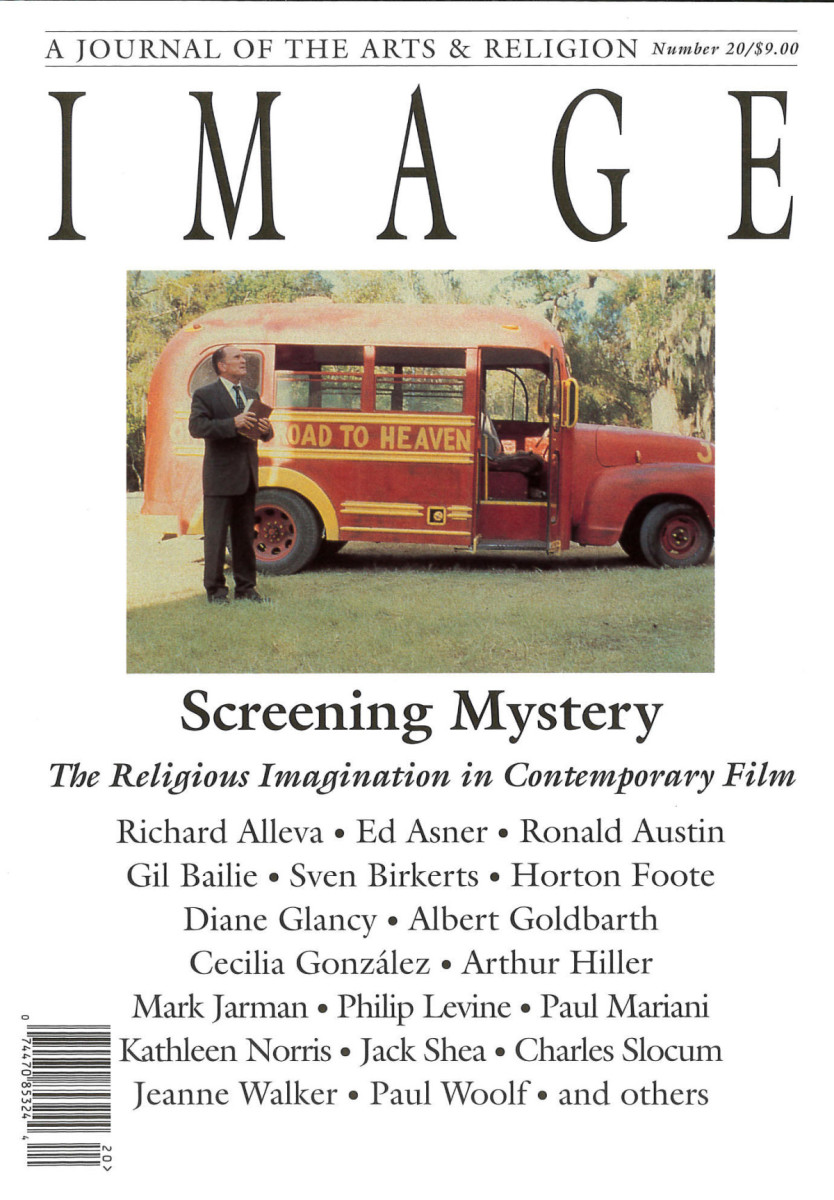
45—A Conversation with Horton Foote
79—Phil Fehrle and Charles B. Slocum, Movies and Mammon: A Dialogue
About the Economics of Filmmaking
Essays
17—Gil Bailie, Cinema and Crisis: The
Elusive Quest for Catharsis
23—Ronald Austin, Sacrificing Images: Violence and the Movies
72—Michael Morris, O.P., Looking for Reel Religion
87—John R. May, Close Encounters: Hollywood and Religion After
a Century
108—J.A. Hanson, Spiritual Subversion: The Films of Nicholas St.
John
Confessions
101—Richard Alleva, "I
Would Toss Myself Aside": Confessions of a Catholic Film Critic
115—Paul Woolf, Turning Toward Home
Film
58—Diane Glancy, Silence is a Story: Scenes from Flutie
Symposium: Screening Mystery
33—Kathleen Norris, Sven Birkerts, Ed Asner, Arthur Hiller, et al.
Contributors
Richard Alleva’s essay “Starring the Devil: Hollywood’s Uncertain Grasp of Evil” appeared in the Spring 1996 issue of Image. He is the film critic for Commonweal, and has toured as an actor with the National Players Acting Company. Before joining Commonweal, he spent five years writing on film for Crisis. He lives and works in Windsor, CT.
Ronald Austin, a writer and producer in Hollywood for many years, serves on the editorial board of Image, and is the guest editor of this special edition. He is the chairman of the 1998 City of the Angels Film Festival.
Gil Bailie is a lecturer and writer whose book, Violence Unveiled, has been called “breathtaking” (Rollo May) and “the single most important book of social analysis and prophetic theology to appear in our generation” (Sam Kean). He is founder and director of the Florilegia Institute in Sonoma, California.
J.A. Hanson is a Ph.D. student in philosophy at Fordham University and co-founder of the film journal, The Antithesis. He is contributing editor on film for re: generation quarterly, contributing commentator on film for the Shoot the Messenger website, and has written on film for Gadfly magazine. He welcomes reader response at: J.A.Hanson@juno.com.
Phil Fehrle is a producer and corporate executive who has arranged financing for numerous productions including John Sayles’ The Secret of Roan Inish, and Nancy Savoca’s Household Saints. He supervised the productions of The Story Lady (NBC), Curacao (Showtime), the award-winning Disney Channel films The Little Kidnappers and The Whipping Boy, and the documentary Charlton Heston Presents the Bible. He also produced the prime-time television series, “Eight is Enough,” “Vegas” and “Helltown,” and was the associate producer of the original “Mission Impossible” series.
Horton Foote is one of America’s leading playwrights and screenwriters. His screenplays for To Kill A Mockingbird (1962) and Tender Mercies (1983) won Academy Awards for best screenplay, and he won the Pulitzer Prize in 1995 for his play The Young Man from Atlanta.
Diane Glancy is the author of three novels, including Pushing the Bear and The Only Piece of Furniture in the House, three books of short stories, two collections of essays, and six books of poetry. She has won numerous awards, including the first North American Indian Prose Award and the Capricorn Prize for poetry. Part Cherokee, she teaches Native American literature and creative writing at Macalester College in St. Paul, Minnesota.
Ira Gold’s fiction has appeared in The Madison Review, The New Delta Review, Midstream, Kerem, and Soundings East. He is working on a novel about the cultural conflicts encountered while growing up Orthodox in an American shtetl. He teaches literature at Touro College.
Albert Goldbarth’s essay, “Square of Light,” is featured in The Best American Movie Writing 1998. He has two new volumes of poetry forthcoming: Beyond (David R. Godine) and Troubled Lovers in History (Ohio State U. Press), as well as a collection of essays, UFOs and Yiddish (U. of Georgia Press).
Mark Jarman’s latest collection of poetry, Questions for Ecclesiastes, was a finalist for the 1997 National Book Critics Circle Award. He is also co-editor of Rebel Angels: 25 Poets of the New Formalism and co-author of The Reaper Essays. His book of essays, The Secret of Poetry, is forthcoming from Story Line Press, as is his next collection of poetry, Unholy Sonnets. He teaches at Vanderbilt University.
Philip Levine’s last book of poetry, The Simple Truth, won the Pulitzer prize in 1995. Alfred A. Knopf will publish his next book, The Mercy, in April, 1999.
John R. May is Alumni Professor of English and Religious Studies at Louisiana State University. He is the co-author of Film Odyssey: The Art of Film as Search for Meaning and The Parables of Lina Wertmuller, the co-editor of Religion in Film, and editor of Image and Likeness: Religious Visions in American Film Classics and, most recently, New Image of Religious Film.
Michael Morris is a Dominican priest who teaches at the Graduate Theological Union in Berkeley, CA. He is the co-director of the Santa Fe Institute, a research center in Berkeley for Catholic liturgy and culture. He has been a regular contributor to the National Catholic Register and is the author of the biography/early film history Madam Valentino: The Many Lives of Natacha Rambova (Abbeville Press, 1991).
Charles B. Slocum is the Director of Special Projects for the Writers Guild of America, the union representing screen and television writers. In that position, he advises the Guild on economic and strategic matters, and has participated in negotiations with Hollywood studios and TV networks. Previously, he worked for Paramount Pictures in television finance. He is currently pursuing a Master of Divinity degree at Fuller Theological Seminary.
Jeanne Murray Walker’s fifth book of poetry, Gaining Time, was published earlier this year by Copper Beech Press and her play, Rowing Into Light on Lake Adley, will be produced at the Hartshorn Theater in Delaware during the 1998-1999 season. She has recently been named a Pew Fellow in the Arts.
Paul Woolf serves in the Jewish religious community in the traditional capacity of a maggid, an ordained storyteller and teacher. His many credits as a writer and producer in Hollywood include “Little House on the Prairie,” “Home Improvement,” “Annie McQuire” (starring Mary Tyler Moore), and the groundbreaking series, Life Goes On. He now teaches screenwriting at the University of Southern California Cinema-TV School.
Tim Wright, who conducted the interview of Horton Foote, received his Ph.D. in Communication Studies at Regent University in Virginia Beach, Virginia, where he teaches graduate classes in theater, camera acting, and scriptwriting. His doctorate research focused on the work of Horton Foote.
Acknowledgements
All movie stills are courtesy of Photofest, New York, NY.


You can email "Issue 20" by Copying and pasting this link into an email or instant message
or, clicking this link to email the link using your computer's email program.
These icons link to social networks where users can share and discover new webpages.