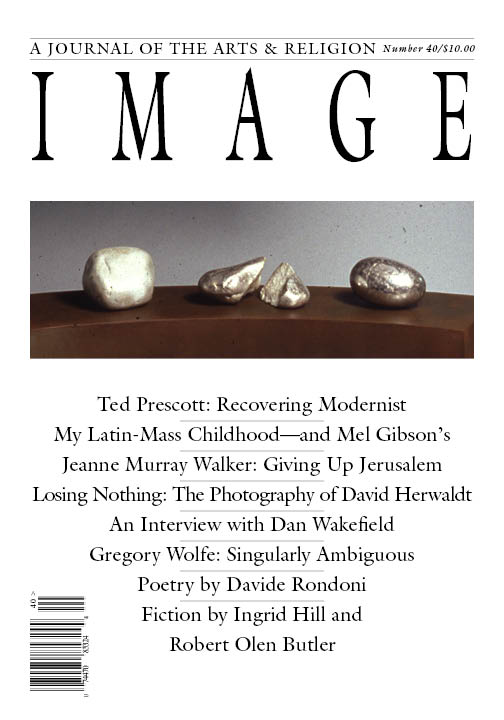
3—Gregory Wolfe, Singularly Ambiguous
Fiction
5—Robert Olen Butler, Up by Heart
47—Ingrid Hill, Valor
Poetry
21—Kathleen Wakefield , In that Hour
38—Davide Rondoni, Two Poems
61—Michael McFee, Witnessing
76—Alfred Corn, Anthony in the Desert
88—Garret Keizer, Three Poems
105—John Leax, Two Poems
121—Martha Serpas, Witness Tree
Interview
91—A Conversation with Dan Wakefield
Visual Arts
23—Theodore L. Prescott, The End of My Modernism
77—Donald Forsythe, Heading toward Santiago:
The Photographyic Pilgrimages of David Herwaldt
Essays
63—Jeanne Murray Walker, Giving Up Jerusalem
Confessions
110—Sophie Masson, The Eyes of the Icon
Contributors
Robert Olen Butler has published nine novels—most recently The Deep Green Sea (Henry Holt), Mr. Spaceman (Grove), and Fair Warning (Atlantic Monthly Press)—and two volumes of short fiction, including A Good Scent from a Strange Mountain (Henry Holt), which won the 1993 Pulitzer Prize for Fiction. His stories have appeared in The New Yorker, Esquire, The Paris Review, The Sewanee Review, Best American Short Stories, and New Stories from the South.
Alfred Corn is the author of nine books of poems, including Stake: Selected Poems, 1972-1992 (Counterpoint), and, most recently, Contradictions (Copper Canyon). He recently held the William and Rita Bell Chair for Anglican and Ecumenical Studies at the University of Tulsa, and now lives in Rhode Island.
Chiara De Luca, who translated Davide Rondoni’s “Good Friday,” is a poet and translator of French, English, and Italian. She teaches at the University of Bologna.
Donald Forsythe is a professor of art at Messiah College in Grantham, Pennsylvania, where he teaches courses in photography and printmaking. His artworks in a variety of media have been exhibited widely, and he has received numerous grants and awards including a recent fellowship to the Ballinglen Art Foundation in Ballycastle, Ireland.
Ingrid Hill is the author of Dixie Church Interstate Blues (Viking Penguin) and Ursula, Under (forthcoming from Algonquin). The latter has been nominated for both the Pulitzer Prize and the National Book Award. Her work has appeared in Black Warrior Review, Chicago Review, Indiana Review, Michigan Quarterly Review, The Southern Review, North American Review, Story, Shenandoah, and the anthology New Stories from the South.
Garret Keizer is the author of three books of essays: No Place But Here (Viking), A Dresser of Sycamore Trees (Viking), and The Enigma of Anger (Jossey-Bass), as well as the novel God of Beer (HarperCollins). His essays have appeared in The Christian Century, Harper’s Magazine, The Best American Science and Nature Writing, and The Best Christian Writing. His poetry has been published in Beloit Poetry Journal, Plains Poetry Journal, Texas Review, and Wormwood Review.
John Leax has published three collections of poems and several collections of essays. An enlarged edition of Grace Is Where I Live, his collection of essays on writing, was recently published on compact disk by WordFarm, and will be available as a trade paperback in April. He has taught at Houghton College, where he is poet-in-residence, since 1968.
Sophie Masson was born in Indonesia of French parents and came to Australia with her family when she was five. She has published thirty-five novels for adults, young adults, and children, and writes extensively for newspapers, magazines, and journals in the U.S., U.K., Italy, Germany, and Australia. Her novels The First Day, Malkin, and Serafin are available in the U.S. from Saint Mary’s Press. For more, see www.northnet.com.au/~smasson. The essay printed here is an expanded and edited version of an article which first appeared in the Australian magazine Quadrant.
Michael McFee has published six books of poetry, including Earthly (Carnegie-Mellon), which co-won the national Poets’ Prize. His poems have appeared in Southern Review, Tar River Poetry, and The Poetry Anthology 1912-2002. He is Bowman and Gordon Gray Distinguished Professor of English at the University of North Carolina, Chapel Hill.
Theodore L. Prescott is a sculptor who writes frequently about art. He is a former president of Christians in the Visual Arts and edited its triennial publication, CIVA, for six years. He is currently editing a book about beauty, to be published by Eerdmans in 2005, and is also working on plans for a private memorial work. He is a Distinguished Professor of Art at Messiah College in Grantham, Pennsylvania, where he chaired the art and theatre programs for nine years.
Davide Rondoni lives and works in Bologna, Italy, where he founded the Center for Contemporary Poetry and edits the literary review clanDestino. He has published several collections of poems and a short story collection in Italian; his most recent title is He Would Have Loved Everyone. His book The Bar of Time (Guanda) received the Montale prize. He has translated Rimbaud, Péguy, Dickinson, and Baudelaire. The ten-section poem published here as “Love, You’re Still Alive,” is part of a longer, thirty-three section work of the same title.
Martha Serpas’s first poetry collection, Côte Blanche, was published in 2002 by New Issues Poetry and Prose at Western Michigan University. Her poems are included in Vespers: An Anthology of Spirituality in the Twenty-first Century (Iowa) and in Uncommonplace, an anthology of Louisiana poets from LSU Press. She teaches writing and religion and literature at the University of Tampa.
Les Standiford is director of the Creative Writing program at Florida International University in Miami (named one of the country’s ten best by the Dictionary of Literary Biography) and the author of more than a dozen books and novels, including the recent Book Sense 76 nonfiction selection Last Train to Paradise (Crown) as well as the thrillers Bone Key and Havana Run (Putnam).
N.S. Thompson, translator of Davide Rondoni’s “Love, You’re Still Alive,” is a poet, critic, and translator of Italian. Born in Manchester, he now lives and works in Oxford, U.K., where he teaches literature at Christ Church. His last collection of poetry was The Home Front (Festival), and he was included in Oxford Poets 2001: An Anthology (Carcanet). In the U.S., his work has appeared in The Hudson Review, Poets and Writers, Sewanee Theological Review, and The Southern Review.
Kathleen Wakefield won the 1999 Anhinga Prize for Poetry for her book Notations on the Visible World (Anhinga). Her poems have been published in The Georgia Review, Poetry, Kenyon Review, and The Journal.
Jeanne Murray Walker writes essays as well as poetry and scripts for the theatre. Her sixth book of poetry, A Deed to the Light, will be released by the University of Illinois Press this spring. Her poems have appeared in many anthologies and journals, including Poetry, Image, American Poetry Review, The Gettysburg Review, and The Nation. Her plays been produced across the U.S. and in London. Married and the mother of two children, Jeanne lives in Philadelphia and is a professor of English at the University of Delaware.


You can email "Issue 40" by Copying and pasting this link into an email or instant message
or, clicking this link to email the link using your computer's email program.
These icons link to social networks where users can share and discover new webpages.