

Manuel Andreas Dürr studied classical painting in Florence and now works in Biel, Switzerland, where he co-heads the film production company Schwarzfalter and is creative director of the online media project ChristianStory. His works have been shown in Europe, China, the US, and at the Vatican.
Image: You recently won the Vatican’s international competition to paint a new series of Stations of the Cross for Saint Peter’s Basilica. What were the other finalists like? Did you spy any commonalities?
MAD: Over a thousand people from all over the world sent in portfolios of ten works, and around a dozen were invited to send an oil painting of the crucifixion. These were then shown in a private exhibition for a committee at the Vatican, and they made the decision then and there. One thing that stood out was the complexity of the work of the finalists. Most had many figures. Mine was reduced to Christ and the two brigands on his sides.
Image: Your works will hang in Saint Peter’s alongside the works of Michelangelo and Bernini. Does the location induce any anxieties, whether theologically or artistically?
MAD: It is a life’s honor. The task is too great, of course. I have to trust the commission’s judgement and God’s providence, that the choice was the right one. Then, I can only do my best.
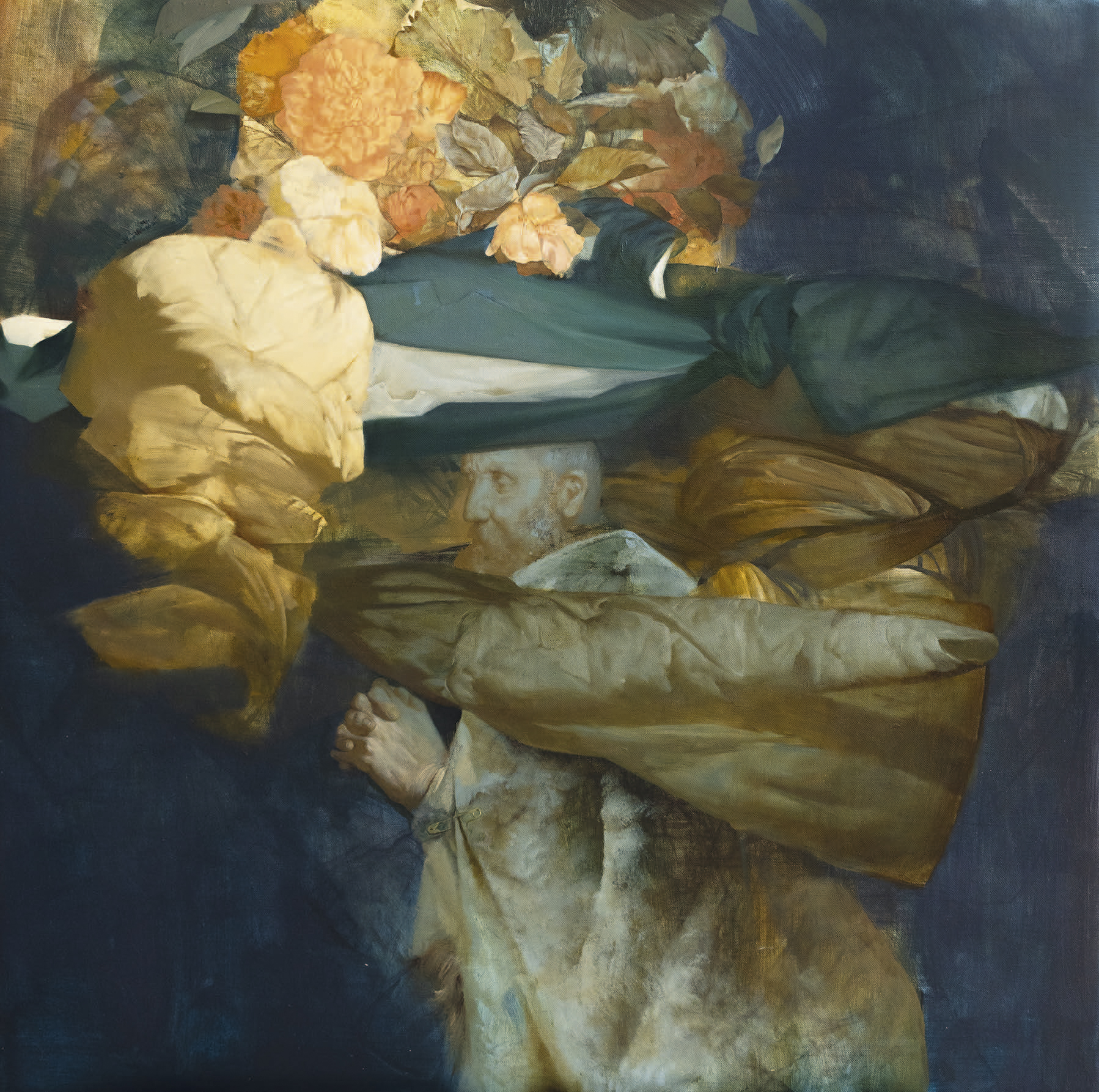
Manuel Andreas Dürr. Holy Fool, 2023. Oil on canvas. 31½ x 31½ inches.
Image: Did you find yourself approaching this project differently than other paintings of religious subjects?
MAD: The artistic challenge is to have two purposes in mind: The paintings will be used for prayer, and they will be seen by tourists. They need to work for both. Ideally, they would be familiar enough to Catholic liturgical sensibilities, while also fresh enough to draw in the casual viewer.
Image: The Stations of the Cross are of course ritual waystations in Catholic tradition, helping the believer simulate the progression of a pilgrim through Jerusalem. Does this ritual context make specific demands of your work?
MAD: The traditional depictions need to be the reference point, I think, as opposed to taking a historicizing, forensic approach. My Stations take what’s already been painted as their context. To make it concrete: The way I paint Jesus is clearly in the Italian tradition. One could have emphasized ethnic specificity, but I wanted him to be recognizable in the way he has been depicted in that specific context.
Image: You’re Protestant. That might seem surprising, but the Vatican is actually quite ecumenical when it comes to collecting art (I think of its Chagall collection). Has the ecumenical nature of this commission challenged or surprised you?
MAD: I was surprised to win, and I am moved by that ecumenical approach. I must say, there are people who are more Protestant than I. I feel quite connected to the Catholic faith in many ways, so it was no stretch from my end. Also, I feel very much at home in Italy and with its art. I think art is the right medium for ecumenical exchange.
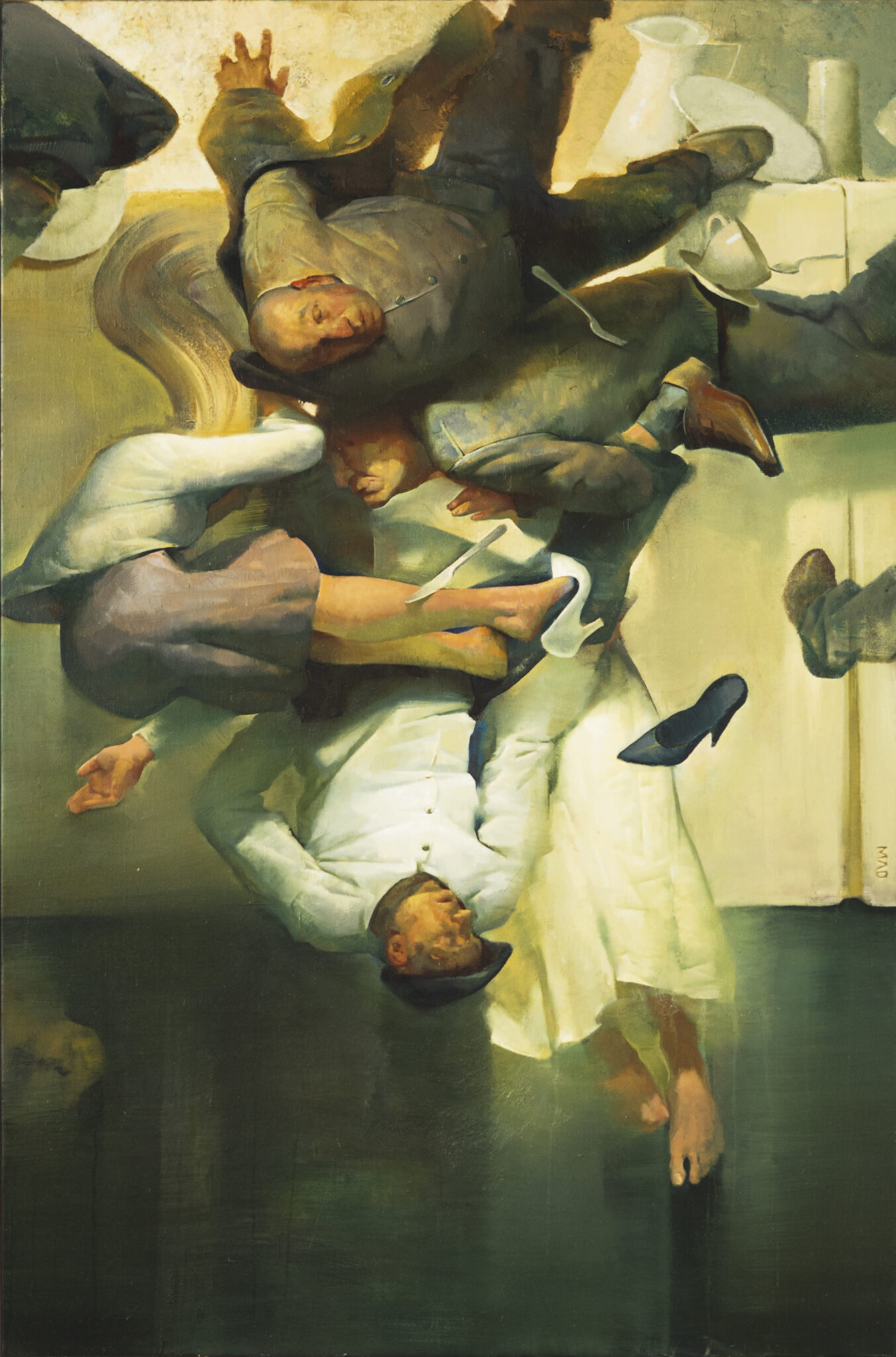
Manuel Andreas Dürr. Fortuna, 2021. Oil on canvas. 74¾ x 47¼ inches.
Image: Could you talk a bit more about your own faith and the religious and cultural environment you grew up in?
MAD: I grew up in a charismatic-renewal expression of the Reformed Church in Switzerland, that is, a small world within a small world. All my life I remember us drawing from and feeling connected to different traditions—feeling that there is only one body of Christ and suspecting that many things can be learned from very different denominations. My father and brothers all have PhDs in theology from Catholic universities (one teaches New Testament at the Angelicum in Rome); we pray the Psalms, adapted slightly from the Coptic hourly prayer called the Agpeya; and we are used to singing old hymns as well as contemporary worship music.
Image: When did you realize you wanted to be a professional artist, and how did you go about training?
MAD: I studied at a contemporary art school where the main goal was to be original. That’s a good aim, but in practice that meant: Don’t do what others have done before. Ignore the examples of excellence and find your niche. But to avoid what worked in the past might not always be the best way to learn. You wouldn’t tell someone learning tennis to ignore Roger Federer. I first wanted to emulate—to the degree that I could—the masters in the field. Italy was the right place for me, and I studied classical, academic art for a couple of years. After that came the hard process of finding my own voice.
Image: Your style and approach are steeped in the figurative traditions and technical processes of the Old Masters. For instance, you avoid taking preparatory photographs to assist you in the studio. Would it be fair to say your process is guided by an ethic that is moral as much as aesthetic?
MAD: Tools like photography are great, but they come at a price. By supporting, they tend to also replace. Unused muscles atrophy. I find that reliance on visual aids tends to undermine the imaginative faculties. (I think we should be very careful about ChatGPT as well.)
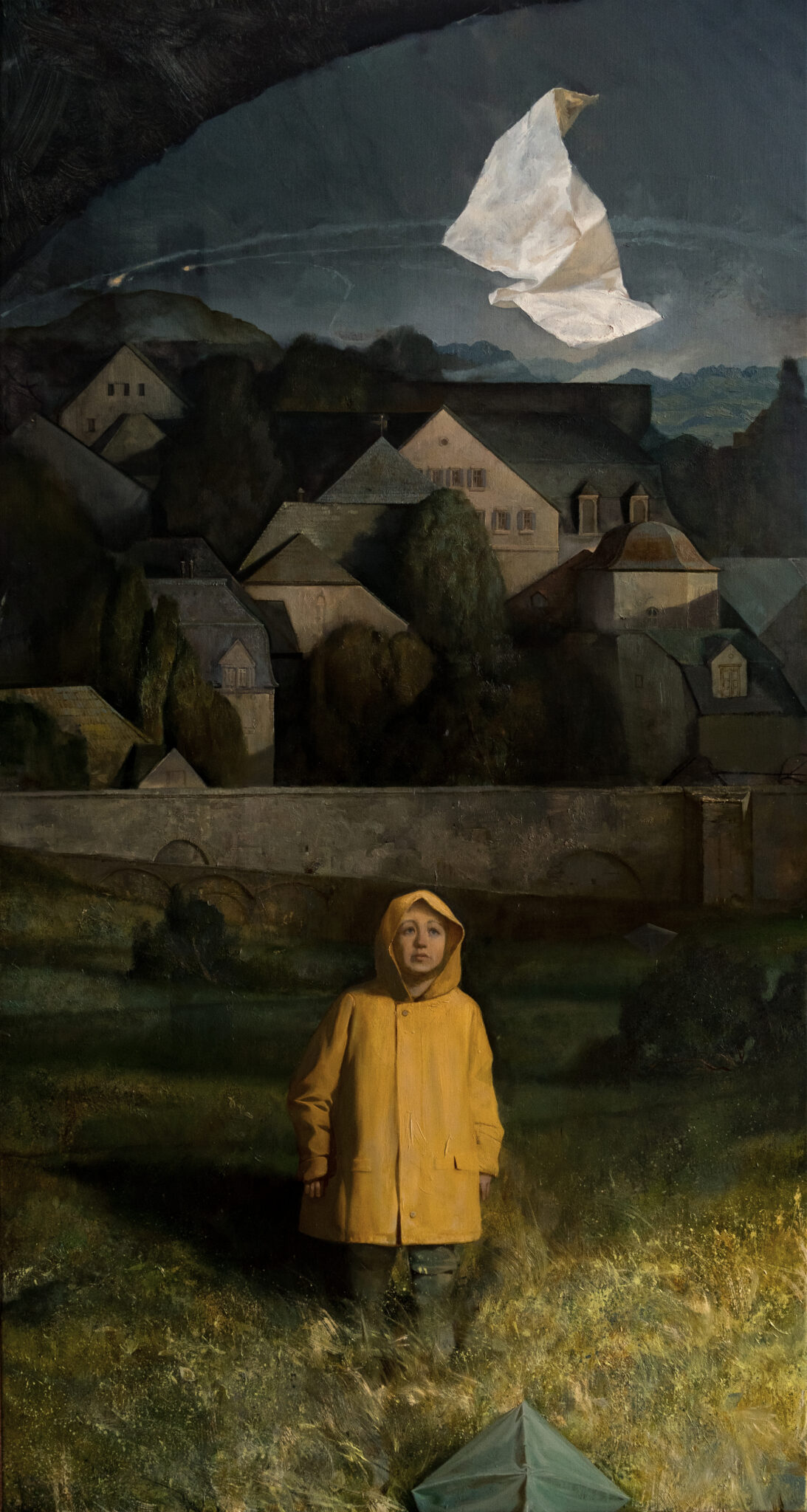
Manuel Andreas Dürr. Storm, 2023. Oil on canvas. 59 x 35½ inches.
Image: Looking at your work reminds me that there are many ways to be “modern” or “contemporary”—and that neither category necessarily entails the rejection of tradition. Have you ever felt a pressure to be more iconoclastic, as it were?
MAD: I have, and I do. There is always the pressure to conform to expectations. People often compare my work to “contemporary art,” but last I checked, I am also contemporary. I am trying to work from what interests me and what I love to do, rather than what I think might play well. For me, that has been a difficult lesson.
Image: Turning the discussion around, who are the modern or contemporary painters you admire most, and how do they shape your work?
MAD: I have a deep admiration for a lot of abstract expressionist works of the last century. Abstract American art speaks to me intuitively. I love Mark Rothko and many of the New York school. The way they thought of the formal qualities of the canvas and the paint is important for me. I also love the expressive qualities in drawing of many modern artists, in Stanley Spencer’s work, for example.
Image: There is an allegorical dimension to many of your paintings. At the same time, you avoid making your paintings too didactic. How do you walk that tightrope?
MAD: I had to learn not to preach. There are already excellent preachers, and to preach is its own art form. Instead, I needed to find what painting is good at saying. I do not try to convey a message in the same way a story, a letter, or a poem would, but at the same time, there needs to be a world of meaning that I inhabit while painting. What the “message” of a painting will turn out to be is not fully in my control—the viewer brings a lot to it as well. But I do think a successful painting can open a world of meaning to someone, if the painter has inhabited a world of meaning in the first place.