


Rachel Yoder is the author of the novel Nightbitch, which explores motherhood, artistic identity, and transformation through the story of a woman who (maybe) turns into a dog. Selected as an Indie Next Pick in August 2021, the novel has been named a best book of the year by Esquire and Vulture and recognized as a finalist for the PEN/Hemingway Award for Debut Fiction. A 2024 film adaptation written and directed by Marielle Heller and starring Amy Adams received widespread critical acclaim, with Adams earning a Golden Globe nomination for her performance. Yoder holds an MFA in fiction from the University of Arizona and is a graduate of the Iowa Nonfiction Writing Program at the University of Iowa, where she’s now an assistant professor of screenwriting and cinema arts.
Yoder grew up in an intentional Mennonite community in the Appalachian foothills of eastern Ohio. And in this wide-ranging conversation with Lisa Ann Cockrel, sitting at her kitchen table, she discusses how her upbringing shaped her understanding of faith, community, and the domestic sphere. She reflects on the search for community that has defined her adult life, the ways writing and artistic practice have become a secular continuation of her religious formation, and how Nightbitch emerged from the tension between the familial and the artistic. From the kitchen as a site of both nourishment and brutality to performance art as a path toward authentic motherhood, Yoder explores the irresolvable tensions between self-emptying and self-possession, between the individual artist and the communal life, and between the material body and spiritual mystery.
Image: How did religion shape your childhood?
Rachel Yoder: My dad grew up Amish and then became Mennonite, so he has a unique, transitional experience between Amish and Mennonite cultures. And we were still very connected to his extended family, so I grew up spending time with conservative Mennonite family. But we lived on a Mennonite commune that was quite progressive. My parents are part of the Silent Generation, but the other parents on the commune were largely college-educated Boomers who were invested in living close to the land and social justice more broadly. So, my childhood was a study in the contrasts between my parents and their conservative extended family, and also between my parents and the other, often more socially liberal, parents in our commune. LGBTQ inclusion was a catalyst for my parents to move back to their hometown after thirty-five years in the commune.
Image: How do you think this unusual upbringing shaped your imagination?
RY: The language I grew up with in the Mennonite church—how we talked about religion and God—permeates how I think about my writing practice and being an artist, because I do think being an artist runs parallel to being a person of faith.
Image: That makes intuitive sense to me, but would you describe why or how that is?
RY: A lot of writers—myself included—have devoted our lives to a calling. We convene, we get together to examine texts, we go to conferences. We meet to talk about truth and beauty and meaning, and we work toward those things through writing practices that require a great deal of faith. Written texts have quasi-religious meanings that we return to time and again.
I think devotion has a lot to do with writing, devoting your life to something that has no guarantees. As a writer, perhaps you’ll never see the worldly fruits of it. You sit 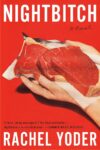 at your desk to commune with something mysterious, to investigate that mystery. Christianity doesn’t work for me in a lot of ways, but as an artist I’ve reworked the parts I find beautiful—this searching, this openness to revelation. It just seems to me that instead of going to church, we should all write poems and grow basil. We should all be artists.
Image: Nightbitch explores the interior experience of the central character who is referred to as both Mother and Nightbitch. Motherhood can be profoundly isolating, of course, but it can also be profoundly communal; it shares this with both creative and religious practices. How has community factored into your own life since leaving the commune?
RY: I’m always searching for the community I had growing up in an intentional community and with my large Amish-Mennonite family. It was a given that you weren’t alone, that help was nearby should you need it. And I assumed that would somehow appear in motherhood, because that is a time when community beyond the unit of the nuclear family is so essential.
Much of my adult life has been characterized by figuring out ways to create community. I’m still trying to crack the code. Some of my friends here in Iowa City are similarly post-church, and we’ve been talking about how art may be the way to create community now that we’ve left these institutions that sustained our parents and grandparents. Writing and being an artist—this way of living through art—is sort of replacing religion for me.
I started a book club, and it has been so sustaining. We talk about texts, and therefore talk about beauty and truth and meaning and how what we’ve read applies to our lives. I don’t think I know how to build community outside the arts or books. It’s something I saw my parents do, and it feels very natural to me. It’s almost like I’ve started a kind of house church.
Image: Nightbitch is married, but her husband is absent for much of the book, which creates space for her to grapple with motherhood on her own terms. And yet, you don’t demonize the husband. He’s obtuse, but he’s also wild in his own ways, which is a point of connection between him and Nightbitch. What inspired this couple and their dynamics?
RY: In my Mennonite upbringing, there were very clearly defined gender roles. The domestic is all-consuming; a woman’s whole duty is to family and the domestic space. How could there possibly be room for making art, which also wants to take up your entire life? For Nightbitch, that tension is at play in the marriage. There’s this desire to connect and to enjoy being a wife and a mother. At the same time, she wants to be alone, because that’s where she can make art. And now there’s a child in that space too, and she’s trying to negotiate what feels unresolvable: How can you be both a mother and an artist?
Image: These tensions aren’t resolvable, but Nightbitch doesn’t give up. And her effort to hold motherhood and art-making in tension rather than ceding everything to the child ends up being good for the whole family.
RY: Yes, and it also makes the husband more whole.
Image: Exactly. It makes his life richer and fuller. Nightbitch doesn’t suggest women can have it all—the marriage, the kids, the career—without difficult trade-offs and tension. But it offers a deeply encouraging reminder that family life is not a zero-sum game; instead, it’s good for everyone when mothers flourish and pursue multiple passions instead of ceding everything to the domestic.
RY: It isn’t really in the book, but it’s certainly the case that the husband has to come into a richer understanding of fully being a father and participating in child-rearing. Yes, everything’s more complicated because the mother is also an artist. But in the end, their lives are richer because they’re both writing new scripts for their roles. And that’s so difficult because they have to ask questions of each other like: Can I do this? Am I allowed to do this? Will I be judged for doing this? Will I be punished for doing this? How do I negotiate this change within a marriage? All these questions are running underneath the story.
Image: The kitchen is a space where this tension between the domestic and the artistic is particularly acute. It’s the room where she’s feeding her child and also feeding herself. Those are sometimes competing needs, and Nightbitch’s own hunger manifests in shocking ways.
RY: Yeah, all the raw meat.
Image: All the raw meat! Nourishment and brutality often go hand in hand. You’ve talked elsewhere about the pacifism you were raised with juxtaposed with the everyday gore of animal husbandry, seeing big slabs of meat all the time. How did you decide to situate this showdown between the domestic and wild in the kitchen?
RY: I feel like the kitchen is the nexus of life. When you said that there is this battle between nourishing other people and nourishing herself, I think that’s absolutely right. She is fighting against a story in which a mother doesn’t feed herself; instead, she starves in motherhood; she gives everything away and only eats the scraps, if anything. In the book, Nightbitch goes out to hunt and kill for her nourishment. She has to fight for it. She has to go all the way to this animal place in order to get what she needs and then move back into a place where she doesn’t have to be brutal, where she can just take what she needs without having to scare other people.
The kitchen keeps coming up in my work. I wrote a screen adaptation of Nightbitch that wasn’t produced, but the kitchen was in the finale as a place where the outdoors was coming in. Everything was full of dirt, dirt spilling into the kitchen, the kitchen and the outdoors becoming one. I’ve written another script, and there’s another kitchen in there that’s full of dirt. There’s something going on where I want to transform the space of the kitchen and rewild it. I’m not sure what that’s all about, but I do keep wanting to make it bloody and very dirty.
On a farm, like where my dad and his family grew up, you’re very careful about keeping everything clean. You don’t want to mix indoors and outdoors. I grew up hearing my Mennonite aunts banter about how someone had schmutzed up the kitchen—“Keep your shoes out there,” that kind of thing. On the commune, we had these neighbors from Southern California, and they were blond and very exotic, and their house was a mess. And it felt like a revelation to me. It felt so free. The kids screamed and they ran through the house, and it was dirty, and there were cats and there was trash, and it was a refuge. That’s where I would go to get away from the very neat and tidy and clean and quiet Amish-Mennonite house where you don’t schmutz anything up.
Image: Are there other kitchen scenes—literary or visual art or some other genre—that take on the domestic in a way that you find particularly generative?
RY: I was really puzzled and intrigued by a performance piece by Martha Rosler, a feminist artist of the sixties and seventies, called Semiotics of the Kitchen, which you can watch online. In it she’s working with different kitchen appliances and utensils, using them in ways you don’t generally use them. She’s making them make strange grinding noises in this peculiar straight-to-camera way. I turned to performance art and feminist art to give me images when I was writing the adaptation of Nightbitch.
Image: Nightbitch develops her own deeply embodied performance-art piece over the course of the novel. And I’m curious why you made her a performance artist instead of, say, a painter, or some other kind of artist. What interests you about performance art in particular?
RY: I was playing with the idea that there’s actually very little separation between art and life. I wondered if this whole experience of her doggishness could be her doing art. But I was also interested in motherhood as a kind of performance. In my own life, when I was around other moms on the playground, I had to perform being the mom who wanted to talk about her kid, which felt unnatural to me. Nightbitch moving back into her art could be her moving into a performance of motherhood that is more authentic to her, because in order for her to make art, she couldn’t be pretending in life. Also, I wanted to have her on a stage at the end. It was important for her to move from being invisible to being highly visible.
Image: The performance of motherhood also connects with community and some of the tensions we find there.
RY: Yes! The communities that exist for mothers, and what they’re promoting, are such a mixed bag. I wanted to include a multilevel marketing scheme in the story because this is such a corrupt or false way of coming together. People are looking for real connection and instead are being offered the hollow promises of capitalism and the sort of self-help talk that doesn’t deliver anything in the end. And it literally costs you money. But what are some of the ways mothers can more authentically come together and create community? Maybe it’s through art.
But community is complicated. Artists tend to be loners at times, and counter-cultural. So how do you bring together a group of loners, people who are suspicious of groups, and how do you create durable institutions with and for them?
Image: I think that question is at the heart of a lot of your work: the interplay between the individual and the group and how we navigate our need for both solitude and community. And right now, so many people are skeptical of the institutions that have traditionally provided a stable source of community, churches among them.
RY: I do think we’re at a moment of peak alienation right now as a country, when so many institutions have failed us or have gone to disturbing and extreme places. We’re going to have to find new ways to come together in a sane and productive manner across our differences.
Image: It feels like a cultural moment when maternal humanism could be especially helpful. In her book The Mother Artist, Catherine Ricketts writes that when she looks at her children, “my view of the world is reframed by maternal humanism, composed of awe, curiosity, and adoration for the vulnerable ones of this world—which is to say, all of us.” She goes on to say:
An artist who’s been transfigured in pregnancy gives us the body in all its strange beauty. An artist who has lost a child refuses to explain away tragedy, and companions all who grieve. An artist who’s been through the calamity of childbirth shows us women’s vulnerability and strength. We need artists who have tamed their egos enough to take time to care for others, then revived their ambitions to be generous with their talents. We need artists who reimagine women’s desire in all its complexity. We need artists who rightly balance self-emptying with self-possession.
RY: That’s so smart and thoughtful. I have this group chat with my husband and three of his friends who are now also my friends, and at one point I asked them: Do you think moms are the moral core of society? They replied: Yeah, obviously. Duh, Rachel. I was surprised! I guess I never really knew that.
But what really sticks out for me in that passage is the tension between self-emptying and self-possession. I was taught the emptying part, the self-sacrifice part. But I don’t have great role models for the self-possession part. For what it means to feed yourself properly, to have boundaries, to do what you want to do and not think of it as selfish or being a bad mother.
Image: You’ve mentioned elsewhere that Nightbitch started as a joke between you and your husband at a time when you were dealing with some heavy things—your identity as a writer, as a mother. The MAGA movement was gaining traction in our politics. Nightbitch gave you a place to play with absurdity. What are your hopes for absurdity and levity, and what can they do for us as writers and readers in heavy times?
RY: Tomorrow in my advanced screenwriters class, we’re going to talk about the beauty of bad ideas. Kelly Link says that bad ideas are much closer to interesting ideas than ideas that are just good enough. For instance, a book about a mom who turns into a dog sounds like it wouldn’t work, like it’s too overtly absurd, but part of me wanted to prove it could be a viable choice. Something in that energized me.
I think absurdity is a great tool to meet our moment, and so is satire. At periods in history when things are most locked in place, it’s two poles pushing against each other. We’re deeply polarized right now, and there’s just no arguing anyone into any other place. And so what are you going to use? Sometimes the only way in is through laughter. I think we’re in a moment of deep searching through absurdity. There’s a lot of chaotic absurdist energy right now in film. Maybe that’s not every writer’s approach, but that’s what I’m here to write.
Image: Speaking of film, your first book is a novel that was adapted into a movie. You have an MFA in fiction, an MFA in nonfiction, you teach screenwriting, and you’re a widely published essayist. What sorts of storytelling capacities do these different genres provide?
RY: It’s fun to have so many tools and to have experimented in so many different modes. I love being able to say, oh, I’m writing a novel, but it is going to be essayistic in some parts. Or, I’m writing a film and it’s going to turn into performance art at the end. It’s exciting to have things move between different modes and forms.
It’s hard to know, sometimes, when an idea comes, how to decipher where it goes. But I’m getting better at figuring that out. Right now I’m working on both a feature film and a novel, and the novel feels much more driven by questions. I don’t have a clear sense of where it’s going, but I have a sense of the ideas driving it. Film comes to me in images. I can see it playing out, and I see the whole thing from beginning to end. If I can see it, and I know the full thing, I usually think it doesn’t have enough mystery to be a novel and it needs to be on screen. And then there are also short stories, which are wonderful exercises in precision that feel very different from novels and scripts.
Image: How do essays work for you?
RY: Essays feel very close to novel writing for me, because they include both story-telling and ideas, and it’s going to be mysterious to me. I’m not going to know what I’m doing while I’m writing it. I think essay is the hardest form, actually, because you have a limited amount of material in terms of plot or character. You’re limited to things that actually happened, but that’s not the story. The story is something else that’s going on underneath. So you’re sifting through this finite quantity of images and moments and trying to figure out the story. It’s really a project in editing.
Image: Are there specific stories or role models from your childhood that shaped your vision of what was possible for you as an adult?
RY: I grew up with three unmarried aunts who were the heart of our family. The house they shared was where we convened. It was where you got dropped off if your parents were going out of town. When you walked in, they said, “Would you like some nice warm bread from the oven? There’s a game in the closet. There are books, picture books you can go look at. Would you like to come out and look at my flowers? Should we go out to the garden? Let’s get some tomatoes.” It was just so wonderful to be around them. They had ultimate hospitality, ultimate servanthood with a smile. In that community, women were the keepers of the family, the raisers of the children, the makers of the food, the tenders of the garden. They were the heart that kept the whole family beating. It was a beautiful legacy. But what an impossible dream to fulfill on your own, if you move away from your community and you’re out in the world.
Meanwhile, the men were over at a table telling stories and talking about ideas and drinking coffee. There were no women at the table. Now I go to the coffee shop and write and drink coffee, which is not something I saw women doing when I was very little.
Sometimes I think that if my parents had wanted me to stay Mennonite, they should never have let me watch movies. My friends had a house full of VHS tapes like Indiana Jones and Star Wars; some other friends introduced me to Rocky Horror. I saw a lot of different ways of existing in the world, like Kathleen Turner in Romancing the Stone, the way a woman could fight with the guy, the way a woman could stand up for herself.
But to my parents’ credit, I was allowed to be smart. They always supported whatever I wanted to do educationally, and that is the gift I value most from my mom. She gave me a choice about what path I would take. But I didn’t know how to come back to the Mennonites as an intellectual woman. Where would I fit in? I now see that there are places in more progressive Mennonite churches for women like me. But in a more conservative place like Hartville or Holmes County, I wasn’t really sure where to go as a woman with ideas. That’s why I didn’t go back to Ohio after college and instead moved to Arizona. For many years, for my twenties, I wandered in the desert.
Image: You’ve said elsewhere that where you grew up, the spiritual was more important than the material. Your work focuses so much on the material and on the body. There’s something deeply incarnational about Nightbitch, where a psychological struggle becomes embodied, the invisible made flesh through the protagonist’s metamorphosis into a dog-like creature. Are you intentionally trying to flip your inherited script about the material and spiritual?
RY: No, I’m not trying to flip that script; I’m saying the spiritual and material are one and the same. The most ecstatic experiences I’ve had—childbirth among them—have happened when I was as pure body, pure animal, as a person can be. To me, that is holy. That is when I begin to feel a oneness with all of creation, when I return to a state of pure sensation.
When you bring control and obedience into the equation is when I start to get lost, or to lose God. Am I proposing for us all to become raving pleasure hounds motivated only by our basest urges? Of course not. Maybe what I’m saying is that I think our bodies are actually fundamentally good.
So much in Mennonite culture is predicated on the control and obedience of the female body. The female body is a servant of the family and community. And this obedience is reinforced through religious doctrine—the body as a temple and so forth—which locks it into limited sexual activity and lack of reproductive choice. So when I say that being a woman has always been a problem for me within my Mennonite family, what I am also saying is that my body has always been a problem, because I want to own and control it fully, and that does not make for a good Mennonite woman.
I don’t know why, but I have always felt a deep love for and entitlement to my sensory urges. My hunger, my sexuality, my anger, my ambition and aggressiveness—as a young woman and then even as a young mother, these all felt like problems, because they didn’t fit within how I was taught women and mothers behaved. I’m still exploring all this in my work. How can the body possibly be bad? How might we get past this inherited feeling that our animalness is bad? What if our animalness and our bodies are actually the source of our sacredness?
I am obsessed with this idea of a concept turning into something physical, how an idea can make you sick. And in Nightbitch’s case, how her rage or desperation takes on a physical form.
Image: You have said that writing Nightbitch was a way for you to channel rage. What did writing this book teach you about channeling your rage?
RY: It taught me that the best way to channel my rage is to speak it, to turn it into words. Because I do think there’s something about anger that remains silent, that it finds a different way to manifest in your body. If I’m able to put anger into words,
then it doesn’t manifest in other ways—for me, that means through autoimmune
issues.
Here’s a crazy story: At three in morning, the night after my book party in 2021, I woke up thinking I was having a heart attack. I went to the ER, and they ran all the tests, told me I was anxious and needed to go home and relax. I got worse. I went back, and they were confused. They couldn’t figure out why I was in so much pain. I was burning up, every organ was on fire, and the fascia was burning with intense, piercing pain. Finally I got a diagnosis: It was lupus. It was literally wolf disease, which I got the night of my book release. You couldn’t put that in a novel because it’s too on the nose!
Ever since then I’ve been dealing with this autoimmune stuff, with the connections of autoimmune to rage and saying and not saying things. Nightbitch felt terrifying to write, because I was saying things that I felt I was not supposed to say. That continues to be my work: What happens if I tell the truth?
Image: How do you think Nightbitch’s performance might evolve after the novel ends, maybe when her son goes to school? What might she learn over the next five or ten years that changes her art?
RY: Nightbitch is at the extremes of her experience in the novel. She’s blasting out of the old stories of motherhood and raging her way into these new stories, which are quite extreme, which involve animal massacre and nakedness on stage. Five or ten years on, I would see her settling in to something more nuanced and complex. Maybe not as loud, but maybe more interesting.
I think a lot about Louise Bourgeois in relationship to Nightbitch. Bourgeois’s work is very personal, very much about motherhood, grounded in psychology and her experience of the family as a little girl. She worked on those same issues for her whole career, until she was in her eighties, and she gradually turned into a sort of witch, making huge spiders and these bulbous, headless she-wolf statues. I can imagine Nightbitch’s trajectory that same way.
Image: Final question: How do you see the role of spiritual questioning or spirituality in contemporary literature? What narratives do you find compelling? What’s missing or mistaken?
RY: That’s a good question. I think a lot of people have an allergy to religion in our contemporary culture, specifically a lot of liberals. As soon as you’re saying anything religious or spiritual, a switch flips. But there is obviously a spiritual dimension of being a human. Whether you want to refer to this mystery as God or think of it within a religious tradition is up to you. There are ways to think about it outside that. But just shutting it off isn’t the answer. When I read literature that’s operating outside the spiritual or outside mystery, it feels like content. It feels like a product. I will always be more interested in literature that engages with bewilderment and the strangeness of being human and the possibility that some of the realest things about being human are the things we can’t see. It seems so cynical to leave mystery out of literature.
Lisa Ann Cockrel is editorial director of Here Below Books and senior acquisitions editor for Eerdmans. She holds an MFA from the Bennington Writing Seminars.
Photo by Usman Yousaf on Unsplash