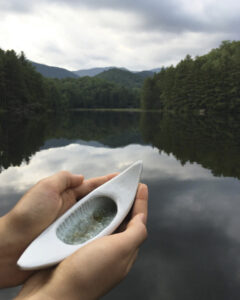


Becky Moon is an artist of half North Korean and half South Korean heritage who paints the imagined structure of the human mind through the arrangement of fictional objects. She is based in New York City, where she is pursuing her MFA at Columbia. Her most recent solo exhibitions were at Bruno David Gallery in Saint Louis and Harvard.
Image: You’ve mentioned that your family can trace its roots to Christian martyrs in Korea. Can you talk about what that history means to you?
BM: My maternal grandparents were born in North Korea in the 1930s, after the Great Pyongyang Revival of 1907, a Protestant revival that began a wave of Christian faith in Korea. They were both born into pious families that went to church every weekend. After Korea gained independence from Japanese occupation in 1945, communist forces took over the North. They were brutal against believers. Many Christians were martyred, including my grandfather’s family. I cannot imagine what it’s like to give up one’s life for the sake of faith in an invisible God, but I can think of the words of Hebrews 11: “Faith is the assurance of things hoped for, the conviction of things not seen.”
Seeking religious freedom, my grandparents escaped to the South on foot, leaving everything behind. My grandmother often talks about how her family used to own a huge furniture store in Sinuiju, the northern border city. And how her father planted ten thousand chestnut and maple trees that would turn the barren land into waves of green. They left all those trees behind in a land they can never return to. Christian faith has held my family together for generations.
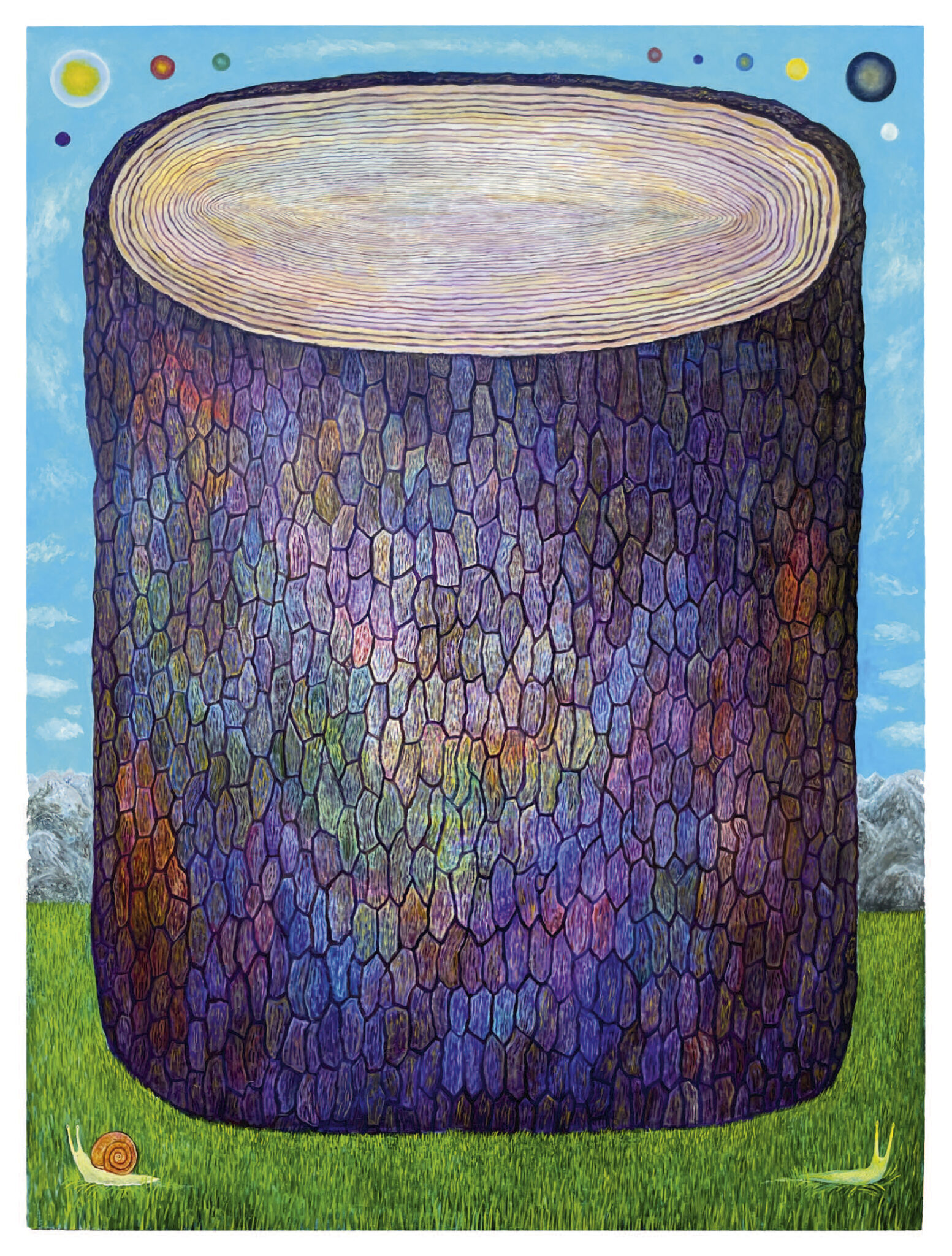
Becky Moon. One Block, 2024. Acrylic on canvas. 48 x 36 inches.
Image: What kind of religious upbringing did you have?
BM: My mother was born a Christian. My father was born a Buddhist but later converted to Christianity, attended seminary, founded a church, and became a Baptist pastor while maintaining a full-time job as an attorney. On top of that, he published various books on jurisprudence, religion, and philosophy. Growing up in Seoul, every Sunday I went to my father’s church, which he founded in a neighborhood that included other mainstream Korean religions (Buddhism and Shamanism) but not Christianity. The Bible, the existence of God, divine intervention, and other heavy religious and philosophical topics were common themes at the dinner table.
Image: What elements have stuck with you from being raised in the Korean Baptist church?
BM: I appreciated the eagerness for communal service and the concept of extending God’s love to others. However, some Christians I interacted with were aggressively sexist and regressive. Even today, there are pastors in South Korea who are against ordaining women as pastors. Thankfully, my family isn’t like that. I’m especially grateful to my father for being an open-minded proponent of women’s rights in and out of the church. He was psyched when I cut my hair as short as his: we would even help trim each other’s edges. He never told me to silence myself because I’m a girl, and he taught me that God’s grace is for everyone.
Image: As an artist, there is a sense in which you are ultimately responsible for figuring out and articulating your own vision of the world. Does that generate any tension with the strong communal identity you grew up with?
BM: I recently had a jarring conversation with a Christian who said they quit art because it was too “me, me, me,” that there was no room for honoring God in a painting. “Even if every person in a room painted the same chair, everyone’s artwork would still look different, because art is such a personal thing, and I think that makes it ungodly,” they said. I had this conversation right after spending seventeen consecutive hours in the studio preparing my MFA portfolio, with half-dried paint on my hand. I thought, “Gosh, is this really something you want to tell someone who is betting their whole life on this path?” I view creativity as a gift, not a barrier against God.
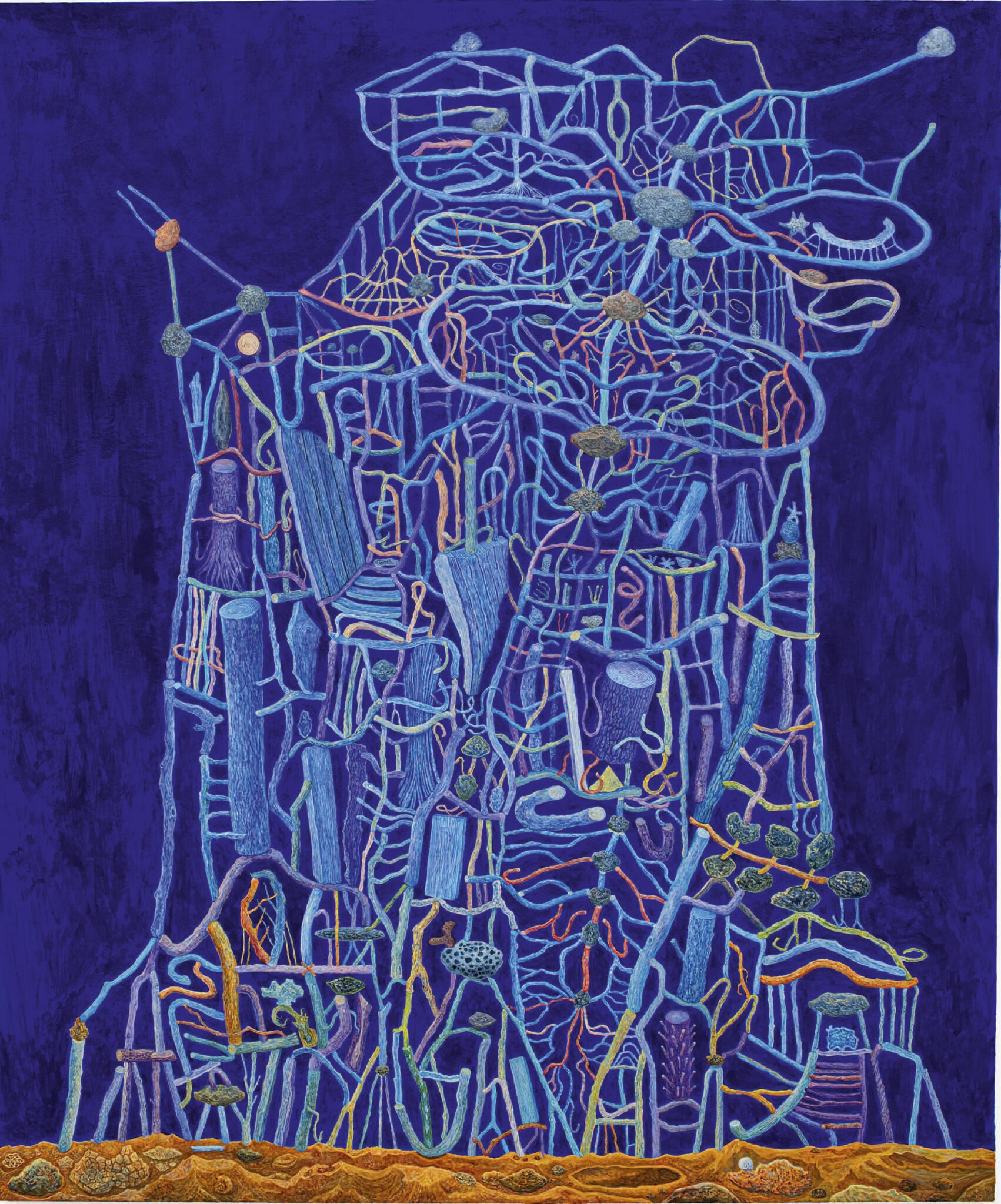
Becky Moon. Ganglia, 2025. Acrylic on canvas. 52 x 44 inches.
Image: When and how did you first know you wanted to be an artist?
BM: In my second year of college. Until then I’d never quite discovered anything I found joy in and was also skillful at. I fell in love with painting. I could never get tired of holding a brush in my hand. I find so much joy in painting, because it’s the intersection between the hand and the mind. Whatever’s on my mind gets a physical form on the canvas.
Image: You have a very personal iconography involving tree trunks and branches. Can you explain their significance to you?
BM: When I heard the story of my grandmother’s father planting ten thousand trees in North Korea, it felt like my destiny to paint those trees. So I’ve been obsessively painting trees, branches, and twigs since then.
Wood is versatile. It can turn into anything. A tree must die to become timber and become furniture, architecture, or anything else. This sacrifice feels in tune with the Christian faith. One must let go of one’s old self to transform into another.
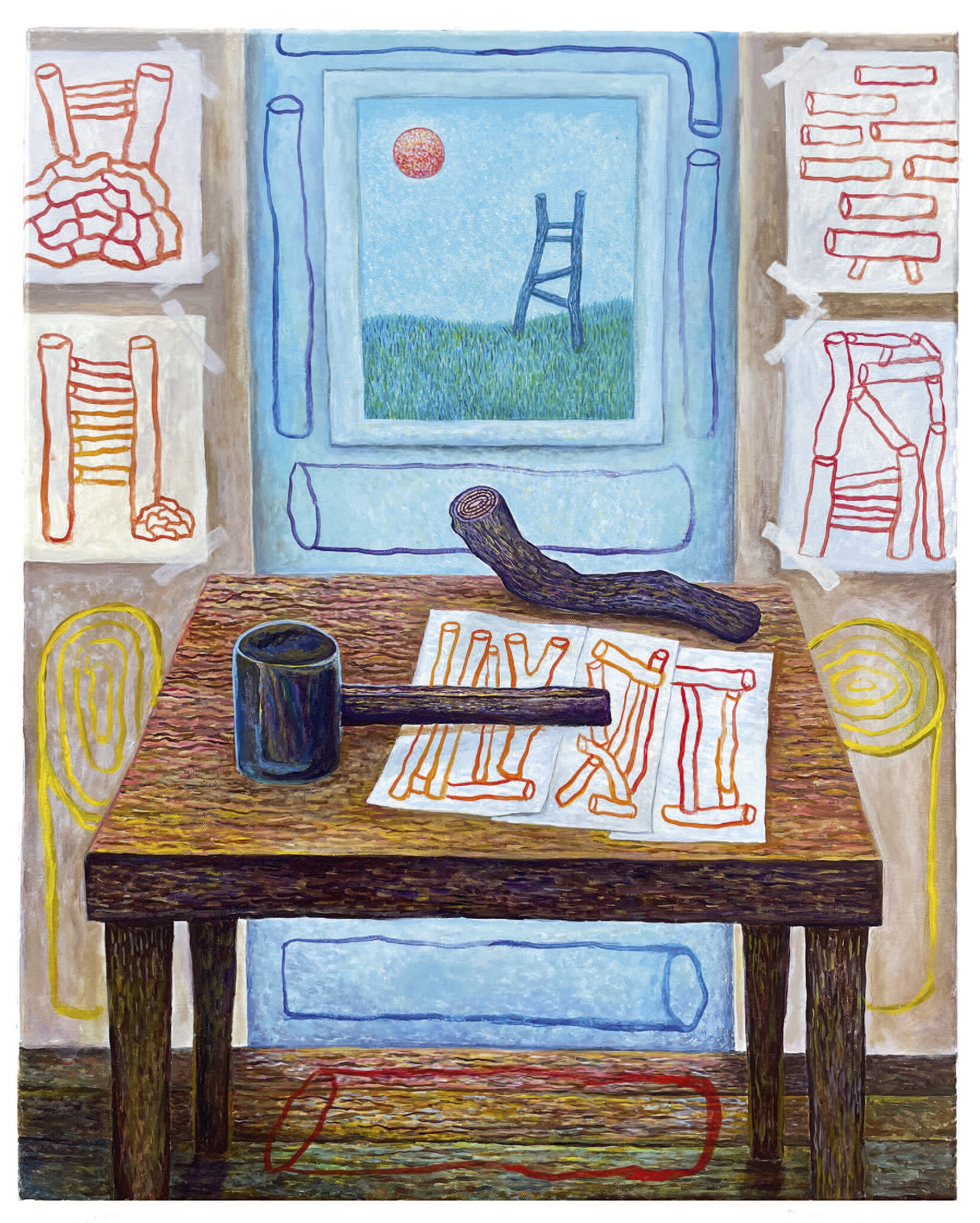
Becky Moon. Building a Ladder That Cannot Be Climbed Twice, 2024. Acrylic on canvas. 24 x 20 inches.
Image: Your generation is one of the first to grow up with a sense of climate catastrophe. How does that awareness leech into the worlds you paint?
BM: Every new summer is now the hottest summer in human history. When I was growing up, at any given moment at least two or three moths were resting on our apartment door. Now they are completely gone. I used to be terrified of them, but now I miss them. It shocks me that some children will never see particular species of insects and animals that I grew up with.
Although my art is mainly about giving physical forms and structures to invisible faculties of the mind, like belief and memory, painting natural objects and insects that live on wood, such as ants, termites, snails, and beetles, has made me more aware of how anthropocentrism causes irreversible damage to other species.
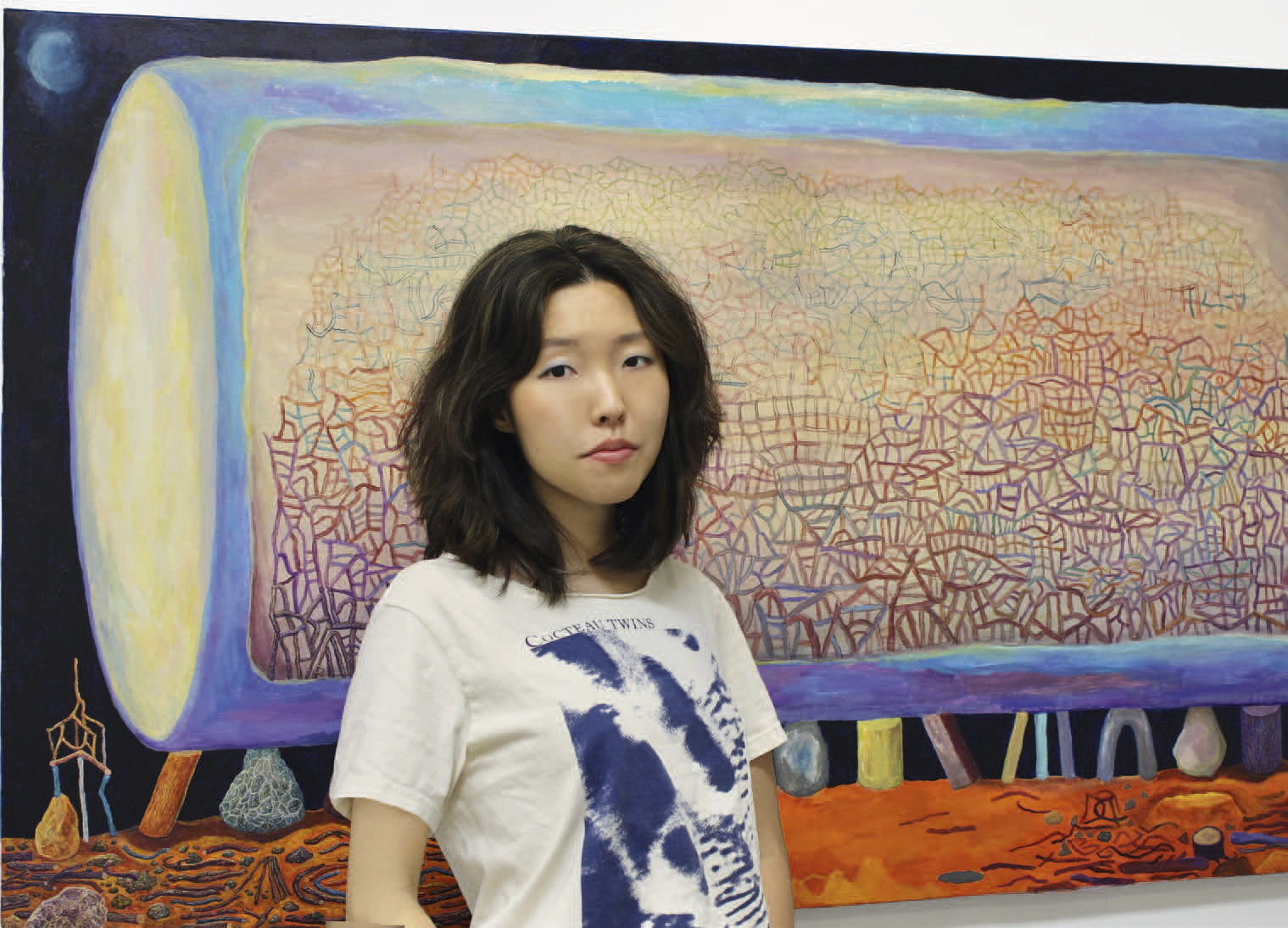
Image: Your branches or roots often interconnect, suggesting a mycorrhizal network. I’m curious whether you see a lesson for humans in this sense of “entangled life,” to use Merlin Sheldrake’s phrase.
BM: I paint complex structures built from simple components. They stand horizontally to show the thin line of gravity holding them together; in real life, a structure like that would collapse within seconds. I like to reveal the surprising tenacity of a fragile structure. It echoes the way various aspects of life are intertwined without causing the universe to collapse.
Image: These networks also look neuronal, which makes me wonder if there’s a suggestion here to do with our internal lives or languages. Is it fair to say you’re communicating about the nature of communication?
BM: When I worked as an education associate at the MIT Museum, surrounded by neuroscientists, I enjoyed seeing diagrams of the neural structures of humans and animals. They make a fascinating map. The nervous systems of gastropods are especially exciting; they look like networks of secret chambers. In my paintings, I consider each branch or rock a metaphor for a single thought or belief. They balance each other to create something bigger. Every thought, big or small, is crucial in sustaining the whole.