


GRASSLANDS ARE REBORN because they burn to the ground.
There have been times in earth’s history when this was not true, but in our age, the prairie would become forest if not for the regular renewal achieved by controlled burns. A burn holds back the woods so that the grass can grow anew. For millennia, Native communities on the American prairie carried out deliberate burns, maintaining the land they depended on for food and medicine. Today at Knox College in Galesburg, Illinois, faculty and students at the Green Oaks Field Research Center use similar techniques to maintain a small part of the once-vast prairie.
The flame that sweeps across the landscape, turning the dry grass of late winter into char, may come naturally, as lightning, or by human act. This sacred mixture of accident and intent, destruction and growth, death and birth was explored in Michael Takeo Magruder’s 2025 exhibition at Knox College, re:Generated Prairie. At a moment when profit-motivated artificial intelligence pervades our cultural landscape, the luminous beauty of re:Generated Prairie emerges from AI algorithms of a different kind, which Magruder uses to dismantle and recompose digitally recorded sights and sounds of the prairie. His project forces us to reckon with the existential dichotomies common to science and art, simultaneously challenging our relationship to the natural and the technological.
It would not be much of an overstatement to say that being promised access to the controlled burns at Green Oaks brought me to my new job as Knight Chair for the Study of Religion and Culture at Knox in fall 2024. So when Magruder asked me whether there were any sacred landscapes on campus, I told him that to me, the prairie is sacred. He stopped me right there. What was sacred to me would be sacred to him: To be brought to a special place by a person who cares about it is a crucial part of his landscape artworks. As we spoke about why the burn matters to me and my enthusiasm for seeing it firsthand, we realized we both had much to say about the prairie, human experience, and the way humanity thinks about and interacts with nature. What was originally going to be a single work connected to Knox soon became an entire exhibition on the ties binding a midwestern college to the prairie and its annual cycles of renewal.
Magruder’s vision of the landscape begins with photography, followed by digital recomposition. Through iterative engagement with artificially intelligent enhancement and diffusion models, his careful documentation of the prairie’s growth is remade and shared through print and video—a different kind of grassland regeneration. His painterly close-ups of flowers, the eerie diffraction of swaying trees or passing clouds, the shards of otherworldly color among the shadows—all point toward the emergence of unintended artifacts in the technological gaze of humanity.
In April of 2025, my son and I attended one of the periodic controlled burns of Shepard Prairie at Green Oaks. We followed the flame as it moved eastward, our steps crunching through the smoldering remains, the bright orange fire a precise division between what was and what will be. Wisps of smoke swirled over the ground, low-lying gusts trailed across the open field, and plumes rose into the sky. I took photographs, some of which Magruder would enhance and rework as .burn. These images draw out the crackle of flame and reek of smoking ash that stand between prairie and the would-be forest lurking in the background.
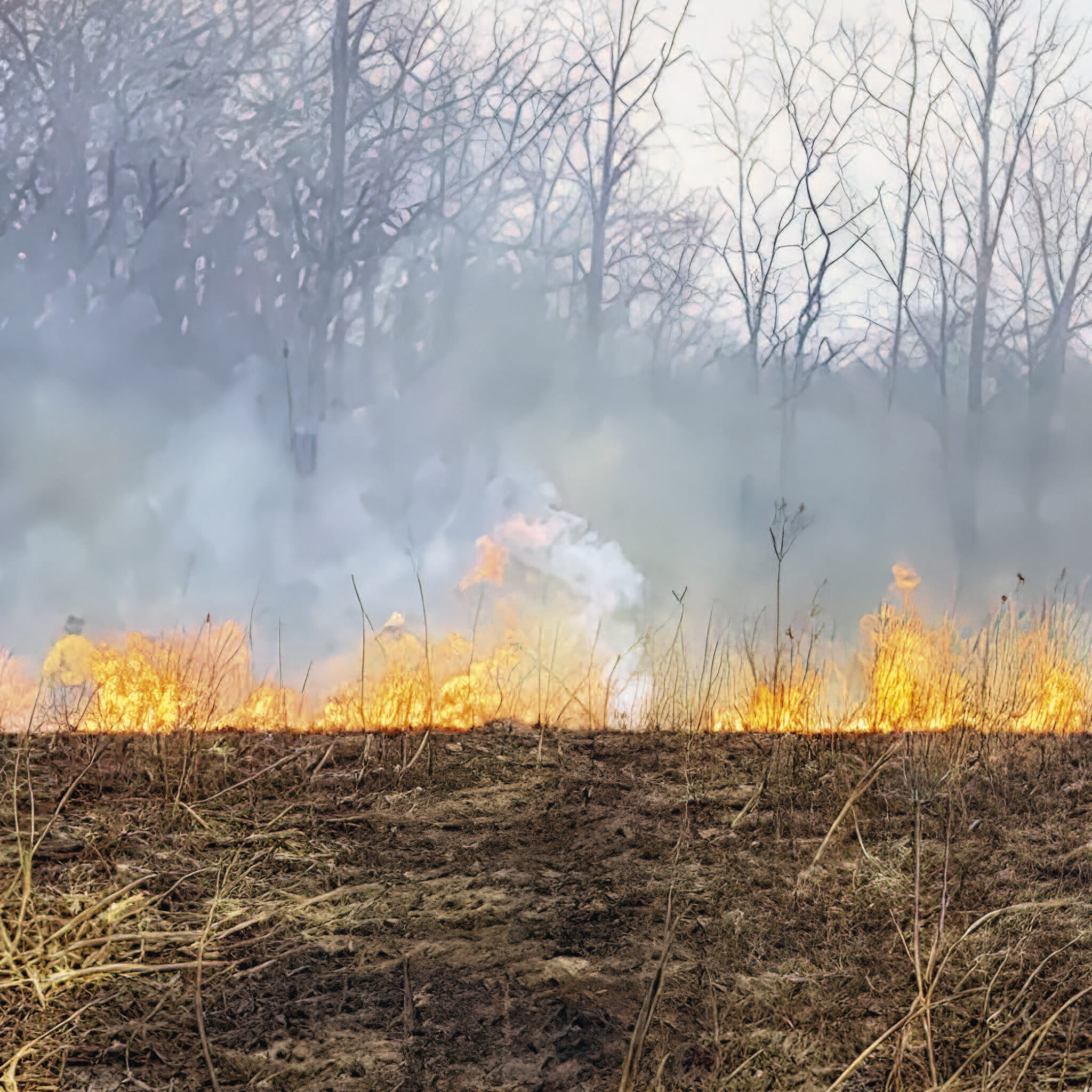
Michael Takeo Magruder. Reconstructed Landscape{s}–Green Oaks .burn (iteration i), 2025. Left half of digital monoprint diptych. Archive pigment ink on polycotton canvas. 35½ x 35½ inches. Generated from a digital photo taken by Robert M Geraci on April 3, 2025. All images generated from photos or video using a combination of traditional digital techniques and artist-controlled AI processes.
For those who believe in providence, there may be little difference between a prairie fire lit by lightning and one lit by human hand: Either way, it accords with the divine plan. To others, a fire that would have appeared divine to the ancients now has exclusively human origin. But even to a modern skeptic, the strike of lightning, the bright flash at the border of life and death, somehow confirms our sense of a transcendent plan, destiny, the sublime. The blinding illumination and inferno that follows prompt awe that defies our rational minds. Compelled by what Rudolf Otto called the mysterium tremendum and the fascinans of a sacred experience (the dreadful fear and the irresistible allure), in a prairie fire we witness death, destruction, and rebirth—and become part of that process.
Many religions offer annual rituals designed to recognize and encourage the cycles of nature that restore life to the landscape. These rites are almost invariably connected to the restoration of humanity as well, expunging the past, absolving sin, or renewing the world. From the recitation of the Enuma Elish in ancient Babylon to the descent of a glittering ball in New York City, humanity awaits a better year to come, one in which the forces of nature align and hope for the future overcomes fear of the past. The controlled burn at Green Oaks offers a modern iteration of this ritual. Just as repeating the Enuma Elish restored the world to its proper order, and our New Year’s resolutions promise a return to our better selves, the burn—carried out in different fields each year—ensures the grassland thrives in the face of encroaching forest.
In May 2025, when Magruder first came to campus to document the grassland’s reemergence, the prairie was already flush with green and full of the songs of birds, the buzzing of insects, and the croaking of frogs at an adjacent lake. In the exhibit that fall, his .growth canvases—large-format images of lush grass with a shadowy forest looming behind—were hung dramatically across an entire gallery wall. These works are products of traditional decisions in composition and color grading, new mechanisms for AI enhancement in sharpening and enlargement, and reconfiguration through a diffusion model that takes an image and produces a new one that is emergent from—but not quite the same as—the original. The canvases speak to the power of life to burst forth, like the sacred that lurks at the edges of our imagination. Reminiscent of Mark Rothko’s abstractions, they draw the viewer in, demanding our attention to the importance of life. Imposing in scale and rich in detail, they invite contemplation from afar and from up close.
Alongside his own work, Magruder selected and displayed material from the Green Oaks historical archives that document, among other things, the development of human technologies for apprehending the prairie. Beginning with a nineteenth-century survey of the land (conducted as part of government settlement plans for what would soon be named Illinois), Magruder chose material that traces the development of photography, from glass slides to aerial images to smartphones. He also included a plant specimen from the biology department’s Green Oaks collection, Rubus fruticosus, common blackberry: a ghostly witness to the land’s changes, displayed near digitally regenerated photos of prairie flora.
To approach the prairie and its natural cycles through the camera phone, the computer, and the gallery, as Magruder asks us to do, is to accept—however reluctantly—that our desire for the natural is impossible without the technological. The prairie itself is possible thanks only to ancient human techniques of land management. Today, when we hike in remote places, hoping for escape from technology and true connection with the land, we bring our cameras with us. The more fiercely we record our moments of natural peace, the more obvious it is that we cannot fulfill our dream of unmediated access to nature. The technique that haunts and frustrates us is the same technique that renders the prairie’s beauty in the gallery. We may want immediate access to nature and to life, but the world—and the prairie—hide on the other side of our technologies.
Perhaps counterintuitively, art that pushes formal boundaries does not necessarily desacralize its subject the way some feared at the advent of mechanical reproduction. In fact, the opposite can be true. The anxiety that photography undermines the artistic image is one we have long rejected, for instance. In this way, Magruder’s digitally regenerated landscapes follow in the footsteps of technical innovators.
But he also follows artistic traditions that confirm the sanctity of nature. In the early twentieth century, Constantin Brâncuși restored transcendence to natural materials in a very contemporary idiom, reinventing “folk” and “primitive” forms to make bronze and marble soar in sculptures like Bird in Space. Nearly a century later, Wolfgang Laib would painstakingly collect an earthbound material, pollen—the very thing that generates trees and grasses—and bring it into the gallery, arranging it into golden, portal-like squares that offer glorious transport to another world.
Like Brâncuși and Laib, Magruder takes us into the sky—to a sacred realm just on the other side of a window in the gallery space. In Reconstructed Firmament{s}, a pair of slow-moving cloudscape videos projected on the wall offer passage to another world. The work also speaks to the cosmic skyscapes of Govindah Sah, an artist who, like Laib and Magruder, blends art and science with a transcendent sense of scale.
The celestial Reconstructed Firmament{s} differs from the earthy .growth, hung nearby, but the two are bound together by an auditory landscape that permeates the gallery. This soundscape, Reconstructed Bio/Geophony{s}, combines recordings of wind, insects, birds, and frogs to algorithmically generate an infinite, dynamic web of prairie sounds that carry us back and forth between the images of grassland and sky.
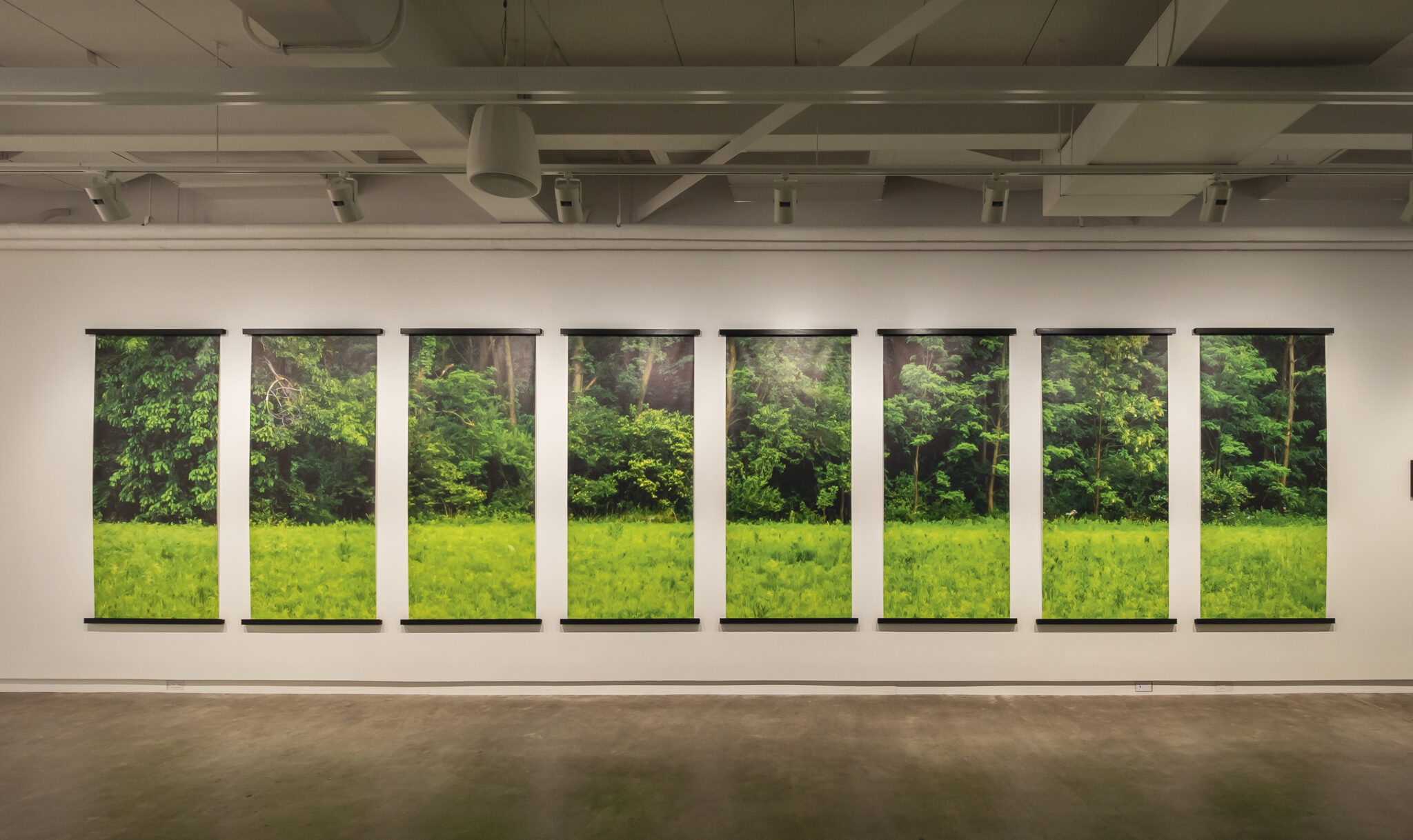
Michael Takeo Magruder. Reconstructed Landscape{s}–Green Oaks .growth (iteration i), 2025. Eight-section digital monoprint tapestry. Generated from a digital panoramic photograph taken by the artist on May 24, 2025. Archive pigment ink on polycotton canvas. 78 x 34½ inches each.
By drawing nature into the gallery, Magruder drives home the technological mediation at the heart of our relationship with the environment. As Kant observed, we cannot access the world as such but can only apprehend it through our intellectual frameworks. If the world-in-itself cannot be straightforwardly known, how much more does our technological representation of the world—from cave paintings to digital art—require interpretation? We cannot know how painters in the dark caves of Lascaux or at the cliffs of Mesa Verde thought about their tools or techniques. Using pigment to replicate reality may once have seemed radical, but we accepted such techniques long ago. Yet each time a new art medium drags us into the future, from Renaissance perspective to photography, we feel shock. We wonder, Is it really art? Without doubt, an artist’s use of artificial intelligence, with that technology’s disturbing potential for deepfakes and hallucinations, compels us ask the question again. But our representation of the world is always through our technologies, a fact perhaps more obvious when we draw on post-industrial, digital image-making.
The Reconstructed Flower{s} of re:Generated Prairie emerge through such digital technology. Beginning with a close-up photograph of a blossom, Magruder draws us even closer through engagement with AI that, in sequential iterations with manual processing, allows him to make repeated enlargements from the original photograph. The result is a tiny snapshot of pixels dancing to the tune of his enhancement models—the product of his careful intent.
Magruder’s regeneration of the image through new AI techniques of enhance-ment—especially his use of a diffusion model to rebuild his camera documentation into something other—his reconfiguration of what the eye can see and the mind can comprehend, all this awakens us to the inescapable: Our modern view is always through a technological lens. As impressionism challenged viewers to experience nature rather than pursue its realistic capture, re:Generated Prairie challenges us to witness nature’s processes while also recognizing our means of witnessing. Magruder asks us to see our seeing and to rethink the “naturalness” of our place in nature.
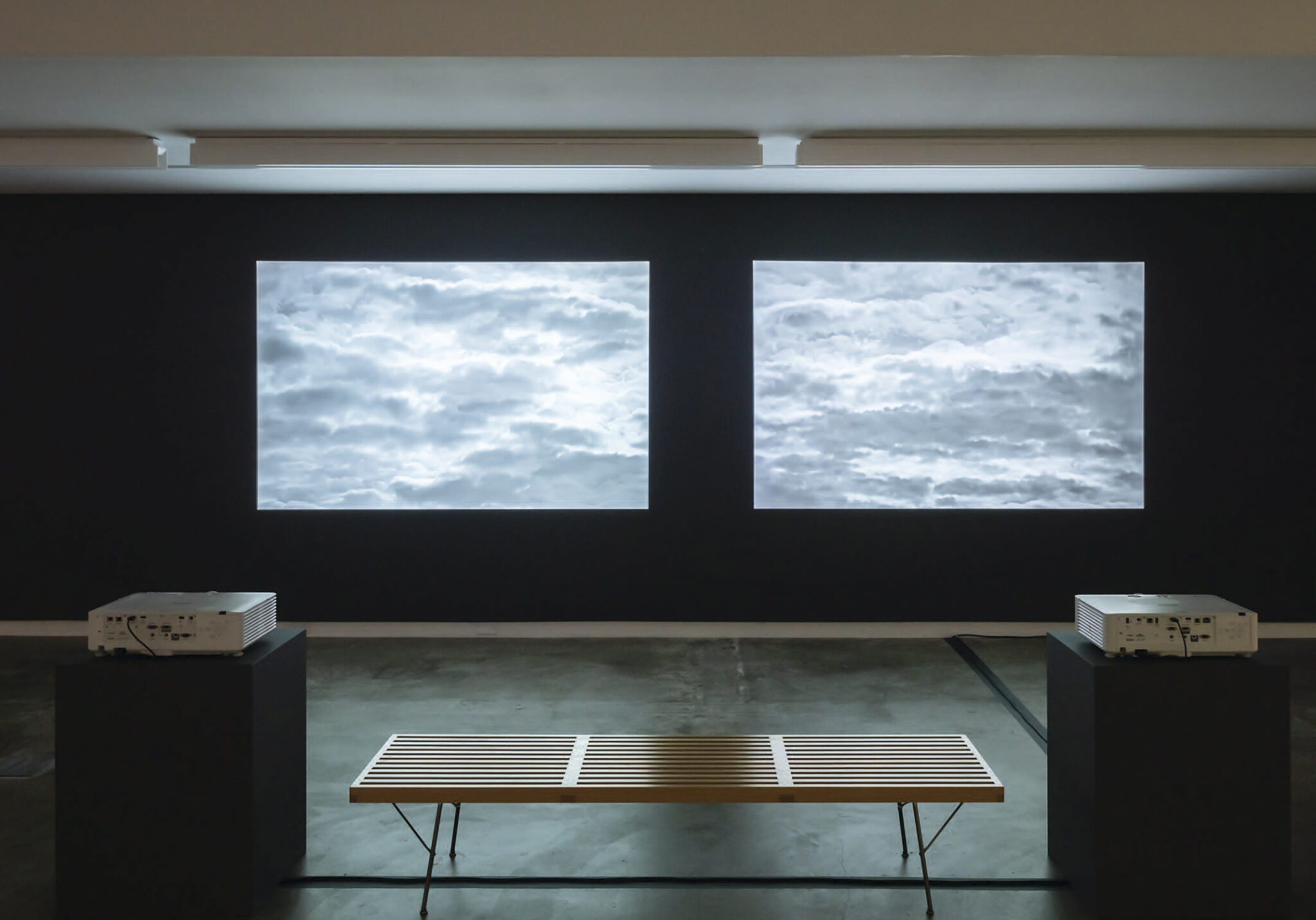
Michael Takeo Magruder. Reconstructed Firmament{s}–Green Oaks, 2025. Dual-channel 4K video sequences. Fifty-second seamless loop generated from a twenty-second digital video clip recorded by the artist on May 24, 2025.
The AI technologies now being pushed on us by grasping technocrats are part of a cataclysmic rush to profit. “Move fast and break things,” goes their mantra. But the prairie teaches a different lesson. It burns—through a mixture of accident and intention—in order to open creative space, holding back the trees that would shade out the grass. Magruder’s considered use of AI reinforces the power of human intent, bringing the technology into his process. In an age of AI, art should follow this lead: Art must reject the banal and destruction for its own sake. Instead, art must find opportunities to draw on new techniques and create new visions for humanity.
re:Generated Prairie puts us in mediated contact with the grassland, with the burn and the growth. That contact is deliberately made tenuous through the use of the digital camera, the manipulation of the images and sounds, and their reconstitution through AI. The artworks invoke nature through technological composition. Perhaps our own technological dependence is at the root of our encounter with the canvas tapestries and loops of regenerated video. The artist’s use of AI to produce such gorgeous works challenges us to reflect on the way we use tools to see what cannot be seen by the unaided eye. The history of science is replete with such discoveries, from Robert Hooke’s enlargement of microscopic life-forms to Galileo’s telescopic view of Jupiter’s moons. We begin just at the edges of our awareness and expand progressively to the structure of atoms and the expanse of our galaxy. Technology enables our understanding of the world—and also our memorialization of and reflection upon our individual lives.
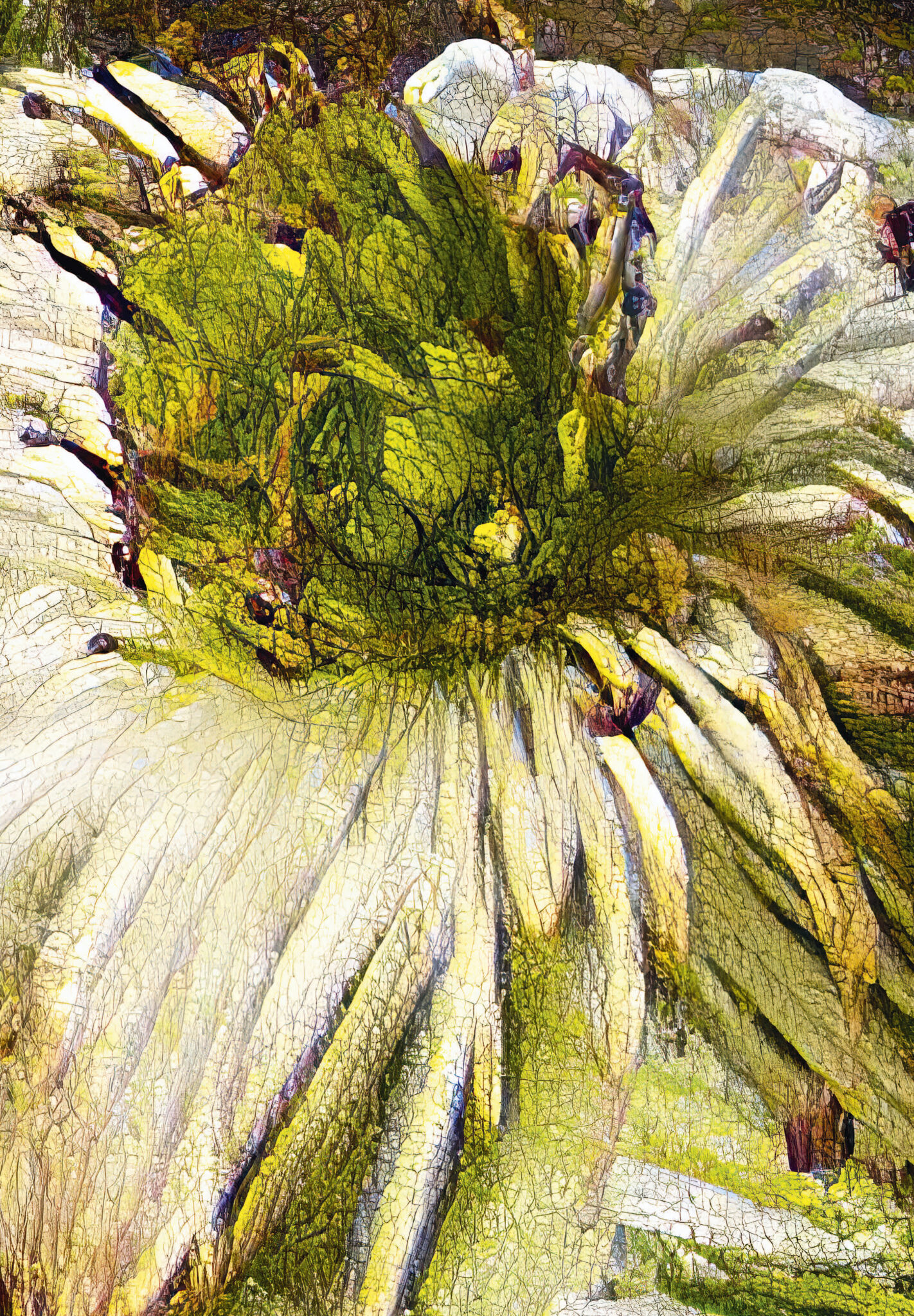
Michael Takeo Magruder. Reconstructed Flower{s}–Green Oaks .Rubus allegheniensis, 2025.Detail of digital monoprint diptych generated from a photograph. Archive pigment ink on metallic cotton paper. 23½ x 31½ inches.
We who witness the annual emergence of new life from the burning prairie are prompted to reflect on our hopes for renewal and redemption. The cycle that brings flowers from ash speaks to the braided patterns of human ritual, human cognition, and the natural world. The burn that might happen becomes the burn that must happen. The very existence of the prairie depends on the fire, and the life of that prairie cannot be separated from the needs of the people who managed the land for millennia. Reflecting on the colonization of the land and near extermination of the bison 150 years ago underscores our need for regeneration in the present—of our world and of our selves.
The post-burn growth documented and reenvisioned by Michael Takeo Magruder in re:Generated Prairie re-creates our relationship to history and to the natural environment. Magruder reckons with our desire to know and renew the world, and the technological mediation of those pursuits. Each year, a prairie burn near Knox College is a moment when humanity takes seriously our obligation toward nature: It replaces accident with intention and emphasizes our crucial role as participants in the regeneration of the world.
Robert M Geraci is Knight Distinguished Chair for the Study of Religion & Culture at Knox College. He is the author of Futures of Artificial Intelligence, Virtually Sacred, Apocalyptic AI (all from Oxford), Futureproofing Humanity (independent), and Temples of Modernity (Lexington).