


Marcus Clarke’s practice surveys the affective and symbolic language of American Christian subcultures through aversion and desire. His sculptures, prints, films, and installations engage with kitsch and camp, using tactics of the attention economy and of post-cynical sincerity to investigate how Christendom haunts culture. He was interviewed by Ellie Driscoll.
Image: Much of your work comments on spectacle in American Christianity, often in megachurches and Pentecostal gatherings. You regularly amp up the spectacle to a deafening level. Do you think of your use of noise as a way to bypass the rational?
MC: Certainly. I see the aggressive aesthetic strategies in my art—fluorescent colors, attention-grabbing electronics, glitter, confetti, noise, exposed wires, caution messaging, shiny plastic things—as all having a rapturous visceral effect. I’m interested in apophatic theology, which is built on the implication that words, language, images, and our own psyche fail to grasp God fully. Apophatic strategies are subtractive: God is not _______. They erase our reference points to a God who defies references. But I think conversations about Christian spirituality through maximalism, through sensual overabundance, can also be effective.
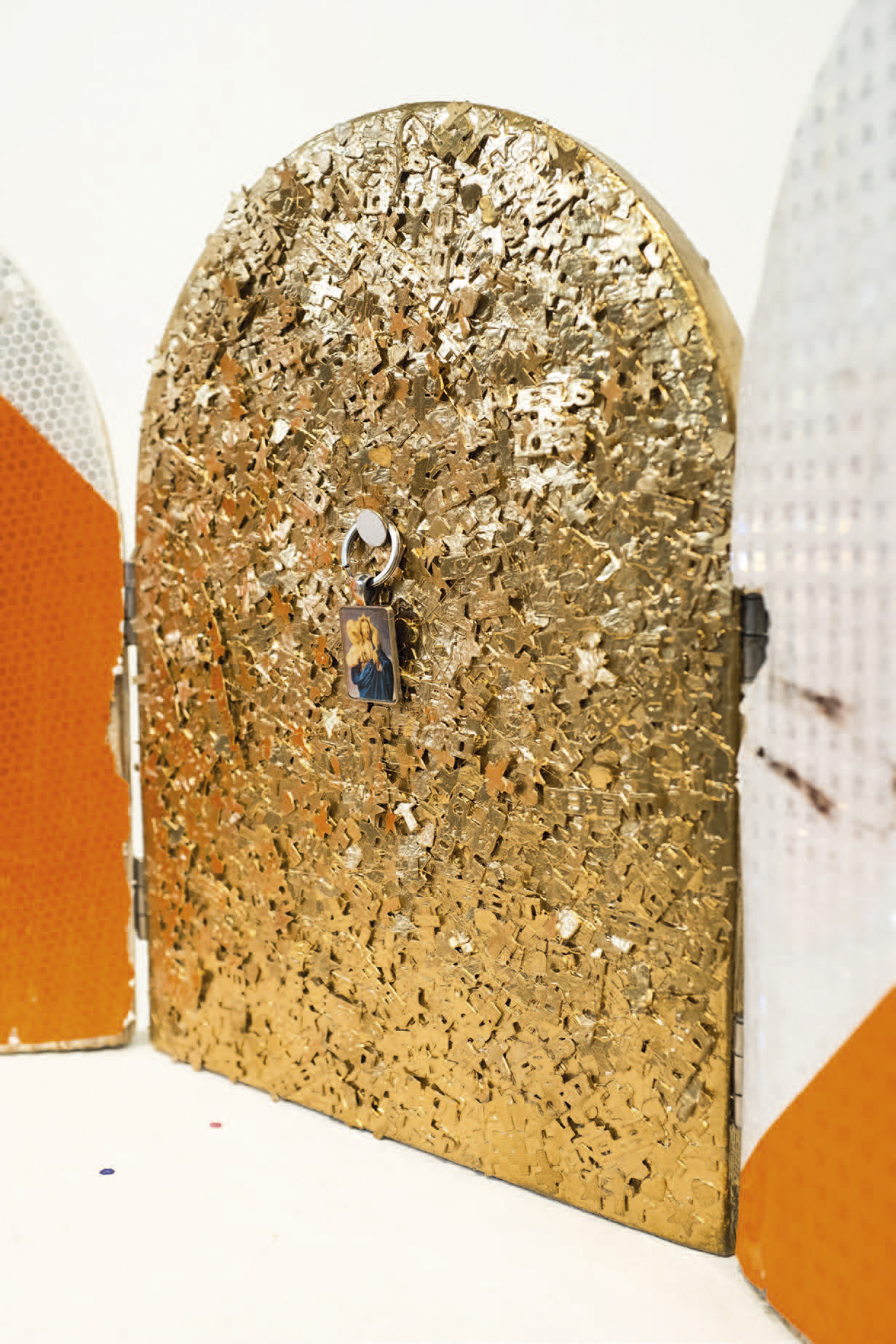
Marcus Clarke. Keychain Triptych, 2024. Paper and spray paint on canvas with traffic barricade and key chain. 16 x 12 x 3 inches. Photo: Patrick Farris.
I have a series of confetti paintings titled Festivus. In one of them I use rainbow confetti, plastic gemstones, and multiple layers of pastel-colored oil stick on top of Bible pages, comics of biblical narratives, cigarettes, hair, and dust—all adhered to a fluorescent orange underpainting. The materials are pure overabundance and chaos—and also worthless detritus. The density of the confetti changes through the canvas, and from afar, the chaos of materials creates an image that loosely resembles Christ. This begins to question the imaging of Christ with such irreverent and ostentatious visual stimuli.
Our American Protestant heritage has an overconfidence in logic as an antidote to doubt and unbelief. For believers, this creates an emphasis on biblical literacy, doctrinal coherence, and the ability to describe your personal faith intelligibly. This marks a departure from pre-Cartesian, mystic devotional practices in which images, prayers, and rituals were absorbed in an affective, bodily way and were understood to form the believer through sustained exposure, growing deep roots.
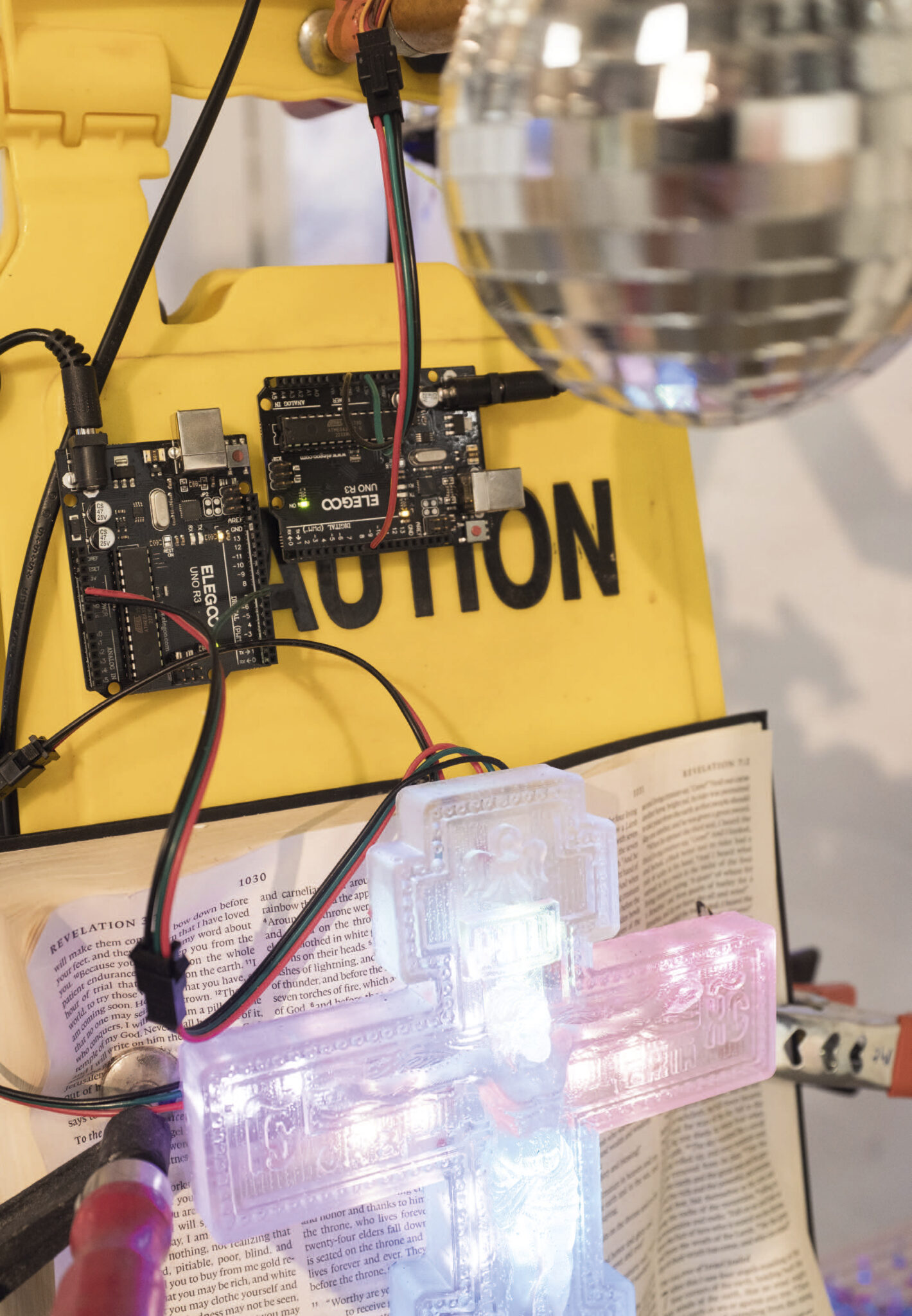
Marcus Clarke. Transfigurcrucifixilation, 2023. Sign with Bibles, epoxy, lights, disco balls, eucalyptus, yarn, motor, fan, confetti, tracts, zip ties, clamps, and prism. 26 x 14 x 15 inches. Photo: Patrick Farris.
In Russian Orthodoxy, there is space for words and images to escape the rational. In the Hesychast tradition, for instance, people repeat the Jesus prayer—Lord Jesus Christ, Son of God, have mercy on me, a sinner—syncing it to their breath so they can “pray without ceasing,” as Saint Paul writes. This is a way to channel a different cerebral and spiritual plane. It not about intellectual assent but letting the repetition of the prayer work deeply in the believer.
I use noise and repetition a lot, whether visually or literally, to begin to fracture whatever the viewer is trying to grab, to create a disorientation to get to a different cognitive level. In the confetti paintings, you are forced to oscillate between the aggressively vivid colors, the nearly grotesque materials, and the foggy divine image. I think disorientation is a really important part of spiritual experience.
Image: You make work that is taken seriously by secular galleries and also by religious communities. How do you aim to use your art to move between these two worlds?
MC: The world of contemporary art is fueled by postmodernism, intellectualism, and the avant-garde. Those aren’t things I’m seeking to reform. I think they are useful and surprisingly generative, even for Christian theology. One of my mentors, Jonathan Anderson, has pointed out that modern art galleries are really ripe places for theological questions.
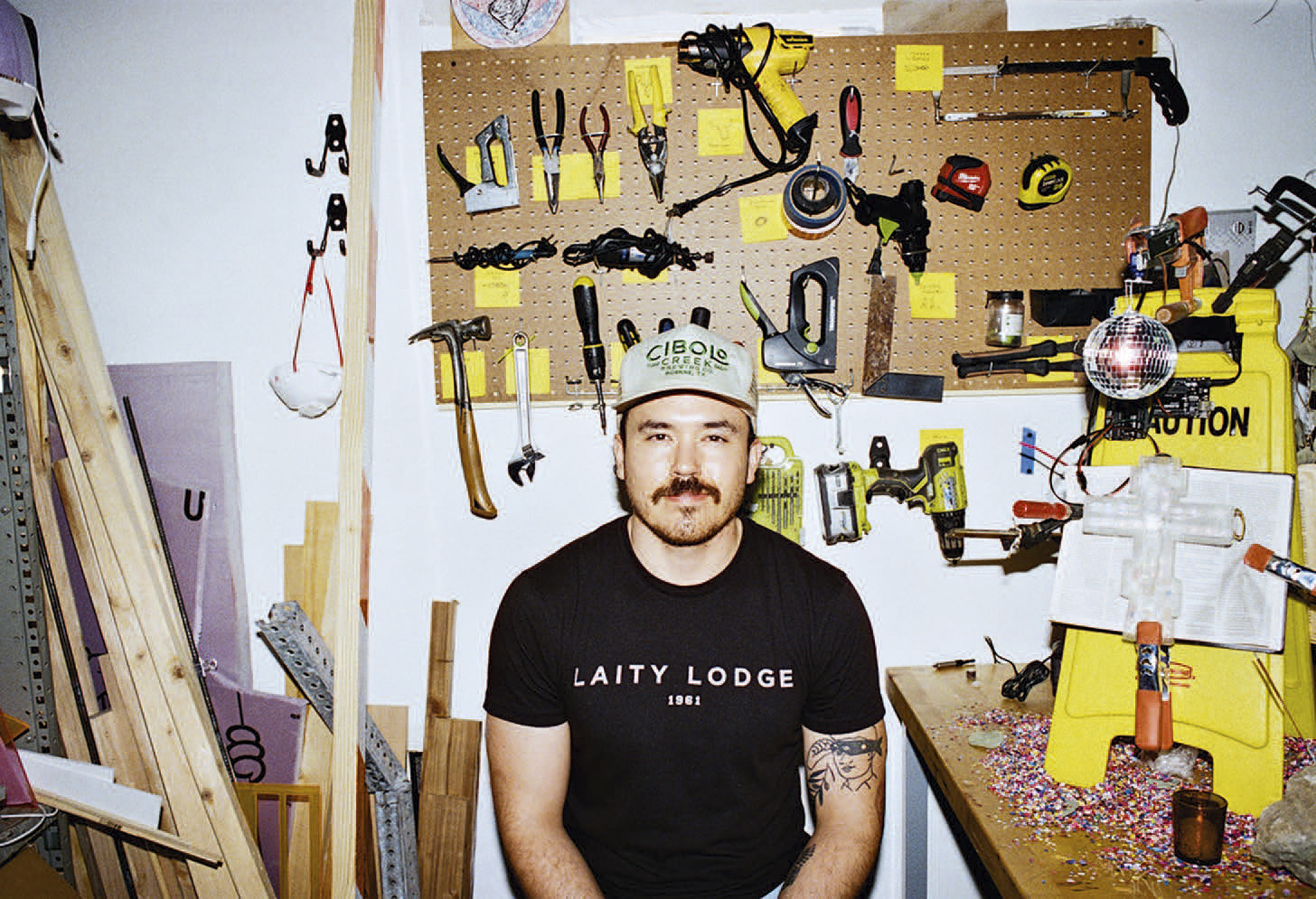
Portrait of Marcus Clarke by Kyle Bowden.
After over a century of isolation from each other, the contemporary art world and Christians have different metrics for valuing art, and a lot of mutual suspicion. Yet, I’ve found that if my art leads with my questions and doubts, the tension is eased up a bit. The contemporary art world is deeply inquisitive and interested in the same existential and philosophical conversations that Christian theology is. It’s been really beautiful to have dialogues with atheists and ex-Christians through my art, and I think that is only available because the work is interpretively open and doesn’t have an agenda tied to it.
Growing up in the Texas Hill Country, I had a youth pastor tell me to “shoot the Bible.” He meant: Take your questions forcefully, even violently, to the Bible. Don’t accept doctrines and positions blindly. You can ask the Bible really hard questions without it crumbling. That was wise and formative advice and has helped me not treat devotional materials like icons, crosses, and Bibles so preciously. I remember the first time in my studio that I used an industrial bar clamp to prop open a Bible. The clamp’s grip, wrinkling and digging into the pages, felt violent and irreverent, but also neurotically fervent at the same time, as if I were trying to squeeze the wisdom out of it.
Image: Historically and metaphysically, icons are thought to mediate divine presence, allowing for a sacred encounter. Your work titled Icon and Censer is a strobing trans-parent hand made of epoxy, holding brass bells, mounted on a mechanical arm. When a motion sensor is activated, the whole thing starts to move and chime. Does the viewer’s experience of being detected recover the icon’s original role, or does it disrupt that role by confronting viewers with a commodified, automated spiritual experience?
MC: I mean, you’re nailing it. With our late-modern mindset, we don’t see icons as mediating objects. We’re just seeing them as antiquated material culture and as representational, with no metaphysical reality in them. I’m not quite asserting that icons mediate a metaphysical, divine presence—that they contain the watchful gaze of a saint or of Christ—but I’m interested in that potentiality. What would it mean for an artwork to gaze back at us?
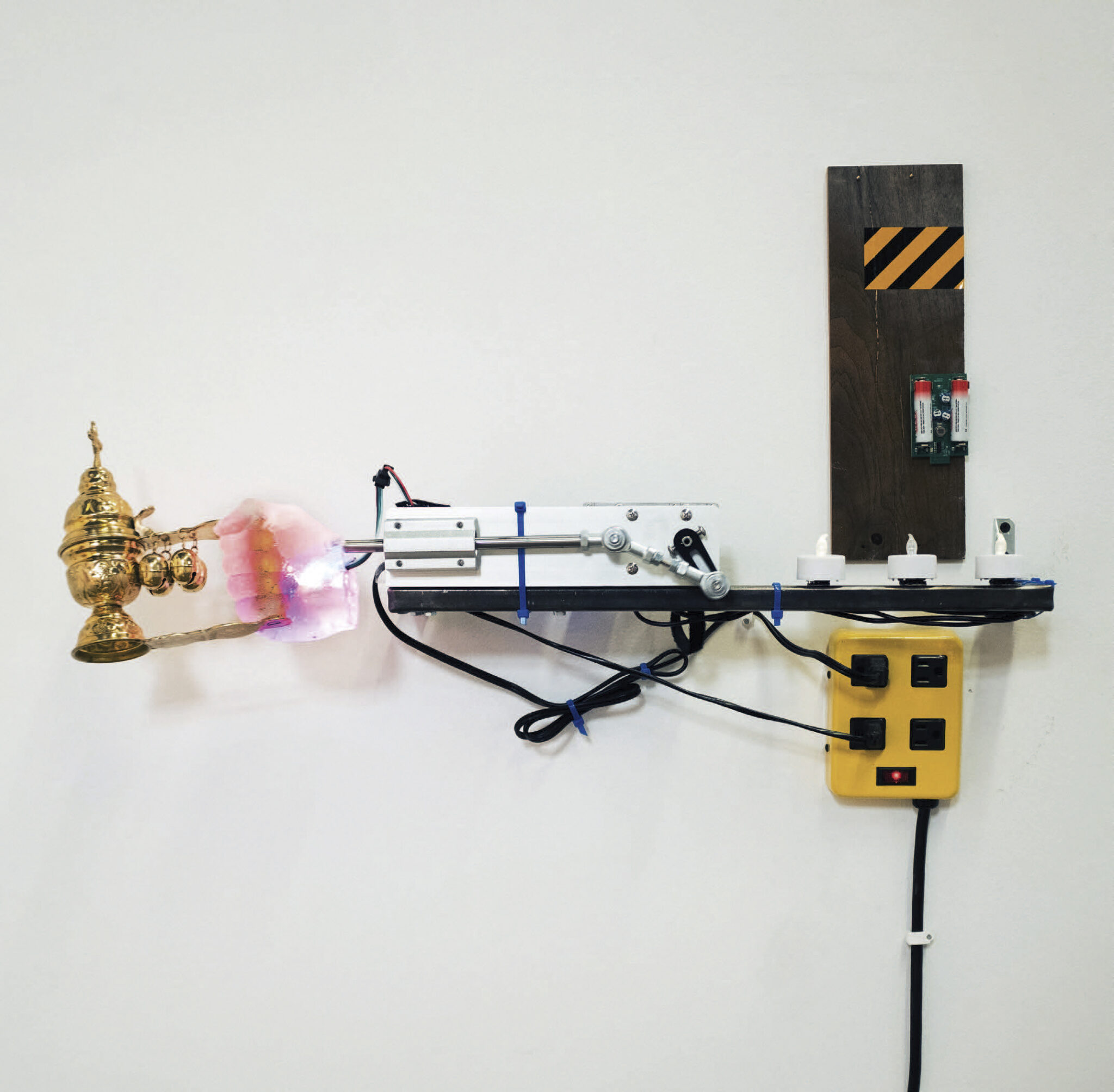
Marcus Clarke. Icon and Censer, 2024. Greek Orthodox censer, oscillating motor, epoxy and LED-light hand, metal, wood, candles, Velcro, and motion sensor. 12 x 28 x 4 inches. Photo: Patrick Farris.
You’re also hitting on some of the commodity aesthetics and tactics of the attention economy that I use across my work. These are derived from late-modern Christianity, especially things like strobing crosses and disco balls that relate to megachurch theatrics. I’m not against megachurches, but I think you can do harm when you tie an experience of God to spectacle. If how strongly I feel butterflies in my chest is my measure for how near God is, what does it mean when I feel nothing?
But what if the experience of God is tangible through an icon? And what if we expand our definition of an icon to be anything that images God, anything created by God? What if an icon of God could be just another human sitting across the table from me?
I hope my art makes a home for people who don’t feel God in commercialized evangelical spaces or the other ways given to us by our American Protestant heritage. God is accessible to everybody. But in the same breath, as Bonhoeffer said, “When God calls a man, he bids him come and die.” It shouldn’t be comfortable.
Related Visual Art


Letters, Music, Flesh: Calligraphy as Sacred Art Among Christians and Jews
ByJonathan Homrighausen

