

Tatu Tuominen is a Finnish artist whose work contextualizes archival material within discourses on ecology and built environment. A lecturer in printmaking at University of the Arts Helsinki, his practice includes printmaking, installation, collage, and moving image.
Image: Can you tell me about your spiritual or religious background growing up?
TT: It was shaped by my grandmother and mother. My grandmother grew up without a father, and her mother left for North America in search of work. She was placed in a rural foster family that belonged to the Finnish Awakening, a strict Evangelical revival movement. As a teen, she moved to the capital to work, leaving behind this controlling religious community, with a personal relationship with God as her only possession. In the city, she got involved in the socialist co-op movement, but Christian faith remained with her, even in a secular environment. She taught me beautiful hymns, the principles of Christianity; her God was generous and merciful.
My mother, born right after the Second World War, belonged to the Evangelical Lutheran Church, as did 95 percent of the population in Finland at the time, but she was part of a generation that gradually moved away from religion and placed its faith in secular state institutions and social democracy.
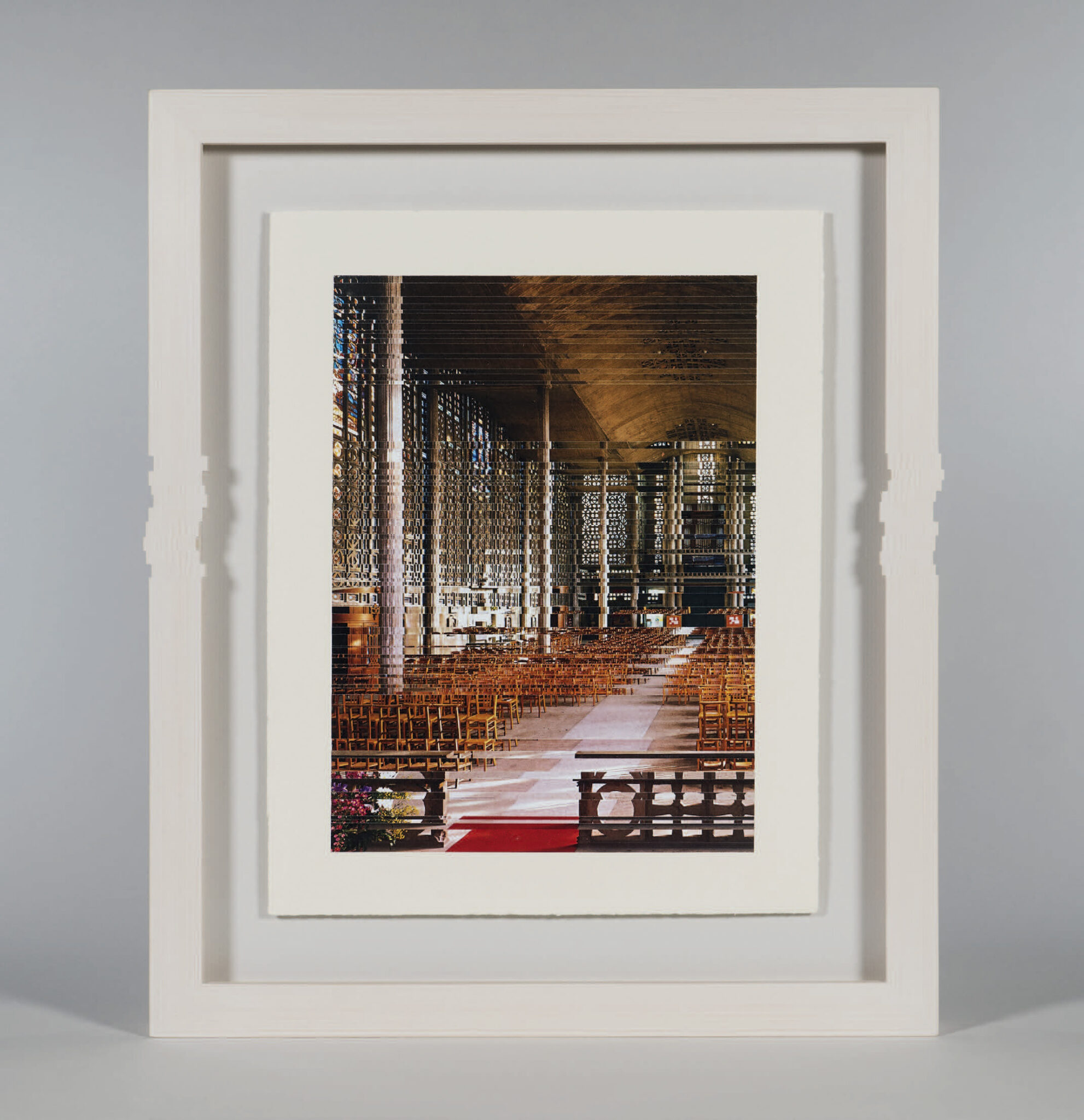
Tatu Tuominen. On The Future of Architecture Since 1889 (Church), 2018. Cut pages of book on paper and artist’s frame. 17⅓ X 14½ inches. Photo: Visa Knuuttila.
Image: Has this background influenced your artistic practice?
TT: Yes, the lives of these two women, together with the secular character of Finnish society, led me to seek the sacred beyond institutional frameworks. Finland has been Christian for less than a thousand years. Some pre-Christian traces remain, reflecting older ways of life. In Finnish indigenous belief, holiness resides in the forest, and Finns still tend to value a close relationship with nature. I find a sense of the sacred in the woods, and that informs my artistic practice.
Image: You have several projects that engage with the history of architecture, especially modernist architecture. Can you talk about where that interest originated?
TT: As a young child, I remember stepping into the vast, cathedral-like interior of the Academic Bookstore in Helsinki, designed by Alvar Aalto—all that light, the white marble, and thousands upon thousands of books. I felt a kind of joyful light-headedness. Architecture is a seminal part of the modernist legacy, a legacy that looms in the subconscious of every visual artist like a stubborn ghost. As a collagist, I work with images of glass and steel architecture as metaphors for the modern age. Architectural plans and photographs appeal to me in their staged quality. In my practice, I aim to rupture this perfection, to cut and reassemble these images into almost an alternative history of modern architecture.
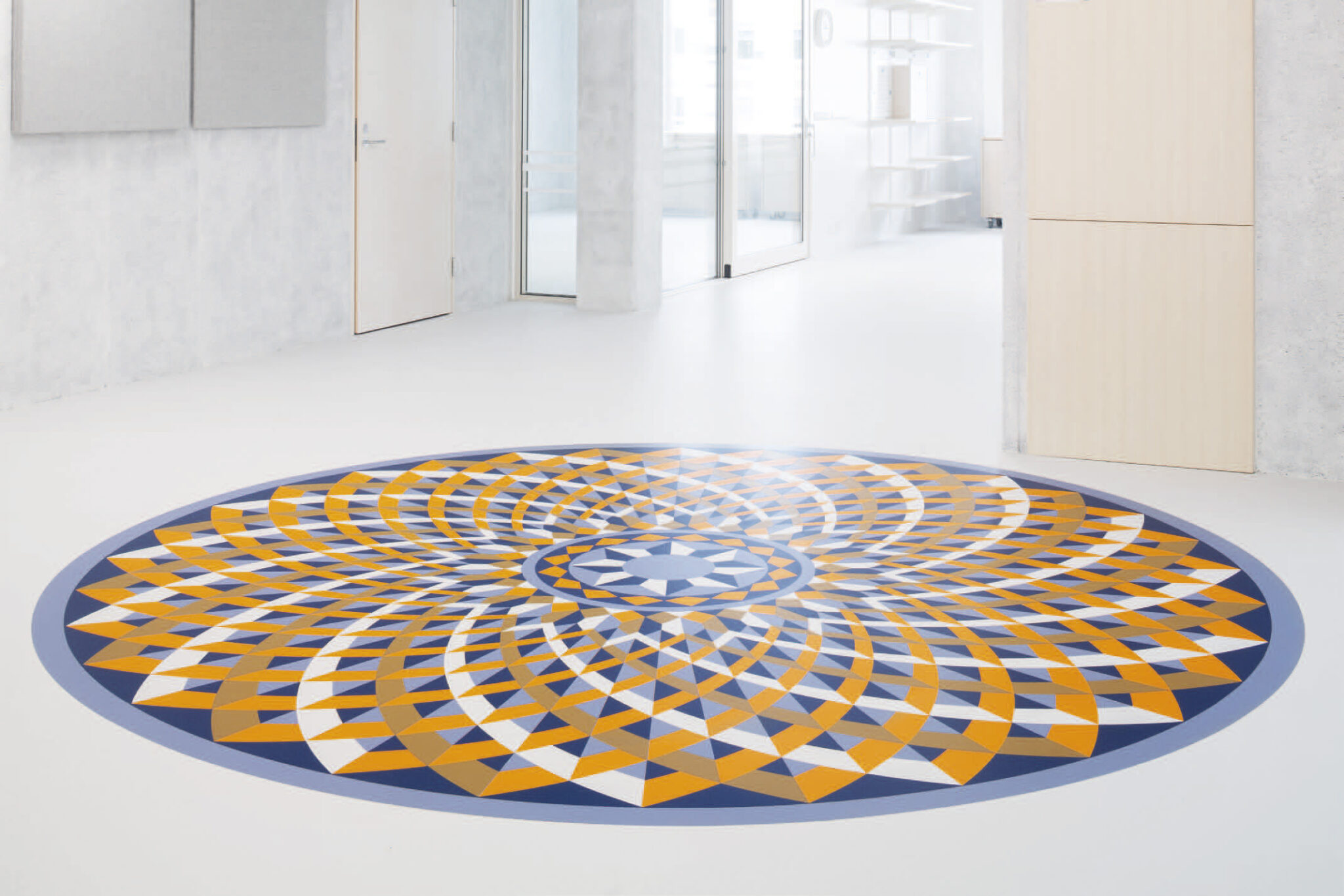
Tatu Tuominen. Fairy Tale Palaces (partial view), 2020. Daycare Center, Helsinki. Floor in polyurethane paint. Photos: Patrik Rastenberger.
Image: You’ve recently done a lot of public commissions, including learning spaces for children. Can you describe those projects and some of the questions you’ve been asking yourself along the way?
TT: I’ve worked on five public commissions recently, most for newly constructed buildings. My starting points are art history, the history of the site, its characteristics, and its locality—so they all differ in appearance and materials.
Fairy Tale Palaces is a six-part work that extends across the flooring of a daycare center in Helsinki, using floor painting, ceramic tile, and wood parquet. The patterns reference floor decorations found in historic buildings, giving the daycare center a sense of grandeur, like a mosque courtyard, cathedral, or basilica. The work is based on the idea that there is something sacred, sublime, and beautiful in the formal language of the historical patterns used in architecture and art. The aim is to cause a disturbance in the chronological time continuum and hierarchies of power by moving spectacular floor patterns from distant times and places into the everyday life of today’s child. Finns have had the universal right to daycare since 1973, and this artwork asserts that high-quality early childhood education is as important to Helsinki as Saint Mark’s Basilica was to the Republic of Venice.
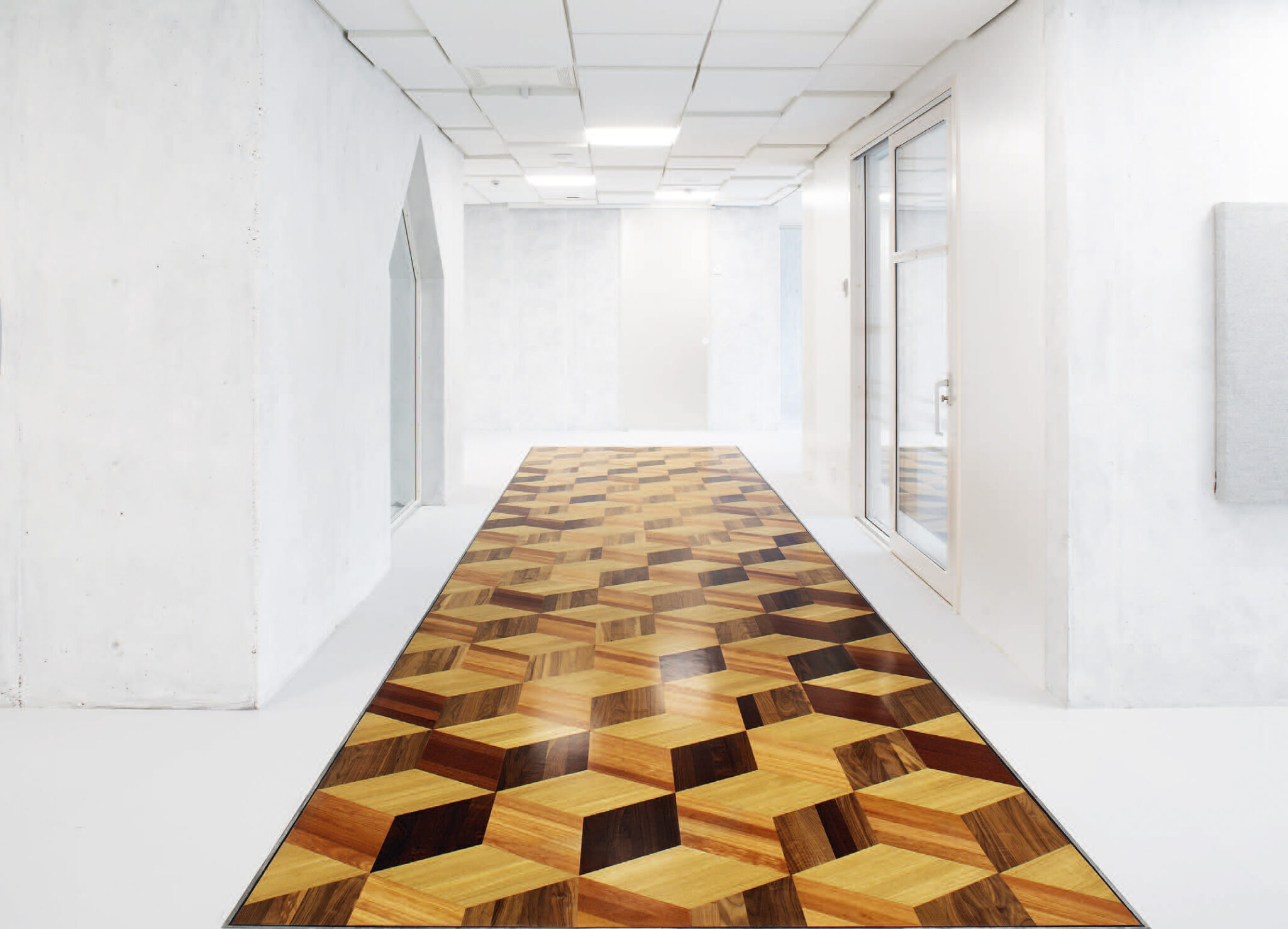
Tatu Tuominen. Fairy Tale Palaces (partial view), 2020. Daycare Center, Helsinki. Floor in solid wood parquet. Photos: Patrik Rastenberger.
My most recent public project is Archaeology of Peltolammi, which will be installed on the façade and interior of a community center near Tampere that holds a school, youth facilities, and library. I designed part of it collaboratively with one of the user groups—schoolchildren. We collected plants from a local nature reserve and pressed them into a herbarium. The forms of these plants will appear as giant reliefs on the façade, and the pressed plants will be framed and installed inside the building.
Image: Your interest in ecosystems also runs through some of your recent graphic projects. Can you talk about the concepts behind A Near Approach to Immortality?
TT: That project explores the lost European primeval forest through two historical sources: a text by the Roman historian Pliny the Elder (23–79 CE) and Renaissance landscape etchings by Albrecht Altdorfer (1480–1538). The project probes what these images and texts reveal about the human relationship with the forest, past and present. Pliny refers in Naturalis Historia to the Hercynian forest, a mythical primeval forest that lay beyond the borders of the Roman Empire in western Central Europe. For Pliny, Hercynia was an impenetrable and otherworldly place. It represented untamed nature, a territory not even Rome could govern. He writes: “The Hercynian Forest, whose gigantic oaks, uninjured by the lapse of ages and contemporary with the creation of the world, by their near approach to immortality surpass all other marvels known.” It is startling that something that, in its own time, seemed as if it had always existed and would exist forever, has disappeared and remains only in stories.
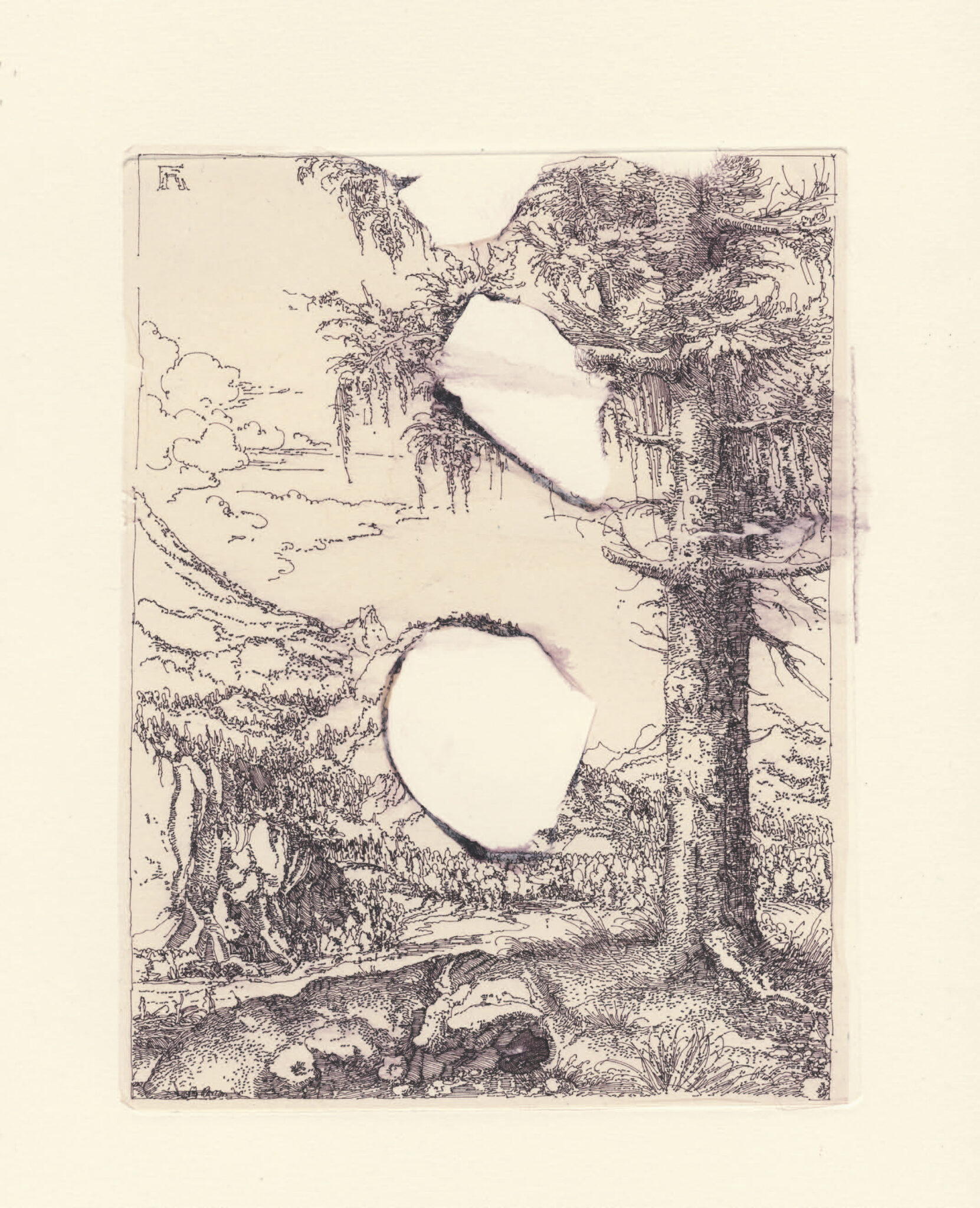
Tatu Tuominen. A Near Approach to Immortality (Landscapes I), 2026. Drawing, chine-collé, and artist’s frame. 8¾ X 11½ inches.
Altdorfer’s prints were among the first works to disseminate the concept of landscape across Europe, as they could be reproduced easily. During the first decades of the sixteenth century, landscape emerged as an independent subject in visual art, something that could be shown without humans or a religious or mythological subtext.
For the series of drawings subtitled Landscapes, I created new landscapes by tracing the lines of Altdorfer’s etchings and manipulating them through drawing, cutting, and gluing. The section called Hercynian Forest is a moving-image and sound work in which the Hercynian forest emerges as a paper stage set. As the viewer’s gaze slowly moves through the landscape, the small paper scraps grow to colossal proportions. The soundtrack is composed of sounds produced by the paper itself. For the section called Foliage, I cut out the parts of Pliny’s text that dealt with the Hercynian forest and created an installation in a gallery setting—a kind of foliage made up of quotations.
Art-historically, landscape has been presented as perfect, static, and complete, but in the current ecological situation, this kind of landscape seems impossible. So, the landscapes in A Near Approach to Immortality are in a state of becoming: they are imperfect, in flux, and fragmentary—like the world around us.
Image: Artificial intelligence offers seemingly infinite ways to access, reproduce, and manipulate the images of the past. Do you see your very tactile, personal way of working as a bulwark against the depredations of AI? Are there ways in which you are, or could imagine, using AI in your work?
TT: I visit the archives I work with in person, going to museums across Europe to see the prints and drawings of the past in their tactile, surprisingly small and frail states. I inhale their musty scent. However, I also use AI to find information about these documents. I see AI as one development in the history of the dissemination of knowledge, like the halftone, the printing press, or even cuneiform. But one must view AI critically. It consumes vast amounts of energy. And AI, alongside data mining, is used for risk management and to predict possible futures. These statistical scenarios exclude the impossible and externalize the foreign. This turns probabilities into certainties. It is an exploitation of the future that narrows the realm of the unknown—the area in which art often operates.
Related Visual Art

Mother-Survivor at the Gates of Dawn: An Icon In Contemporary Art
ByEglė Elena Murauskaitė