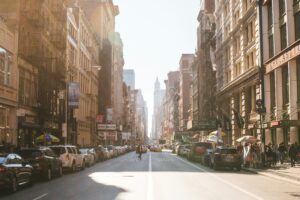


TANYA PETROVA LIVED WITH HER HUSBAND on the third floor of a mid-rise in the Grazdanka suburb of Leningrad. She loved everything about their flat: the herringbone wood floors, the double-casement windows, the rose-colored wallpaper with its tiny blue flowers. But most of all, she loved not sharing a kitchen and bathroom with three other families in a communal apartment.
She had hoped for a unit overlooking the quiet courtyard, but a flat on the other side of the building had its advantages as well, the chief being a clear view of the gastronom across the street. Tanya saw when the store was open. The posted hours were only fiction. She recognized when a shipment of meat or produce had arrived, because the delivery trucks blocked half the street. And she knew when something special had found its way onto the shelves, because a line would trail out the door, down the steps, and along the sidewalk. When that happened, Tanya grabbed her avoska—her “just-in-case,” as Leningraders called their string shopping bags—and joined the queue. Only then did she ask what everyone expected to find inside. Once it was sausage from East Germany. Another time, canned pears from Yugoslavia. Most recently, a shipment of toilet paper had arrived from Poland. Tanya would return with as much as would fit in her avoska, or as much as the store clerks permitted her to buy. Though the store was now closed, a line had begun to form outside.
“Maybe you should investigate?” her husband Pavel suggested.
“We have everything we need for tonight,” Tanya replied.
That was thanks to her planning and foresight. This would be the first New Year’s Eve in their new flat, and Tanya wanted everything to be perfect. She had begun stockpiling what she needed weeks in advance. When she discovered smoked sprats in a store near her office, she bought several cans and stored them under her bed. On a visit to Vasilyevsky Island, she found pickled herring. At a store near the Hermitage, pashtet. At a shop outside a subway station, she bought mayonnaise and canned peas. When New Year’s Eve grew close, she bought potatoes from across the street. And yesterday, she came home with bread, a variety euphemistically called “French loaf,” and a brick of the coarse stuff that, along with cabbage, was never in short supply.
“Do we have anything sweet to serve?” Pavel asked.
“Two boxes of chocolates,” Tanya replied.
“I hoped for something special,” he said.
“Like what?” Tanya asked.
“Some sort of pastry.”
“I could make vareniki and fill them with jam.”
“Could you fill them with strawberries?”
“In Leningrad in December?” She laughed. They were more likely to see a camel trotting down Nevsky Prospect than strawberries in winter.
Tanya could see he was stung and wanted to make amends. If she didn’t, Pavel would mope, his mood overshadowing the evening’s festivities. “I could buy something from Sever,” she offered.
At the mention of Café Sever, Pavel perked up. It had been around since Nicholas II ruled Russia, a favorite of the bourgeoisie, and the Bolsheviks kept it open after the revolution. Rumor was Lenin had acquired a taste for strudel while in exile. The café suffered greatly during the Second World War. Artillery shells shattered the windows and took off part of the roof. But Sever, like the city, proved resilient. It reopened soon after the war, and Leningraders queued up again, at first for bread, cooking oil, and salt, and as the city rebuilt, for eclairs, napoleons, and cream puffs.
“But you’ll need to catch a bus, and then the subway, and then wait in line,” Pavel said.
“That’s something I do every day,” Tanya replied.
“What if the weather turns bad?” Snow still covered the sidewalk.
“Then the sooner I leave, the better.”
“What if everything’s sold out when you get there?”
“That’s a risk I’m willing to take.”
She pulled on her coat, grabbed her purse, and rushed out the door.
The stop for the number 52 bus was one block over from their building. Tanya took her place in line between a woman so short Tanya could see over the top of her head and a man with a cane. She’d learned long ago that waiting in line was easier if Dickens, Dumas, or Twain accompanied her, but in her hurry she’d left them behind. More faces joined the line.
“They must be clearing snow from somewhere along the route,” suggested the man with the cane.
“Or the driver has taken a break to buy his vodka for tonight,” the short woman countered.
It began to snow again, lightly at first, the flakes melting as soon as they touched the sidewalk. But the longer they waited, the heavier it fell, powdering their hats and collars. Tanya debated whether to return home (Pavel would have to accept vareniki) or splurge on a taxi. Perhaps the man with the cane might split the fare, if they were headed in the same direction.
The number 52 finally arrived, the passengers packed tighter than the canned sprats under Tanya’s bed. No one in line attempted to board, except Tanya. She found a place in the stairwell and rode there all the way to the subway station, careful not to lean against the door, lest it pop open and she tumble onto the pavement. Tanya was first to disembark and rushed through the turnstile before the passengers at the back of the bus had exited. She took a seat in the second subway car. It would be closest to the exit when the train arrived at Gostiny Dvor station. A poster above her head proclaimed, Glory to the Communist Party of the Soviet Union! The one next to it noted, The Ninth Five-Year Plan Is Being Fulfilled! One near the door demanded USA Out of Vietnam!
She emerged from the subway into a different Leningrad. The sidewalks in the central part of the city were clear of snow, and holiday decorations hung from the lampposts. Shoppers rushed about, their bags filled with purchases, and the sun peeked through a keyhole in the clouds. Though it was a tiny sunbeam, it kindled memories of their vacation on the Black Sea: the pebble beaches, the ocean breezes, light-night swims, vendors hawking apricots, plums, and peaches. Suddenly, Tanya fell, not in her daydream but there on Nevsky Prospect. She landed atop a man dressed as Grandfather Frost.
“Happy New Year,” he said. His nose and cheeks were as red as his suit.
“Are you okay?” asked a woman dressed as his helper, Snegurochka.
Tanya regained her feet. “I can stand, so I didn’t break any leg bones.” She rotated her right arm, her left, and then wiggled her fingers. “Everything seems to be okay.”
“We didn’t see the ice on the sidewalk,” Snegurochka explained.
Tanya sniffed Grandfather Frost’s breath. “It’s not the sidewalk that’s the problem.”
On any other day, she would have scolded the man for his clumsiness, but it was New Year’s Eve and he was Grandfather Frost.
“You two had better hurry,” Tanya said. “You don’t want to disappoint the
children.”
“There will be time enough for that when they’re adults,” Snegurochka replied.
Tanya proceeded cautiously, watching for ice on the sidewalk and comrades who’d already begun celebrating. When she arrived at the cafe, the line flowed out the door and onto the sidewalk.
“Is this the queue for Café Sever?” she asked, wanting to make sure she hadn’t joined the line for cabbage or carrots from one of the adjacent stores.
“It’s not the line for the Kirov,” the woman in front of her replied.
A man reading Pravda looked up. “Yes, it’s the line for Café Sever.”
“How fast is the line moving?” Tanya asked.
“How should I know?” snapped the woman. “I arrived just before you.”
“It’s moving,” the reader said, “but not as fast as we’d like.”
“Looks like you had a successful outing,” Tanya noted.
The woman’s avoska bulged with potatoes, carrots, bread, and a bottle of vodka.
“Who’s the vodka for?” asked another man standing.
“My husband,” the woman answered.
“If he’s spending New Year’s Eve with you, he’s going to need more than one
bottle.”
So, there was a comic in line with them. Everyone laughed, except the woman with the avoska.
“What’s the latest news?” Tanya asked.
“There’s talk of linking up with the Americans in space,” the man with the paper replied, pointing to an article on the front page. “Like when our troops met the Americans at the Elbe.”
“I doubt they’ll exchange cigarettes and chocolate,” said the comic.
A heated argument broke out near the front of the line, with pushing and shoving. A man had pretended to admire the pastries in the shop window, then tried to slip into line when he thought no one would notice.
“No,” shouted a woman. “End of the line.” She grabbed the man’s hat and tossed it backward. He scurried after it.
The man with the newspaper returned to the topic. “In many ways, the American space program is further along than ours. NASA has already devised a way for astro-nauts to smoke in space. They are issued a carton of Marlboros before each launch.”
“Then we should issue vodka,” Tanya said.
“That’s one competition the Americans will never win,” noted the comic.
“What competition?”
“Who’s better at holding their liquor,” he replied.
A few more steps and Tanya could see Café Sever’s front door. It would open, one customer would exit with a box of pastries, and another would enter.
“The woman guarding the entrance could probably hold off a company of Nazis single-handedly,” noted the man with the paper.
“How do you know she didn’t?” the comic asked.
The door swung open again, and a woman wearing a white fur coat, white fur hat, and white leather boots emerged. She carried six boxes of pastries, three in each hand.
“Whatever happened to ‘from each according to his ability, to each according to his needs?’” the avoska woman asked.
“Evidently, she has greater needs than we do,” noted the reader.
“Judging by her outfit, greater abilities as well.” The comic pulled out a flask, took a swig, and offered it around.
“There’s hot tea for me when I get home,” Tanya replied.
“Where do you live?” the comedian asked.
“Grazdanka,” Tanya replied.
“You have quite a trip ahead of you. Maybe you need to build your strength.”
The comic offered the flask again, and again Tanya declined.
“The Soviet Union has the best public transit system in the world,” noted the man with the paper. “Never any wait. Cars are never crowded. They run in all sorts of weather. And you can get anywhere on just a few kopeks.”
“No need to own a car when you live in a workers’ paradise,” the comic noted.
The bakery door opened, and a woman in a white apron stepped out, surveyed the line, said something to the woman guarding the door, then stepped back inside.
“That’s not a good sign,” the reader said.
“Don’t worry. We’ll be inside soon,” said the comic.
And soon they were. They found another six lines inside, each a dozen customers deep. Each line led to a glass display case, behind each case stood another woman in a hat and white apron, and each woman presided over a case full of napoleons, eclairs, tarts, and cream puffs.
When she finally reached the front, Tanya told the clerk what she wanted. The clerk noted the quantity and price, then handed a form to Tanya, who waited in a second line to pay the cashier. Once she’d paid, Tanya rejoined her original line. When she reached the front again and handed over her receipt, the clerk placed her pastries in a box, tied it with string, and handed it to Tanya.
“It’s for my husband,” Tanya explained. “I promised him something special for New Year’s Eve.”
“Next,” the clerk replied.
There was a ruckus outside. The sentry had locked the door.
“No more. Sold out,” she said, though Tanya saw there were still plenty of pastries left in the case.
The comic, his box in hand, whispered to Tanya, “We’re lucky to live in a workers’ paradise.”
In Leningrad, the sun set early in winter. It was now midafternoon, and dusk began to settle. Tanya retraced her steps, carefully avoiding the icy spots.
As she approached the spot of her early collision, she hoped there had been no more mishaps for Grandfather Frost.
As if on cue, a rotund woman lost her footing, the contents of her shopping bags spilling across the sidewalk as she fell. Tanya helped the woman to her feet, then gathered up the carrots, cabbage, and other items. Carefully avoiding the rushing traffic, Tanya stepped out to rescue a small ball that had rolled into the street. As soon as she grabbed it, she knew it wasn’t a toy. Somewhere in Leningrad, in the depths of winter, over three thousand kilometers from the nearest citrus orchard, the woman had found oranges.
“Where did you get this?” Tanya waved the fruit as if it were contraband.
“Rynok,” the woman responded. The peasant market.
“How much did it cost?”
“It might be cheaper if you just bought a ticket to Tblisi.” The woman laughed through her pain as she said this.
“Do they have any more?”
“A few.”
Tanya left the woman leaning against the wall and headed for the rynok. Though some frowned on it, she had no qualms about visiting the market. If the Central Committee did a better job of managing the economy, there would be no need for the rynok, but as it was, peasants working their allotments helped offset the shortfalls of the collective farms. If there was a deficit of butter in the official shops, there would be a surplus in the peasant market. If the collectives allowed potatoes to rot in the field, the peasants brought theirs to the square. And if half the milk in Leningrad tasted sour, there would be ample fresh milk at the rynok.
Tanya hurried through the stalls, up one row and down the next, looking for the vendor selling oranges. She was tempted by other items on offer: dried mushrooms, sour pickles, homemade pirozhki. One stall sold freshly plucked chickens, their heads and feet still on. But if she tarried, the orange vendor might sell out. How surprised Pavel would be with both pastry from Sever and oranges from the rynok, she thought.
The citrus merchant had set up a temporary stall near the back of the market, his remaining oranges clustered in the bottom of a suitcase. The man looked like Stalin’s nephew, if the dictator had one. He wore an overcoat too thin for Leningrad, but that didn’t matter. As soon as he finished, he’d be on a plane back to Georgia.
“How much?” Tanya asked.
“Ten rubles.”
“Per kilo?”
“Per orange.”
“A family could eat for days on what you’re charging.”
“Enjoy your black bread and cabbage,” the vendor replied.
An older man standing next to Tanya handed over a twenty-ruble note. “I’ll take two.”
The vendor accepted the bill; the customer reached into the suitcase.
“No, I select them.” The vendor picked two that looked no different from any of the others and dropped them in the man’s avoska.
“Do you have a permit?” Tanya asked.
“Do I need one?”
A woman with bright red lips stepped forward.
“How about three for twenty?” She smiled, revealing a large gold tooth.
“Two for twenty,” the vendor replied.
“Three for twenty-five.”
She offered an even bigger smile.
“Two for twenty,” replied the vendor.
She withdrew her smile and handed him two ten-ruble notes.
“How can you justify these prices?” Tanya said.
“I spent money on a plane ticket. I traveled forty-two hours to get here. I took risks with the weather.”
A grandmother in a headscarf stepped forward and without a word handed the vendor two twenty-ruble notes. The vendor dropped four oranges into her avoska.
“No discounts for pensioners?” Tanya asked.
The vendor smirked. Tanya had her answer.
She opened her wallet. Tanya could afford four oranges and still have twenty kopeks left, enough for the subway and bus ride home.
The vendor who sold dried mushrooms stepped forward. “I’ll take whatever you have left.”
“They are already spoken for,” Tanya replied, handing the vendor forty rubles.
“I’ll give you fifty rubles,” said the mushroom salesmen.
The vendor waited for Tanya’s next offer.
“All I can give you is forty,” Tanya replied.
“Then they go to the highest bidder.”
“Wait,” Tanya cried. “There’s one thing in Leningrad more precious than oranges right now.”
“What’s that?” asked the vendor.
Tanya set the box from Café Sever on the table.
The vendor laughed. “What’s so special about pastries?”
“The bakery has been around since before the revolution,” Tanya explained.
“A lot of shops have been around since before the revolution. They just have different names.”
“Richard Burton once ordered pastries from Café Sever for Elizabeth Taylor’s birthday.”
The mushroom vendor snorted. “And Jackie Kennedy shops at Gostiny Dvor.” He dropped his rubles into the suitcase. “Let me have the oranges.”
The vendor looked at Tanya. “With what I made today I can purchase all the pastries I want. I could even pay someone to stand in line for me so I wouldn’t have to do it myself.”
“No, you can’t,” Tanya replied.
“Why not?” the vendor asked.
“The store is closed and won’t open again until after January sixth. That’s the Feast of the Three Kings. Party officials don’t care much for the holiday. You’ll be home well before then, won’t you?”
The man with the oranges eyed Tanya, the mushroom vendor, then Tanya again.
“What type of pastries?”
“Eclairs, napoleons, cream puffs, macaroons.” Tanya noticed the ring on his finger. “Take them home to your wife. Tell her you brought her something special from Leningrad, vareniki just like Richard Burton once bought for Elizabeth Taylor.”
The man laughed. “You’re such a liar you could write for Pravda. Give me your money and take your oranges before I change my mind.”
“Sixty rubles,” the mushroom vendor offered.
“The deal is done. Save your money for vodka,” the man replied.
Tanya stuffed the oranges into her avoska. She didn’t regret that she’s sealed the deal with her pastries. She’d found oranges, in Leningrad, in the dead of winter. And she could still make vareniki. There was plum and lingonberry jam in the cupboard. She hurried to the station outside Gostiny Dvor, mindful of the icy sidewalks. Her problems began as soon as she boarded the subway. An avoska is little more than a net with handles. Everyone sees the catch of the day.
“Comrade, where did you get those?” someone asked.
“In town,” Tanya replied.
“How much?”
“Not much more than you’d pay for a box of pastries from Sever.”
“Do they have any left?” came a third voice.
“These were the last ones.”
“Sell me one.”
“Me too.”
She felt a hand tugging on her bag.
“They’re not for sale.”
Tanya pulled the oranges to her chest and moved to the front of the car. A man with an empty sleeve safety-pinned to his shoulder, a veteran of the Great Patriotic War, motioned for her to sit next to him. Tanya counted the medals on his chest, a dozen if not more.
“I have no interest in your oranges,” he said. They rode together in silence, Tanya reading and rereading the same propaganda posters she’d read in the morning. A pair of teenagers grew bold and approached the front of the car.
“We don’t think it’s fair that you have four oranges and we have none. Sell us two,” they demanded.
“Go back to your seats,” the veteran said.
“Not until we have our oranges,” the cheeky teen replied.
With his one good arm, the vet shoved the teenager so hard he took the second one down with him. No one bothered Tanya again, and when she disembarked, the vet blocked the exit so the teenagers couldn’t follow.
It began to snow again. Any ice that had melted during the day had likely refrozen. Tanya took her place in line at the bus stop.
“Been waiting long?” she asked the man in front of her.
“How long is long?” the man asked.
“Why must you be so difficult?” his wife snapped. “She asked a simple question. She deserves a simple answer.” She turned to Tanya. “About ten minutes.”
“Half a lifetime for a mayfly. The blink of an eyelash for a Galapagos turtle. An eternity if you’re married to her.”
“Just wait until we get home,” his wife said.
“And you wonder why so many Russian men are alcoholics.”
The comment came from a man with a rucksack who’d appeared behind Tanya.
“Returning from a camping trip?” she asked.
“From a shopping trip,” he replied. “You can fit more in a rucksack than in one of those.” He pointed to Tanya’s avoska. “Now help me out.”
Tanya held his pack while the man wiggled out of the straps.
“Why is it so heavy?” she asked.
He undid the flap. Inside were vodka, wine, cognac, pickles, smoked fish, canned tongue, sprats, sausage, cheese, and a small tin of caviar.
“I’ve slogged all over Leningrad today, and I’m exhausted.”
The snow fell more heavily now, the large flakes illuminated in the streetlights. The husband began to pace, hoping to generate additional body heat.
“I’m tired. I’m hungry. And I’m cold,” he complained.
“Then flag down the next car that comes by,” his wife instructed.
The husband stepped over to the curb and waved at vehicles as they passed. The first was a blue Lada, but it was full. Next came a yellow Moskvitch; the driver pretended not to see them. A black Zaporozhets followed. The driver saw them and sped up.
“Whatever happened to the brotherhood of man?” the husband asked. “Can’t they see we’re freezing?”
“They need an incentive to stop,” Tanya said.
“You sound like a capitalist,” replied the wife.
“More of a pragmatist,” Tanya replied.
The husband grabbed the bottle of vodka from the rucksack.
“Hey, put that back,” the owner protested.
“Not if you want to make it home,” the husband replied.
As the next car approached, he extended his arm, vodka bottle in hand. The driver passed, braked, then backed up.
“Let me do the talking,” the wife said.
She quickly negotiated the fare for the four of them. Ten rubles per passenger plus the vodka. Tanya was more than nine rubles short.
“Don’t worry. We’ll cover your fare,” the husband said. He took out ten more rubles and handed them to the driver. In gratitude, Tanya offered him an orange.
“Save it. Share it with someone you love,” he replied.
His wife punched him.
“I love you,” he said.
She punched him again. “I love you too.”
They squeezed into the car, the husband, wife, and Tanya in the back seat, the man with the rucksack in the front. Though the heater ran, the passengers could barely feel a difference from the outside air. The car had no wipers, and every few blocks the driver stopped to get out and clear the windshield of snow. Nor did the defroster work. The driver continuously wiped the glass with a handkerchief. But everyone felt safer in the little yellow Volga than standing in subzero temperatures at the bus stop.
The driver dropped Tanya across the street from her building. She saw a light on in the kitchen and someone moving behind the curtains. Hopefully Pavel had seen she was running late started the evening’s preparations. There were carrots to peel, potatoes to boil, cabbage to shred, and now vareniki to make.
Tanya waited for a black Moskvitch to pass before crossing the street. Someone had shoveled the sidewalk earlier that day, but the evening snowfall had covered it again. She was only a few steps from her building when she encountered a patch of black ice. Her last thought before her head hit the pavement was how pretty the snowflakes looked in the overhead lights.
A woman in a man’s coat kneeled beside Tanya as she regained consciousness. She tried to sit up, but the woman held her down.
“Not so fast. You took a nasty spill.”
She asked Tanya to wiggle her fingers, rotate her wrists, and raise her arms.
“Nothing above the waist seems broken. Now let’s see if you can stand.”
The woman wrapped Tanya’s arm around her neck and after a bit of grunting and groaning had Tanya on her feet.
“Lucky I happened along, or you might have lain here all night.”
“You’re an angel,” Tanya replied.
“I’m not an angel, just a comrade trying to make it home on New Year’s Eve.”
“You’re still something special.”
“Can you walk?” the comrade asked.
Tanya took a few tentative steps.
“Nothing seems to be broken down there, either. You were lucky tonight.” The woman helped Tanya into her building and then the elevator. “You’re on your own from here.”
Pavel heard the lift operating and met Tanya on the landing.
“I was worried about you.”
“I had a little mishap, but I’m fine now.” She limped past him into the flat. “I have something special for you.”
Only then did Tanya realize what was missing. She hobbled to the window and saw where she’d fallen. On the sidewalk lay her avoska, but the oranges were gone, and so was the comrade who’d found her.
Patrick Jankowski is a native Houstonian, a lover of British mysteries, and a brown-thumb gardener. When he’s not writing, he’s devising ways to keep squirrels out of his backyard bird feeder. So far, the squirrels are winning.
Photo by Nastasya Slastnyh on Unsplash