

Mahmoud Saleh Mohammadi, born in Iran in 1979, began his artistic journey in Tehran before refining his practice at Milan’s Brera Academy, graduating in 2017. His work merges Middle Eastern tradition and precision with Western creative expression. Drawing inspiration from antique Persian carpets and Japanese aesthetics, Mohammadi has developed an artistic language that transcends temporal and cultural boundaries.
Image: You first attended art school in Iran. Did you find that environment was shaped by the government’s religio-political aims?
MSM: Honestly, I have to say that based on my experience, the Western stereotype that Iranian art schools are under political or religious pressure is not true. The academic system was quite secular, and my teachers all had their own views on art. Of course there were some limitations, like girls having to wear the hijab, but in terms of artistic content, teaching was free, though not always up to date.
Image: What were you seeking when you decided to pursue further training abroad, and what drew you to Italy?
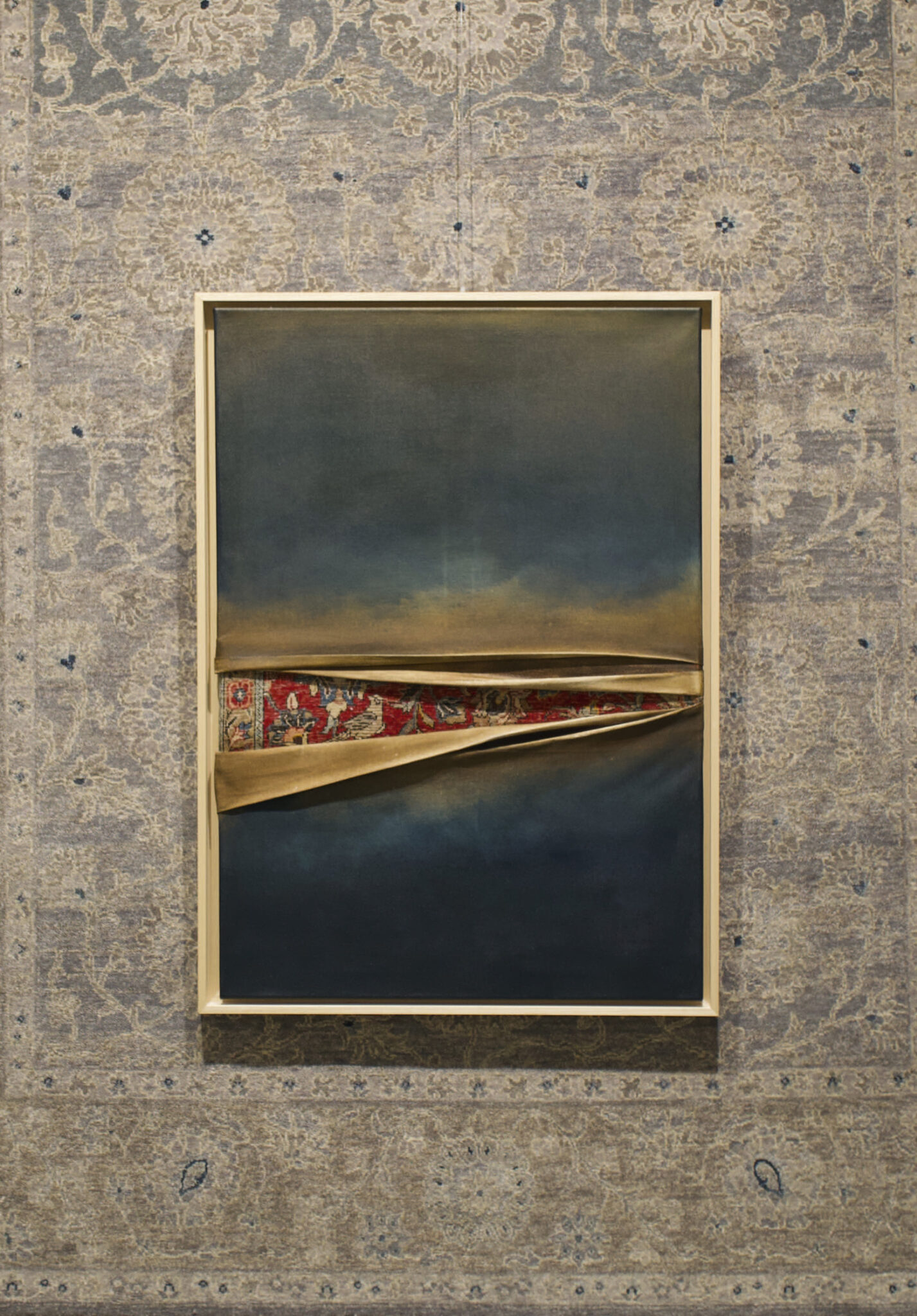
Mahmoud Saleh Mohammadi. Ma (間), 2024. Mixed media, carpet, gold leaf, and acrylic paint on canvas. 39 x 28 inches.
MSM: Italy always attracted me. I loved Italian artists, from Romanticism and classical art to pop singers from the sixties and seventies like Dalida and Peppino di Capri. Amedeo Modigliani blew my mind. I felt I had to live and study there in order to feel art as they did. That’s how I became Italian.
Image: What Western works or sacred spaces made the greatest impression on you?
MSM: During my first years in Italy, I was so fascinated by Milan that I didn’t want to travel anywhere else. The Brera Academy, the Pinacoteca—every corner enchanted me. Anselm Kiefer’s installation at Hangar Bicocca shocked me. Klimt’s museum in Vienna was breathtaking, as was Museo Novecento in Milan, where I first saw work by Modigliani and other Italian artists I admired.
Image: You have also been profoundly influenced by Japanese art and culture. How did you encounter this tradition, and what kinds of connections emerged for you?
MSM: Japanese culture was like a dream inside a dream. From Iran to Italy, I discovered Japan through Japanese communities—and through Akiko Kozato, a singer who opened this world for me. I learned about Zen, Japanese aesthetics, practices like kintsugi and ikebana, and ideas like wabi-sabi and ma, the silent empty space. During years when I felt disconnected from my homeland, I found a new space in Japanese culture. The woman who became my Japanese mother, Eriko, even gave me a Japanese name, Moritto, a few years ago. Maybe I will live in Japan someday.
Image: You now split your time between Belgium and Italy. Do you find that you think or create differently in different countries?
MSM: I normally split my time between Antwerp and Milan, but lately I’ve spent more time in Antwerp working on a big participatory art project at a Flemish castle, Hof d’Intere. Creating art is always a mix of place, culture, environment, and climate. Here in Belgium, my work has become more abstract, where in Italy it was more figurative or objective.
Image: Persian carpets seem to operate in a fluid way for you, neither quite canvas nor found object. How do you find these carpets, and what informs how you decide to use them?
MSM: For us Iranians, carpets are not just objects but a sacred part of family existence: We are born, live, and die on carpets. They belong in homes, mosques, sacred
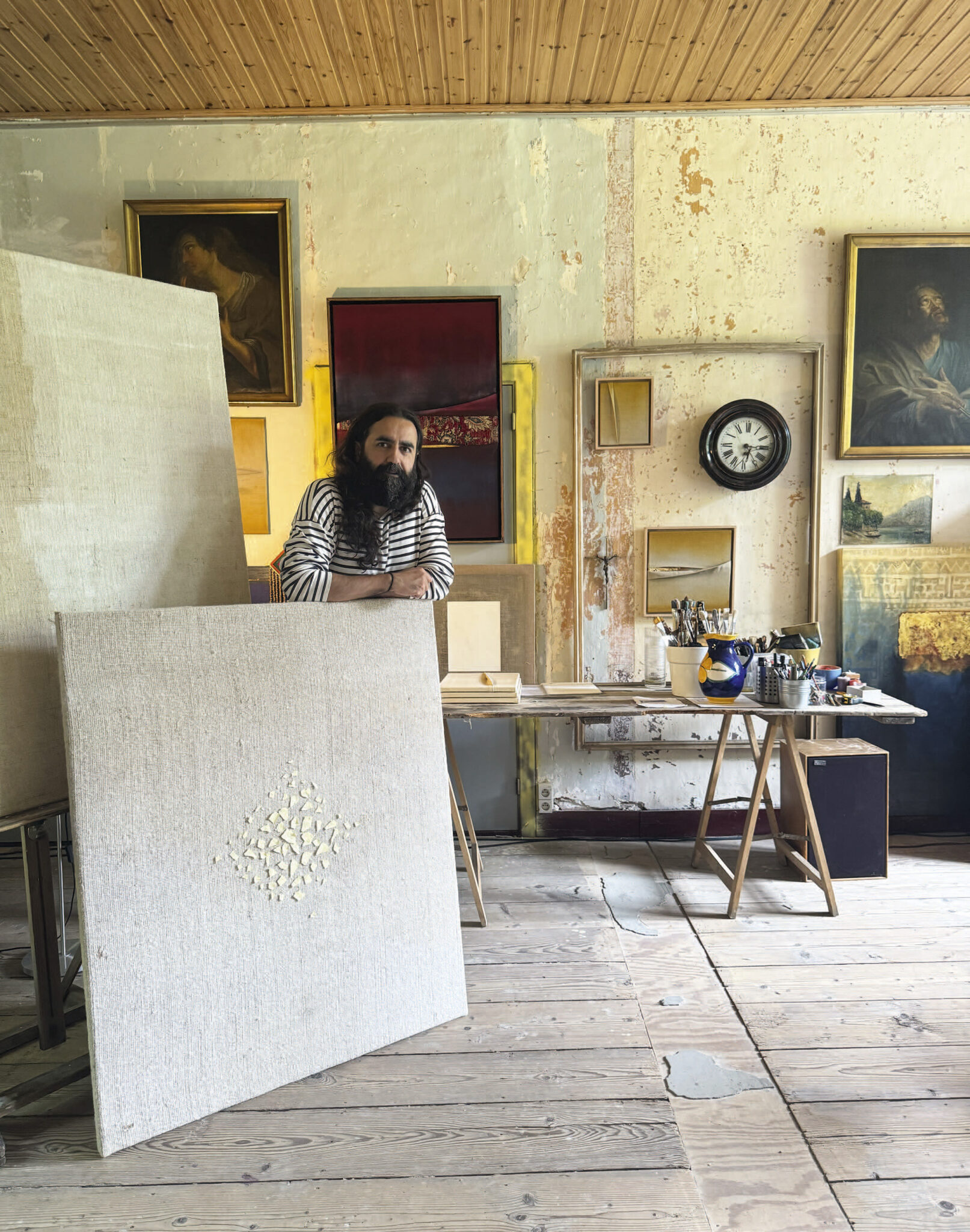
The artist in his studio, Kasteel Hof d’Intere, Wechelderzande, Belgium. Photo: Silvia Holscher.
spaces. Families often made them, including mine with silk carpets. When I came to the West and saw people walk on carpets with shoes, it shocked me. For Iranians, removing shoes and keeping carpets clean are acts of respect. For us, a carpet is like a chair, a place to sit and relax.
I started using carpets in installations to represent community, equality, and connection, and also integrating them with Italian or Chinese cultural objects.
Image: Given the minute level of craftsmanship in these carpets, are you ever fearful of making your own interventions in them? Would it be fair to call your works a form of collaboration with past hands?
MSM:. Absolutely. For me, it was very difficult to go beyond touching the carpet, because it felt like dishonoring my culture, my ancestors, my family—the daughters and mothers who spent months and years tying millions of knots, cutting their fingers.
I couldn’t allow myself to damage the carpets or add resins recklessly. So I always looked for ways to use other techniques, like Japanese folding, or to use carpets that were already damaged or old. In my work with carpets, I always remain loyal to those who created them.
Image: Your carpet compositions evoke modern painters who challenged the limita-tions of the canvas, from Lucio Fontana to Sam Gilliam. What do you hope viewers experience in front of these works?
MSM: I am honored to be mentioned with artists like Fontana and Gilliam. Both came from painting, and in these works I mean to challenge not only the limits of color and composition but also canvas and frame. The white frame is seen as so sacred that it’s a sin to touch it. The two-dimensionality of the canvas was another limit, so I pushed toward three-dimensionality, installations with carpets like hanging gardens. On the canvas, I try to show another layer inside, an opening to reveal another layer of my existence. The painting is a reflection of the artist becoming himself.
But Fontana’s aggressive cutting is not in my nature. Instead, I found folding to be a gentle, tai chi–like movement, opening dialogue without violence. Folding brings my culture, the sacred carpet, delicately into a new image.
Image: You often favor interventions in gold, which connects to various traditions, from Italian altarpieces to Japanese ceramics. Does this color have a deliberately spiritual dimension for you?
MSM: My use of gold started as I became more familiar with kintsugi—the art of repairing broken objects with golden lacquer. Aesthetically, I had admired gold in Italian frescoes, Iranian architecture, and elsewhere, but Japanese aesthetics showed me how to use it. For me, gold is more than spiritual; it has an ethical, human value. Used in art, it is also a form of respect and enhancement, a concept I adopted from kintsugi.
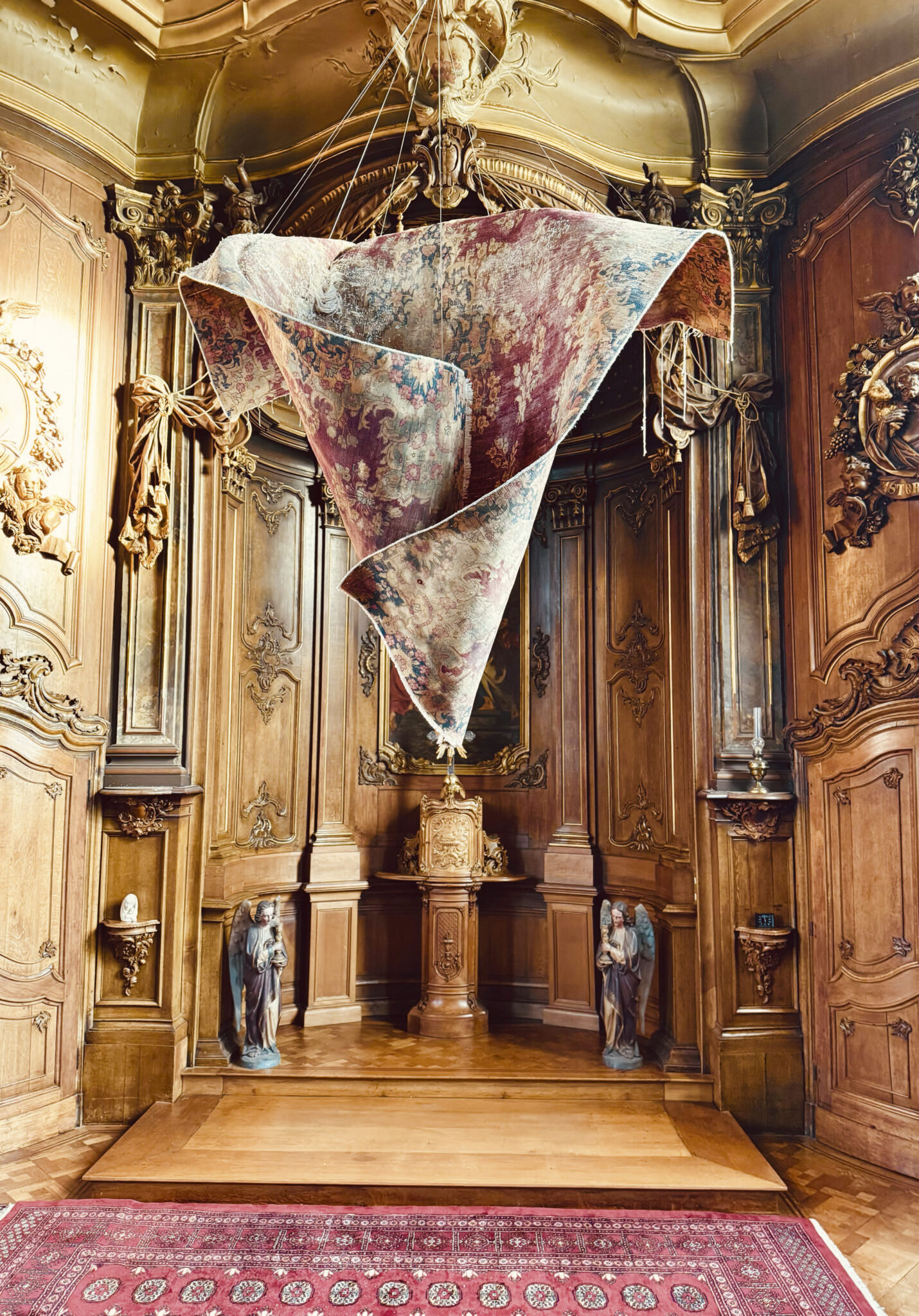
Mahmoud Saleh Mohammadi. Parallel Universe, 2025. Chapel of Hollands College, Leuven. Carpet: Ashtari Carpets. A co-creation with Parallax Metaforum, KU Leuven. Photo: Mau Chi.
Image: When you orchestrate performances, what feelings do you hope to conjure among those present? How do these works connect to your wider sense of what art could or might do in society?
MSM: That’s a beautiful and deep question. In Farsi, the word for God is Khodà. The root Khod (oneself) plus à (to return) sounds the same in Dutch. So Khodà means finding God inside yourself, turning back to oneself, or self-reflection. This is exactly what I aim to evoke in my performances. It’s not about me showing off as an artist, but about creating a space where participants can be fully present with themselves, even if only for a moment. This same concept extends to my installations and participatory social art projects. When we communicate clearly with ourselves, we can be clearer with society, with higher levels of existence, and even with God.