

I am interested in the way that a man looks at a given landscape and takes possession of it in his blood and brain. For this happens, I am certain, in the ordinary motion of life. None of us lives apart from the land entirely; such an isolation is unimaginable.
—N. Scott Momaday, The Man Made of Words
When everything else has gone from my brain—the president’s name, the state capitals, the neighborhoods where I lived, and then my own name and what it was on earth I sought, and then at length the faces of my friends, and finally the faces of my family—when all this has dissolved, what will be left, I believe, is topology: the dreaming memory of the land as it lay this way and that.
—Annie Dillard, An American Childhood
FOR THE FIRST FEW MONTHS following a traumatic head injury, it was as if everything in Rae Stern’s brain had dissolved. Her memories were not completely gone, as if deleted from a hard drive; this was not retrograde amnesia. But it was as though many of the details of her daily life had been misplaced, like a set of keys, or scrambled into a cryptic language with no decoder to be found. Her memory wasn’t gone, but it was not entirely where it had been. Each day felt like opening a neatly labeled file drawer only to find the contents rearranged. During her months of recovery, it was as if the grip of her own memory had become loosened where it once seemed to hold firm.
As she recovered, she began using daily strategies to help remember and regain cognitive functioning. But the sensation stuck with her of memory suddenly unfixed, memory not behaving the way she once believed it must, not like verified truth etched in stone and set in an immovable place. Memory, it turns out, wiggles and slips and resists settling. She continued to find herself curious about the ways her memory slides, slopes, and stiffens across time. She describes memory as dynamic and inconsistent, shaped as much by context and storytelling as by fact. “It’s fickle,” says Stern. “It’s more elusive, more precious. The injury really sharpened my understanding of fragility—not just in memory, but in knowledge, identity, and culture.”
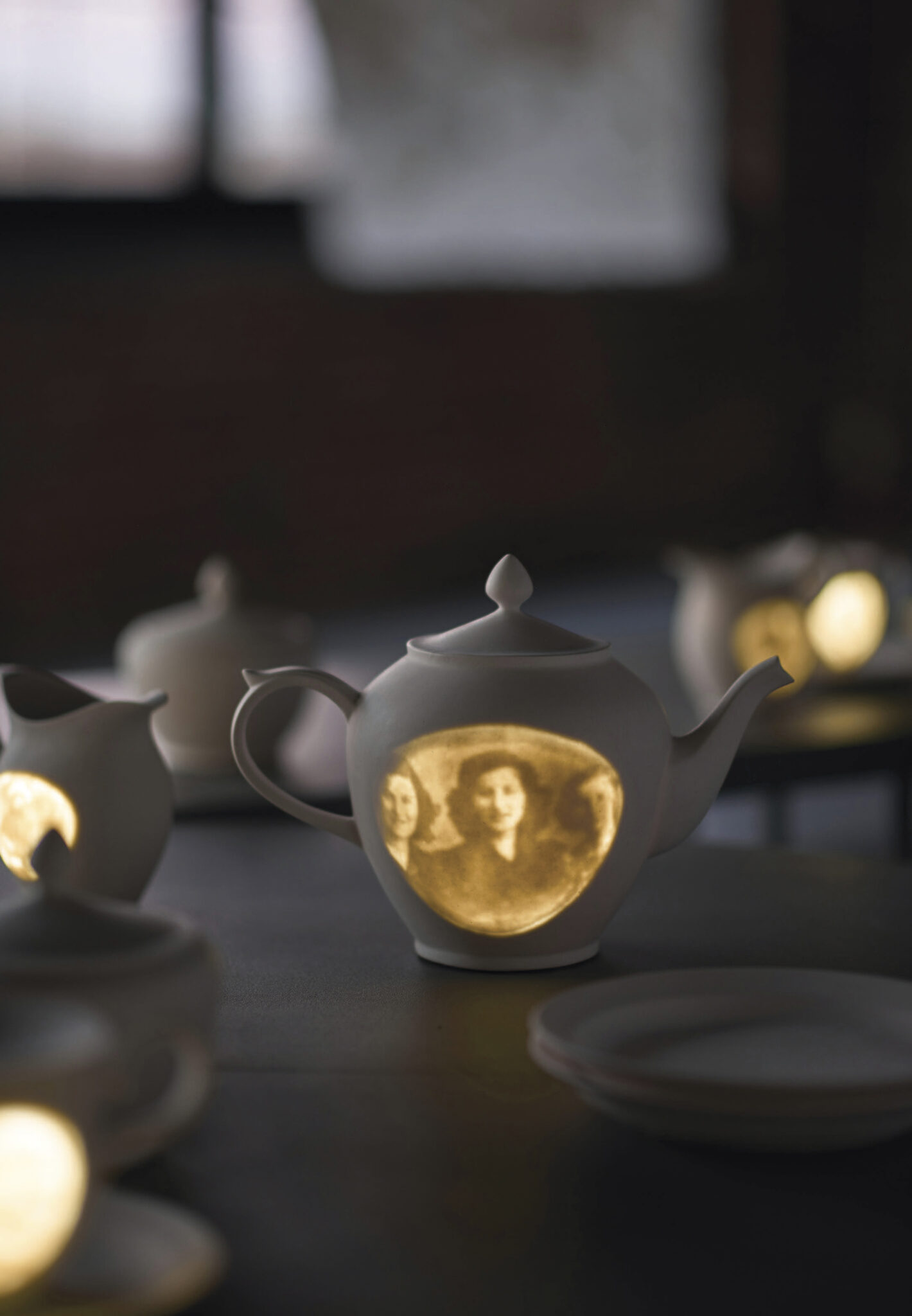
Rae Stern. Outside Time (installation detail), 2019. Based on a photo from the personal archive of Leah Elisha taken in Hungary, 1944. Photo: T. Maxwell Wagner.
The head injury had another effect on Stern. Prior to the accident, she had maintained her artistic pursuits on the side but mostly focused on her career in design and technology. During recovery, she found herself drawn back to painting with watercolor, which became essential in healing her sensory systems. She also returned to her love of photography, not only as an art form, but also as a strategy for memory recovery. She began to spend more time in a studio, focusing on rebuilding her skills. She knew then that she was emerging into a new season of life, one that would combine her experience, her skill as a designer, and her artistic vision into a focused studio practice.
“Unlike all of the previous years of my life,” Stern says, “I didn’t feel like I was supposed to be elsewhere. I’ve always had that feeling, in every job I had, in every educational program. But when I’m in the studio, that’s the place where I feel like, okay, I should be here.”
Today Stern’s work lives in the space between idea and material, between what’s imagined and what’s technically possible. Her creative practice is defined not just by the pursuit of form but by an insistence on questioning assumptions, pushing limits, and not accepting no as the final word. That insistence, she’s quick to point out, wasn’t always natural. It developed slowly, from the accumulation of small victories—projects completed, obstacles overcome, moments of doubt transformed into discoveries. The more she pursued difficult questions, the more she learned to trust that instinct: If something feels like it should be possible, then the challenge is not whether, but how.
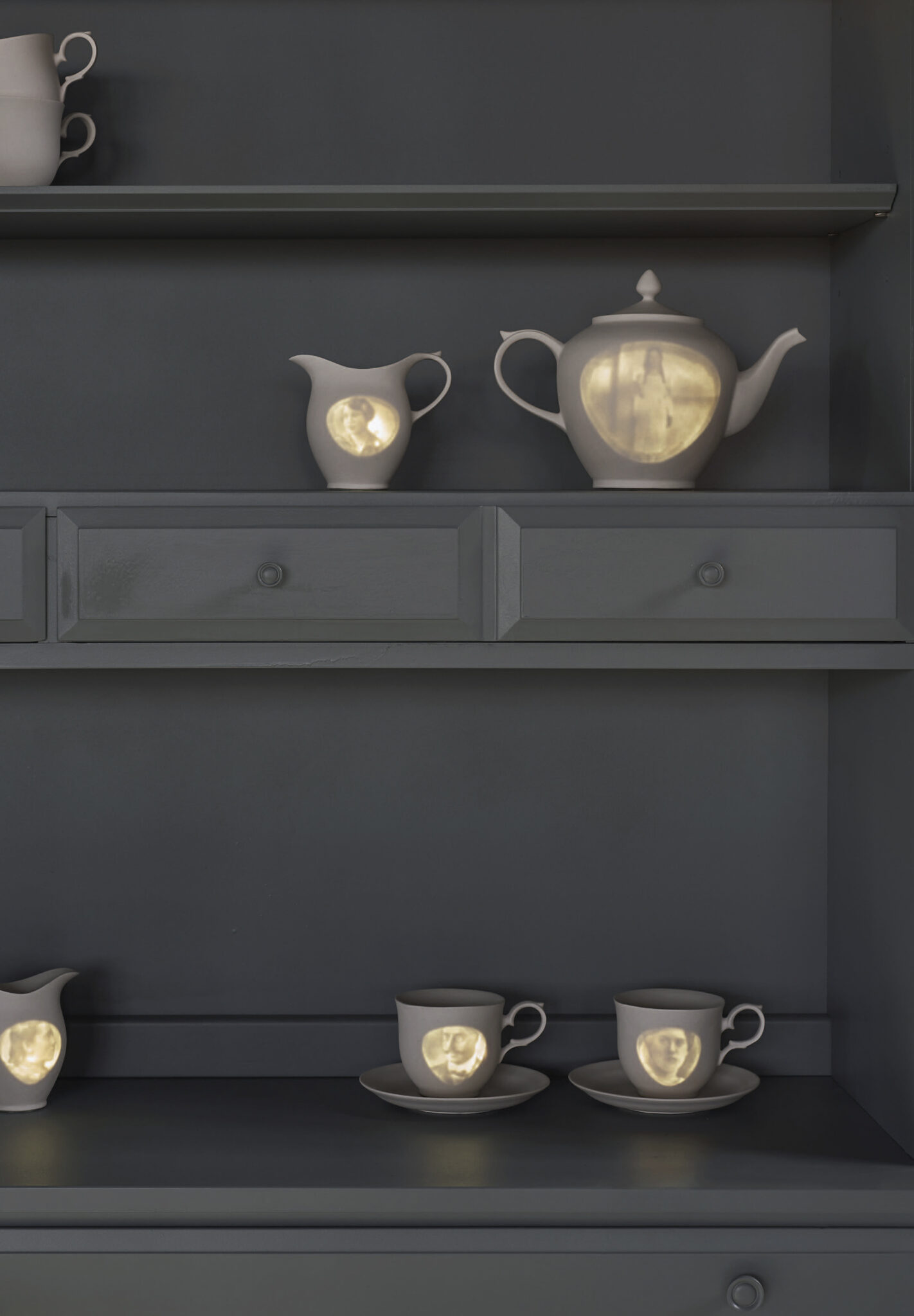
Rae Stern. Outside Time (installation detail), 2019. Slip-cast porcelain lithophanes, custom-designed digital components and LED lights, lithium-ion batteries, 3D-printed TPU, vintage furniture, acrylic paint. Based on photos from the personal archives of Jo Kamm and Marga Hirsch taken in Germany, 1890–1935. Photo: T. Maxwell Wagner.
Her openness to challenge is partly cultural. Born in Haifa, Stern was raised by an Israeli mother and an American father—both Jewish, yet shaped by vastly different cultures and temperaments. Stern learned early that truth is rarely singular. Growing up in Israel in a secular Jewish household, questioning authority was not only allowed but at times encouraged. Add to that a Jewish tradition of dialogue, argument, and willingness to consider multiple points of view, and you get an artist unafraid to push back and insist upon different ways of seeing conflict and coexistence. For Stern, disagreement isn’t inherently divisive, but rather an opportunity for deeper understanding.
Stern attended Tel Aviv University, where she studied psychology and communications, and went on to receive a master’s degree in design at the Bezalel Academy of Arts and Design in Jerusalem. She worked in the tech industry for a number of years and relocated to New York City, until the brain injury altered her path.
Following her recovery and the rediscovery of her artistic pursuits, Stern began to show her work and was accepted to a group exhibition in Kansas City, Missouri. While in town for the show’s opening in 2013, she began conversations with several local gallerists who were drawn to her work, and this led to a solo project as the 2019 visiting artist at the Belger Arts Center. During those years, as she reflected on her experience of memory loss, she came to consider the Holocaust in a new way. Among family artifacts and photographs, she was drawn to images of people whose stories and belongings were disrupted or destroyed during the Shoah.
For Stern, ideas are rarely separate from materiality and experimentation. Bringing together her background as a photographer and her new skills as a ceramicist, she began her residency with a practical question rather than an esoteric one: Can a photographic image be embedded in porcelain?
Stern researched porcelain translucency with Israeli ceramicist Aya Margulis and worked closely with the Belger staff and studio assistants to create porcelain sculptures that at first glance resemble dishware that was commonplace in many homes a century ago. But when one of these bowls or cups is touched by a human hand, a sensor is activated, the porcelain begins to glow, and a photographic image appears for a brief moment before fading away. While she was developing this novel concept—combining old-world objects with new-world technology—she was also building relationships with the Jewish community in the region and asking them to contribute family photos to the project. The result was In Fugue, a 2020 solo exhibition at Belger. Visitors were invited to walk among dozens of porcelain objects, touching them to illuminate the photographs, immersing themselves in the experience of memory appearing and fading, of history revealed then concealed again. For Stern, In Fugue was about exploring the relationship between memory and history not only as it relates to our shared past, but also as it pertains to our present moment. What does humanity risk when the slippage of memory becomes a tool for propaganda and political polarization?
Out of thin air. The white horse appears on the hill out of thin air.
Or: The horse appears out of the blue. We could simply say unexpectedly. But what does the added layer of language contribute?
And in Rae Stern’s latest exhibition, Afterimage, at the Museum of Art + Light in Manhattan, Kansas, what is the significance of the white horse that appears out of nowhere?
For Stern, there are always more layers—to reveal, to comprehend, to dig through, and to be possessed by. In Afterimage, her work offers a quiet meditation on humanity’s complex relationships to place, memory, and history. From the permanence of rock to the ephemera of paper, Afterimage is an encounter with our own assumptions, and an invitation to suspend our cynicism and knee-jerk reactions long enough to witness subtle shifts and gentle nudges that loosen our certainties long enough to elicit curiosity.
But what about that white horse? It doesn’t appear at first. In the exhibition gallery, Swifter Than Eagles is one of the first works to draw attention. A large translucent sheet of thick, pulp-pocked paper hangs from the ceiling, and the light passing through it reveals a black-and-white image of a large tree on a hillside. The image is an illusion: This is not a photograph; there is no pigment. Rather, Stern has developed a paper-making technique in which she sprays wet pulp in layers to form a large sheet, then surgically tweezes the pulp across the surface to place it where it belongs. The thinner the pulp, the more light passes through. The thicker the pulp, the less light. Once the pulp is set and dry, the sheet is suspended against backlighting to reveal the image.
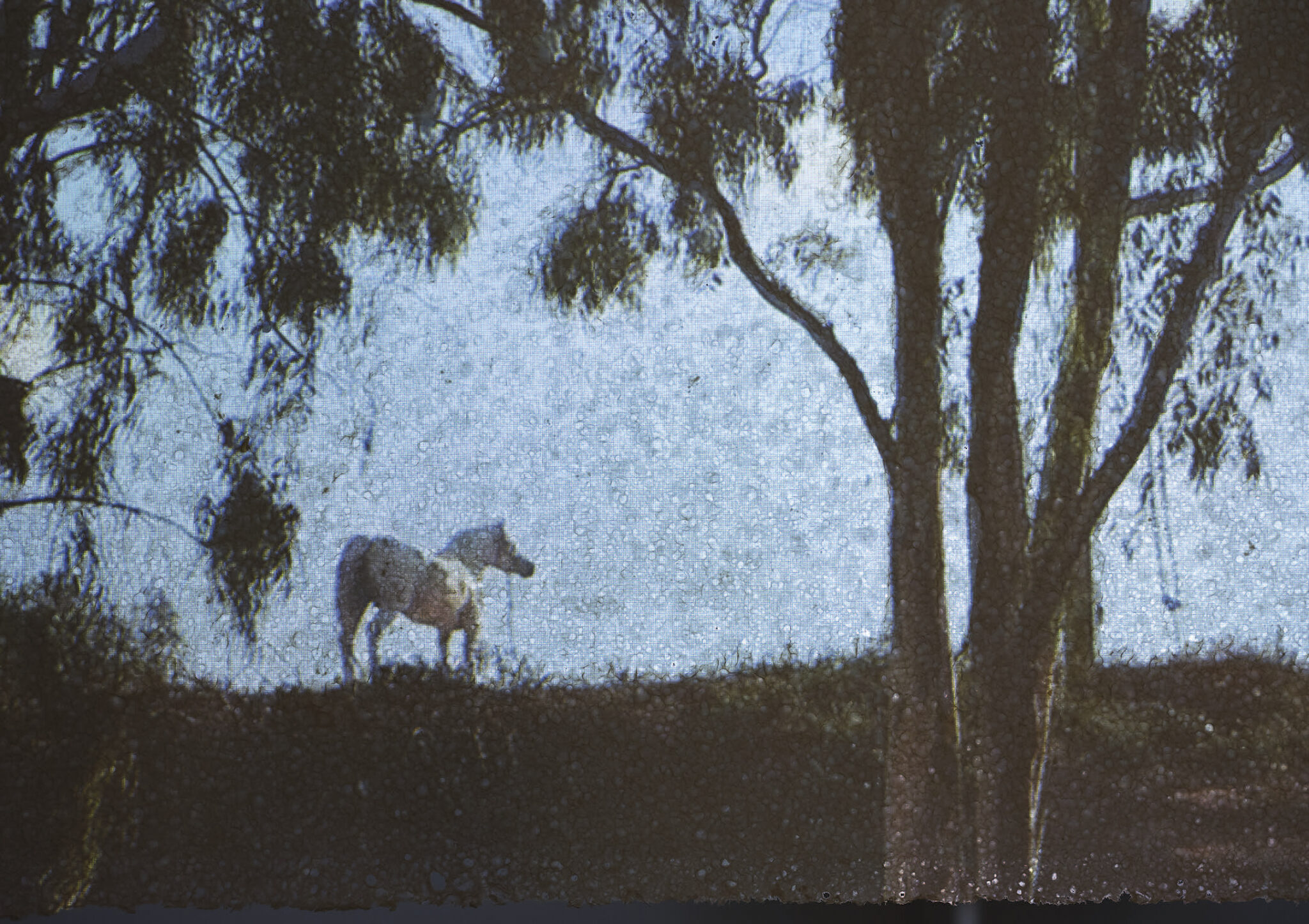
Rae Stern. Swifter Than Eagles (Installation detail), 2022–23. Handmade paper, cotton thread, single-channel silent video projection presented in an infinite loop. 721⁄2 x 413⁄4 inches. Photo: T. Maxwell Wagner.
In Swifter Than Eagles a tree appears, formed by Stern’s patient layering of the pulp. Here in the gallery, the materiality of the large sheet of paper paired with the image of the tree is enough to catch the viewer’s attention. But then, slowly and quietly, the black-and-white still image gives way to color and movement. A projector behind the large sheet reveals a brief scene on the hilltop. A white horse appears. It is prancing. No, it is pacing. It begins to run down the hill. No, it is tethered. It struggles against the rope. What had been a still scene is now activated by the motion of the horse, the sway of the trees, and the questions that arise for the viewer.
Afterimage is the culmination of Stern’s two-year residency as the inaugural visiting artist at the Englewood Arts Center in Independence, Missouri. There she was invited to create a body of work in response to material from the archives at the Truman Library. Her research led her to the dossier of Charles F. Knox, an American diplomat whose journals, notes, and photographs from his mission to Israel coincided with the state’s founding. Intrigued by Knox’s perspective as a visitor to her homeland long before her birth, Stern returned to Israel to attempt to see familiar places anew, through the eyes of an American diplomat of seventy-five years earlier. Afterimage is the result of these investigations—of Stern’s giving herself permission to see the same place from different angles and perspectives. This experience informs her insistence that our polarized and hyper-politicized views of the world often prevent us from seeing the layers and complexities that color and deepen our shared reality.
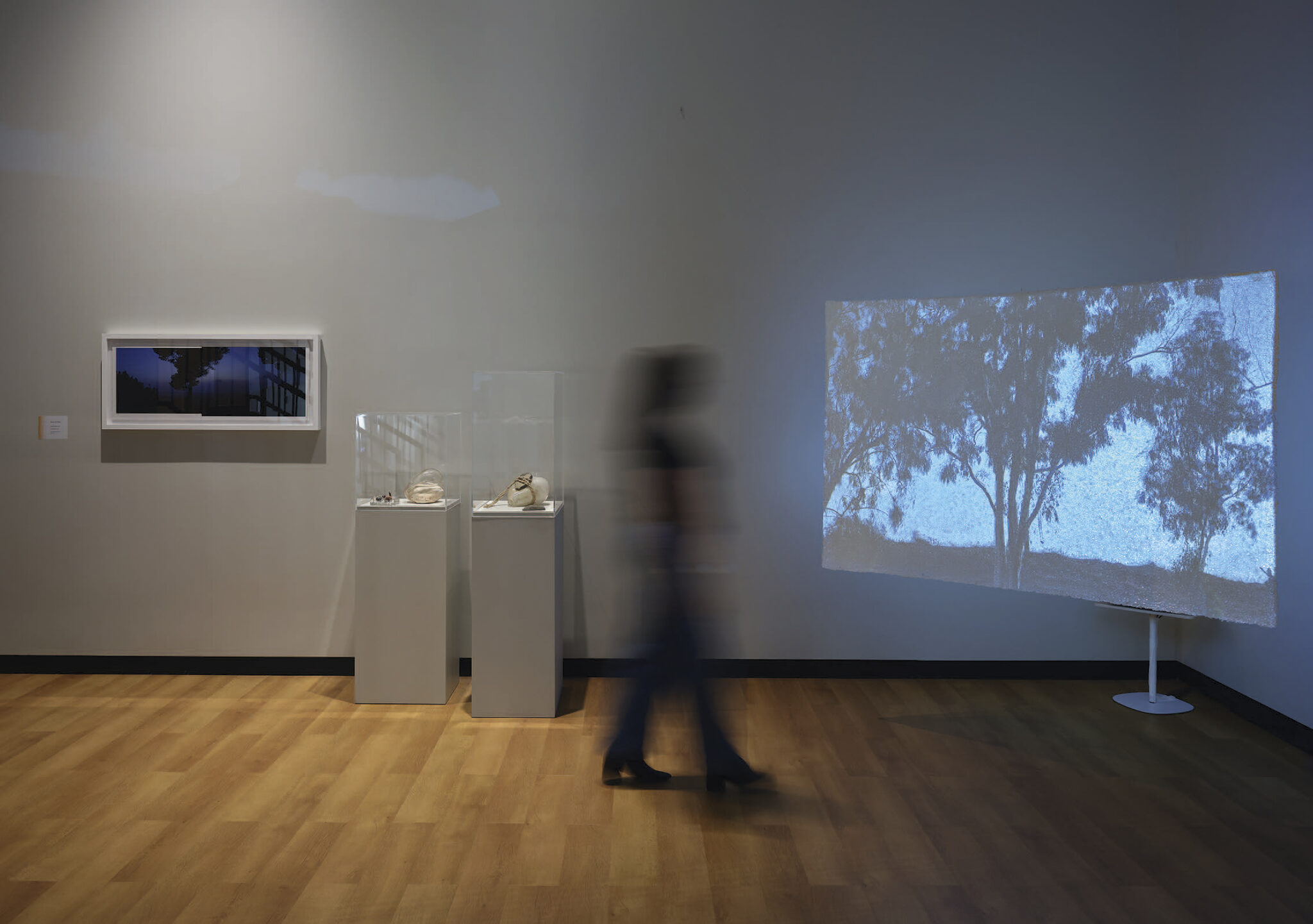
Rae Stern.Swifter Than Eagles, 2022–23. Handmade paper, cotton thread, single-channel silent video projection presented in an infinite loop. 721⁄2 x 413⁄4 inches. Installation view at MoA+L, Manhattan, Kansas. Photo: T. Maxwell Wagner.
On one of her returns home to Israel, Stern was driving to the city of Acre to visit a site Knox had photographed. Acre has a long history of shared community and coexistence among different cultures and religions. On her way there, Stern glanced out her car window and saw a white horse on top of a hill. Entranced, she pulled over and set up her camera. Here on this hilltop, in a land once again on the brink of being torn apart by conflict, the moment felt full of meaning. The white horse holds significance for each of the Abrahamic faiths that consider this land sacred, but it means something different for each. “The white horse stands not as a singular symbol,” says Stern, “but as a prism through which memory, prophecy, and politics refract.”
Alongside the works on illuminated paper, Afterimage also includes a series titled Attempts at Coexistence, small sculptures formed from experiments in fusing glass and rock. During her time at Englewood, Stern worked with a team of glassblowers to see whether glass and rock could somehow be fused together. The glassblowers were skeptical; their experience told them that glass and rock are incompatible. Stern carried into the studio a pile of rocks from Israel, along with a hopeful insistence that these experiments were worthy of time and energy.
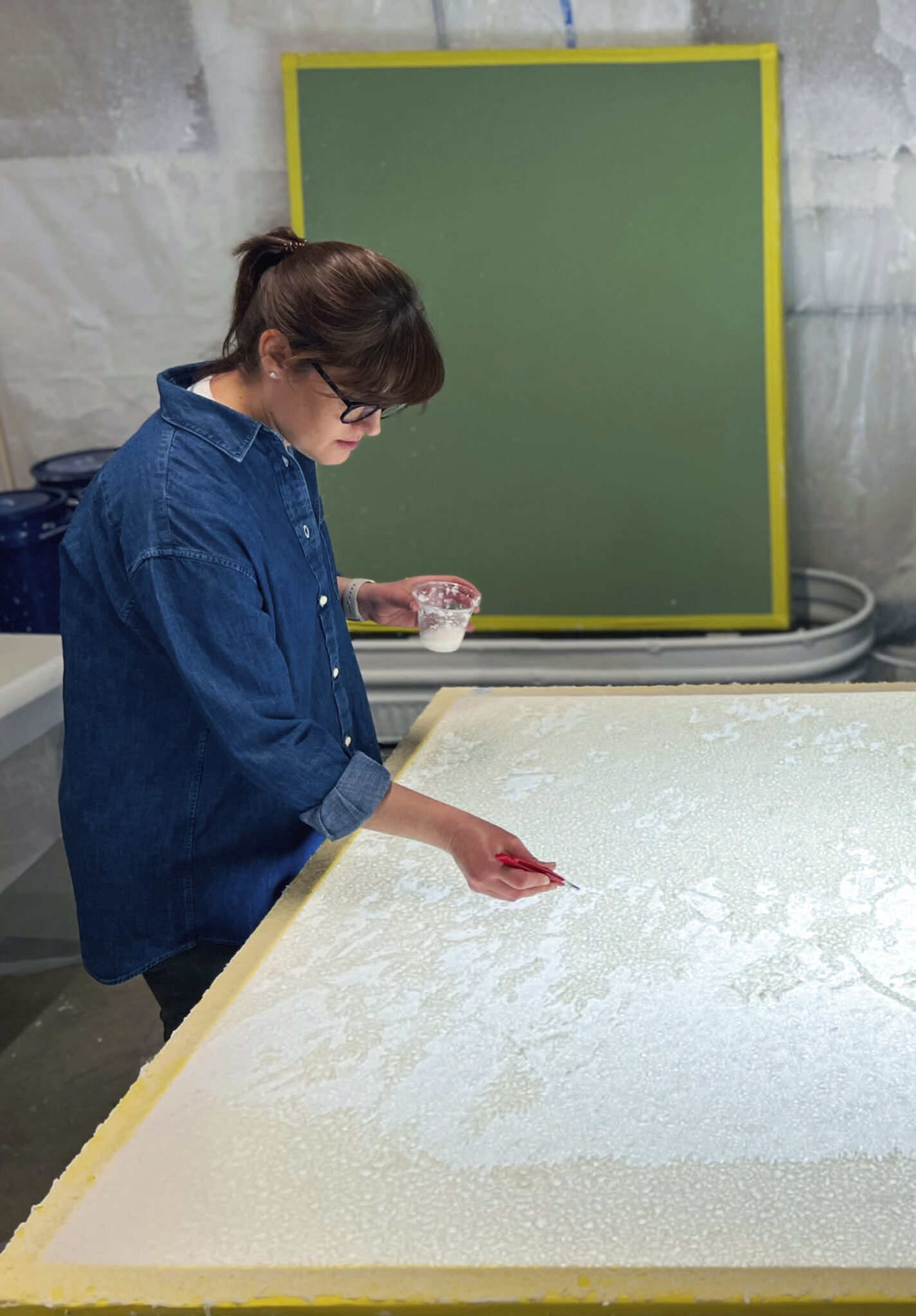
Photo: Emily Martinez
Some of the Attempts are small stones enmeshed within clear glass, as if slowly sinking into water. Others are rocks perched on top of glass, the glass refusing to allow the rock to permeate the surface. Others are larger rocks pressed against blown glass. Some are rock and glass bound together with rope or wire, suggesting that the only thing keeping them together is external force. In some of the attempts, the rock cracked; in others, the glass broke. Each one is an opportunity to see what happens when the artist insists on trying once again in a new way—embracing the lessons of previous attempts while maintaining a dogged insistence to not quit just yet. Each attempt captures a relational moment full of tension and possibility.
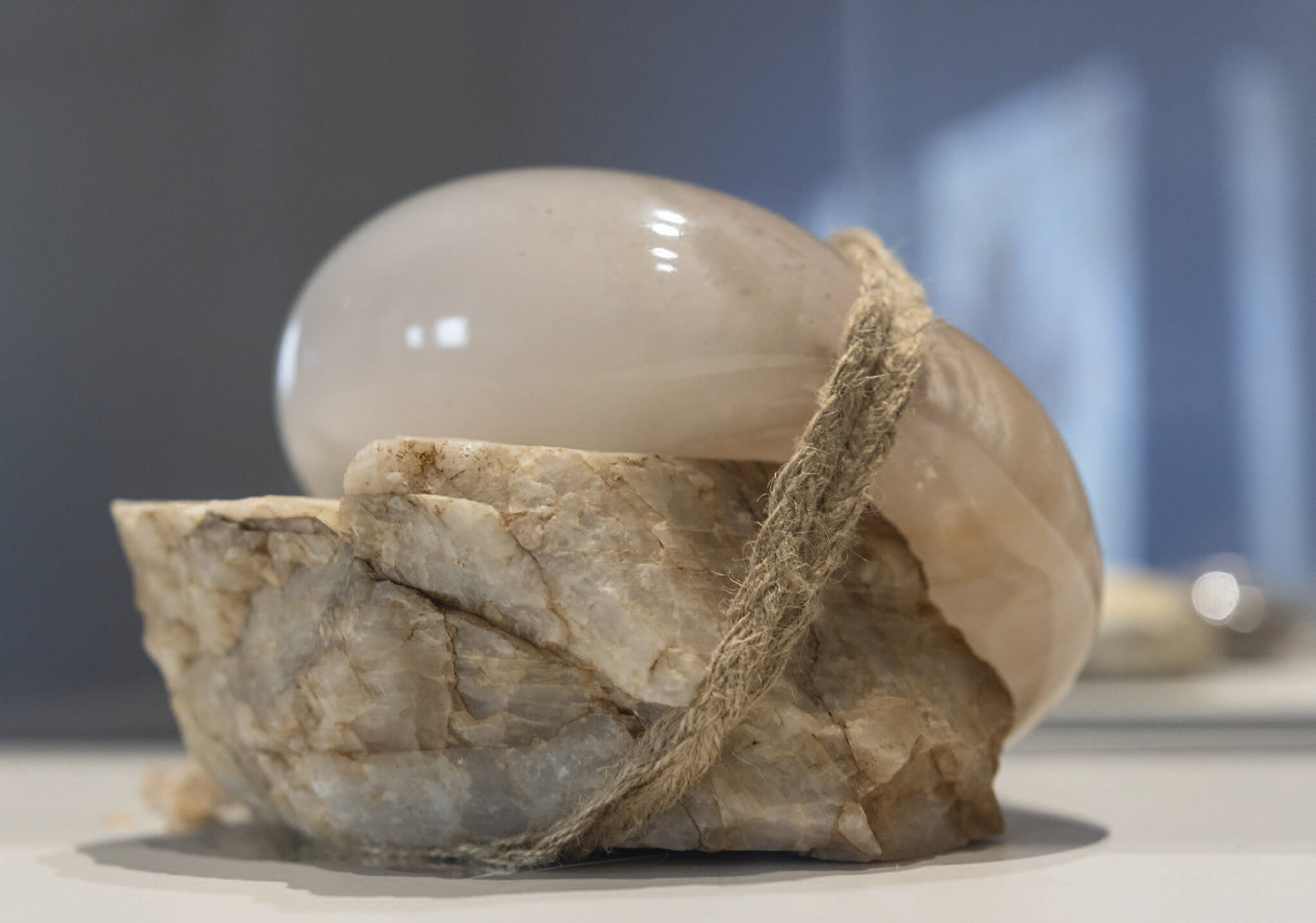
Rae Stern. Attempts at Coexistence (installation detail), 2024–25. Glass, rocks from Israel, rope, copper, wood, nails. Created at Englewood Arts with Swede (Phillip Hickok), Kevin Miller, Payton Koranek, Cole Kennedy, and Bill McLeod. Photos: Noollee LLC.
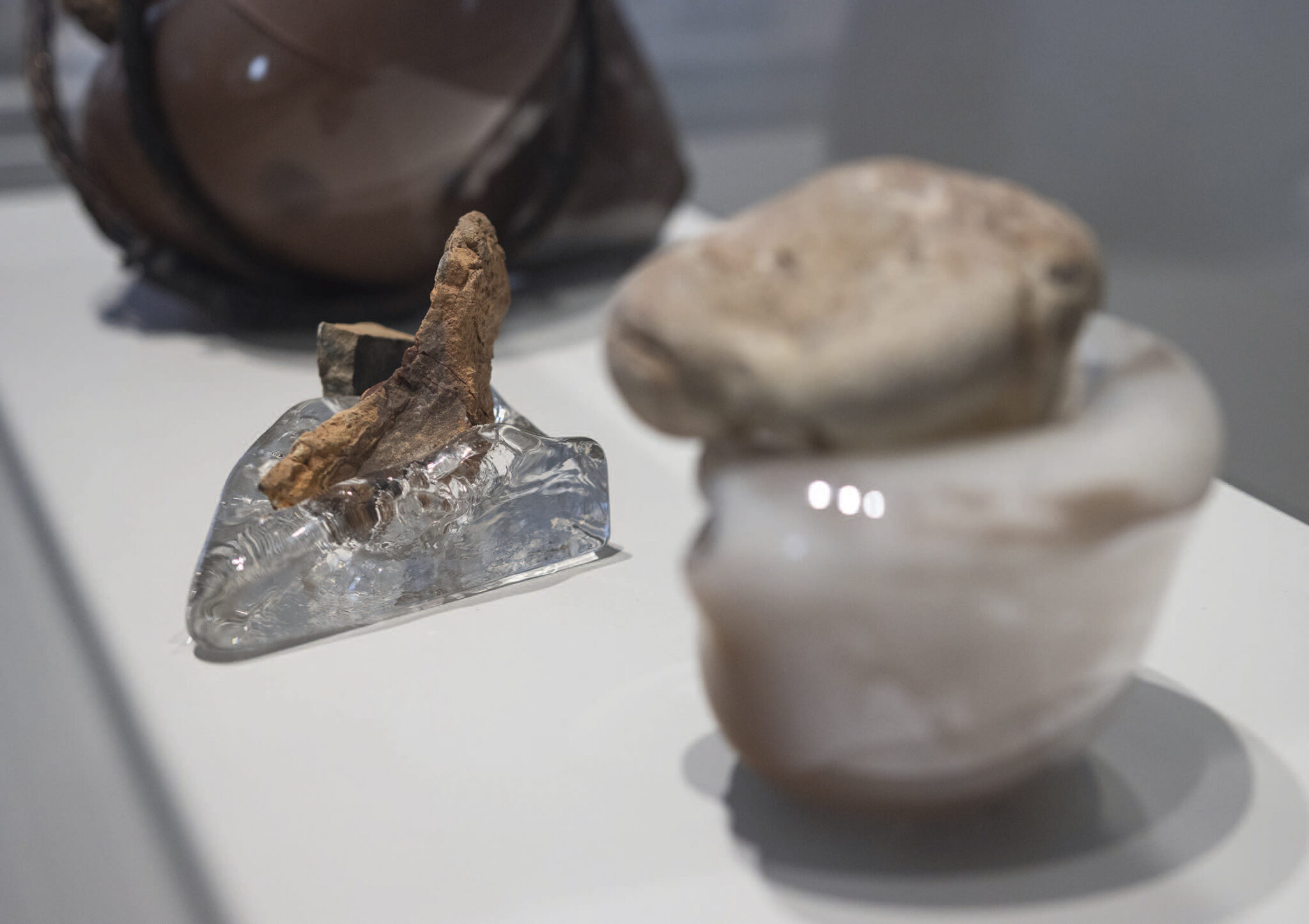
Rae Stern. Attempts at Coexistence (installation detail), 2024–25. Glass, rocks from Israel, rope, copper, wood, nails. Created at Englewood Arts with Swede (Phillip Hickok), Kevin Miller, Payton Koranek, Cole Kennedy, and Bill McLeod. Photos: Noollee LLC.
Stern’s creative practice is defined not just by the pursuit of new forms but by an insistence on questioning assumptions and pushing limits—an insistence partly shaped by having to reckon with the fragility of her own brain. Ultimately, Stern’s art is an argument for nuance and care, for relational thinking, and for the refusal to simplify the world into what’s merely practical or provable.
Stern offers something rare in our moment: not easy answers or platitudes, but a rigorous and poetic way of being with the questions. Her work in Afterimage resists the puritanical binaries that dominate contemporary discourse. The work itself is a quiet criticism of our cultural moment in which media platforms reward extremism and moral certainty, while silencing slower, quiet, curious perspectives. Her work gently yet clearly pushes against that tide. Our shared images—like the white horse—might carry different meanings across cultures and religions, yet the reality of such an image’s universal, prismatic presence is worthy of our pause and wonder—wonder over the mere fact that it appears at all, as if out of thin air.
Andrew Johnson is a writer and multimedia artist based in Kansas City and author of The Thread and On Earth as It Is. His essays and poems have appeared in The Sun, Commonweal, Guernica, Crazyhorse, and elsewhere. He has held residencies at Vermont Studio Center and Charlotte Street Foundation. www.andrewmichaeljohnson.com