

Eileen Ryan explores scientific, spiritual, and ecological issues through an experimental interdisciplinary practice informed by research and playful speculation. Her installations, paintings, and performances have been exhibited across New England at artistic and scientific institutions, as well as in Ireland, Japan, and Portugal.
Image: How has Catholicism, or its echoes, found its way into your work?
ER: My mom is culturally Irish Catholic, and my dad I would describe as iconoclastic agnostic. As a child in church, I often found myself dazing off and looking at the scenes in the stained-glass windows, making stories up of my own. The church had so many little doors, cubbies, hideaways, and altars, I couldn’t help but to imagine what sort of secrets and magic lay within these sacred spaces.
I also remember listening to my dad and his mother argue in circles about the legitimacy of angels and demons. My mom would sit there irritated, allergic from the cigarette smoke, and occasionally chime in, “You’re both saying the same thing in different ways.”
This is a longer way of saying, I think the stories of miracles, sacraments, and relics have found their way into my work. The ritual way I make my art begins in nature, and my observational practice is probably my main path toward spiritual health.
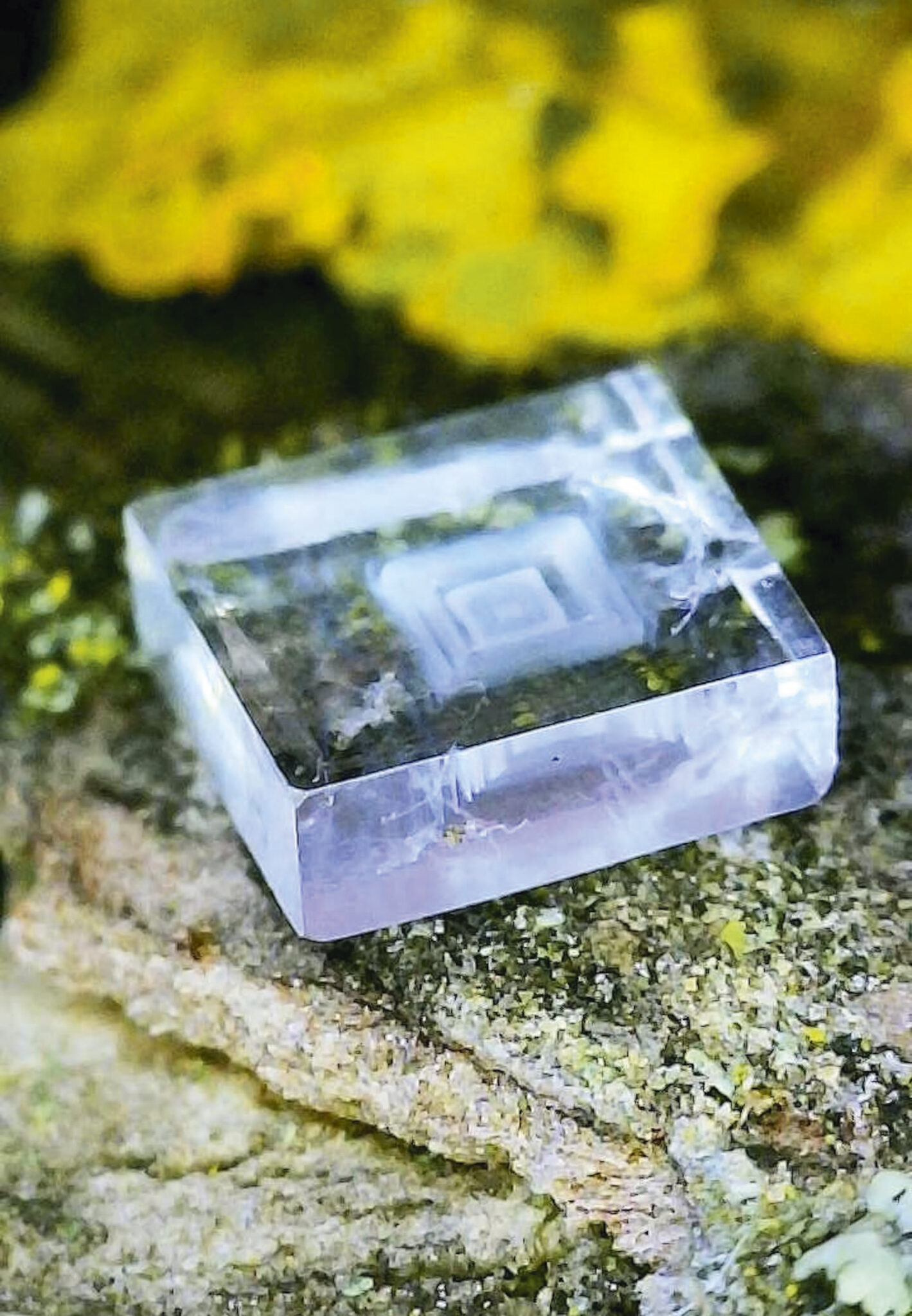
Eileen Ryan. Spiritual Microbiome: Tomb for a Microbe? 2024. Photo of Dead Sea crystal. 36 x 24 inches.
Image: There is a sacramental quality to many of the objects that you make. Is there a moment when you begin to sense a presence or power in them?
ER: A lot of the work I am doing is a practice of recognizing that I am connected to everything around me. When I am deeper into this process, the patterns begin to develop, and I can sense a power of realization or truth, like looking up at the stars and knowing you are nothing and everything all at once.
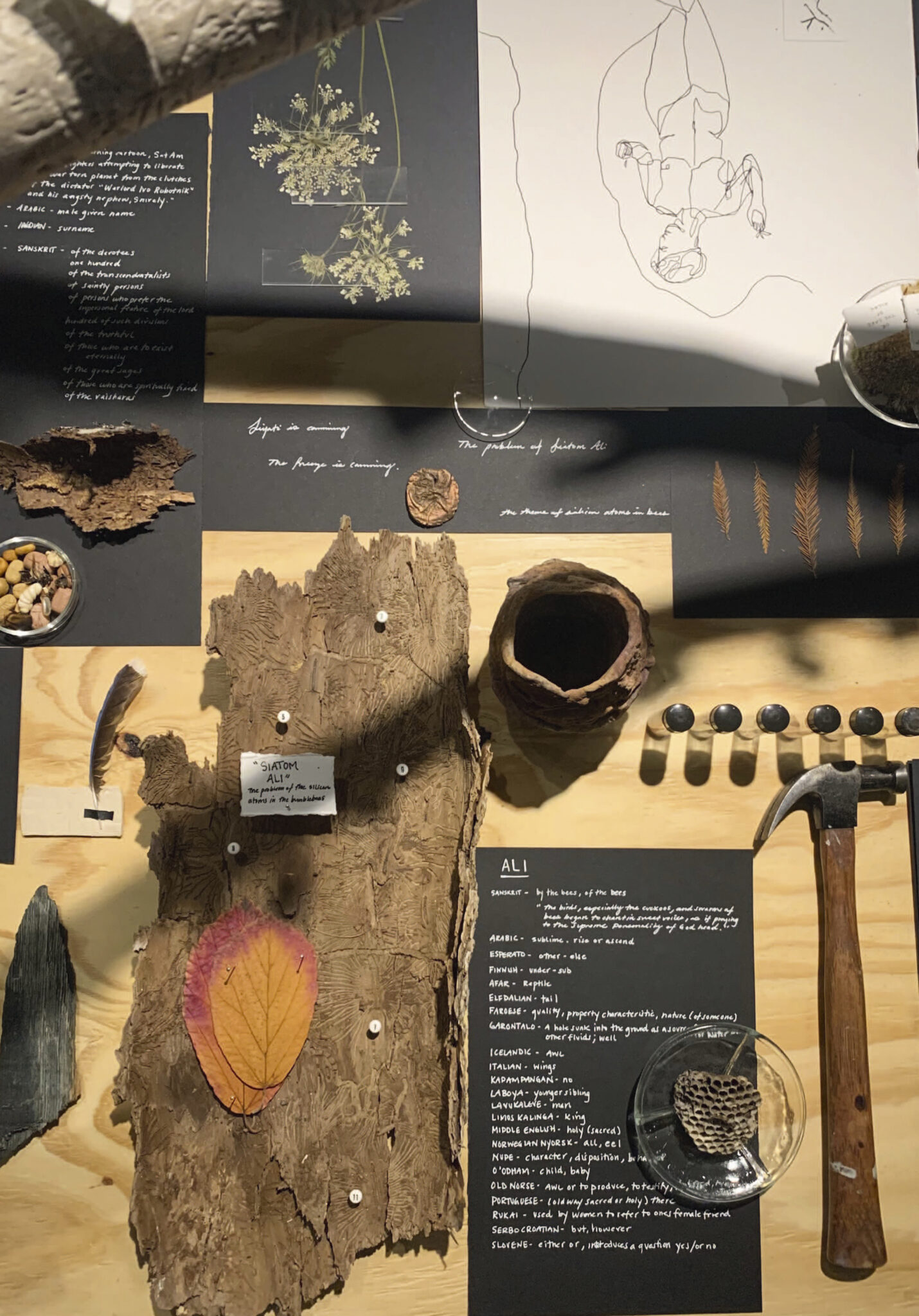
Eileen Ryan. Codex: The Limit Has Been Taken, 2026. Installation. Boston, Massachusetts.
Image: Many objects you conjure are, in a sense, co-creations with other species. Where does intention begin and end in these collaborations?
ER: I am currently collaborating with a few non-human species. Codex is a project in which I have speculatively translated beetle galleries (the marks beetles make in trees) using neural machine translation. The result is a collaboration between two opposing forces, nature and technology. As I hovered my phone over the beetle tracings with the translator, the first message I received was “The limit has been taken.” This multi-year project has spanned multiple countries, and the translations I’ve received have grown and adapted as the program learns more. Beetles are around 327 million years old; humans are thought to be 5 to 7 million years old. What kind of knowledge does a creature that has roamed this earth for so long possess? Could the answers lie in the patterns they create?
Neural machine translation is trained on every language ever recorded on the internet, and it works by creating mathematical markers and cross-referencing a text with every language and then stringing together a phrase or sentence. These messages are often created using multiple languages at once. When I see these marks in trees I wonder, could beetles be the oldest scribes on earth? It’s hard to remember that we humans are part of nature, but even more difficult to remember that the computer is also from the earth—it’s just highly processed and also intellectually a part of us as human beings.
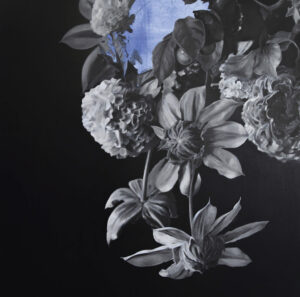
In Spiritual Microbiome [see front cover] I have inoculated a series of Petri dishes containing a sheep’s blood agar medium with holy water from the Vatican. By observing what grows from the water congregants use to cleanse and bless themselves, we can speculate that the microbes from their skin enter the water, creating a unique microbiotic bath of people practicing the same faith; instead of the individual, the unique signature of the flock emerges. Do microbes function differently in sacred water? Is there such a thing as secular water? Do practitioners share parts of their microbial signature with one another? Is there a sacred microbiome?
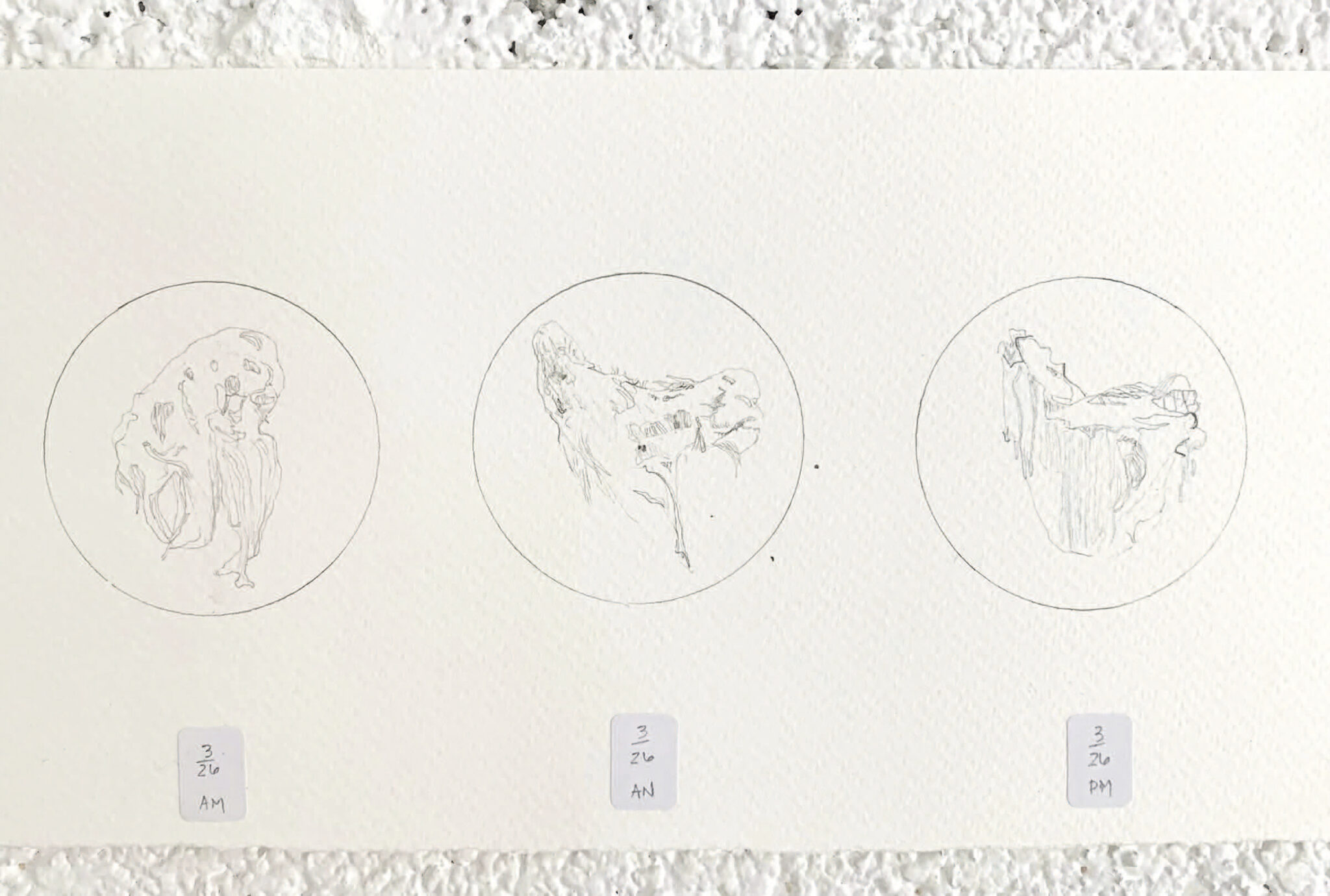
Eileen Ryan. Nineteen Days, 2019. Graphite on paper, drawings of DNA samples. 13 x 6 inches.
Image: Do other species make art? Or does this kind of categorization obscure more than it reveals?
ER: These are my favorite kinds of questions, because there is so much room for theorizing and speculating. There are limitations to what we can understand about other species. Perhaps the way a colony of orange, black, and green lichens grows on a rock is art that is meant for other lichens, or maybe for the rocks, or the sea that comes up to visit during high tide. Or maybe it is just caused by cellular memory and the texture of the rock combined with the direction of sun and wind. Could that be a collaboration?
Everything we know is being filtered through a human perspective. I think many people believe the sunset was painted for them, but what I am interested in right now is trying to speculate about perspectives outside the human.
Image: You set up a lot of your artistic investigations as research problems. Has that always been the case?
ER: I don’t think I always called it art, but I always loved to experiment. I used to paint a lot more at the beginning of my career. As a way to get my head clear, to find a direction or be more playful, I would do experiments in my studio, on the side, often inspired by a question or line of questioning. Eventually these experiments became my main focus, and now I use drawing or painting to help express these concepts artistically.
Image: What are the most unexpected responses you’ve had to your work?
ER: I’ve been surprised that people in seemingly opposite fields actually relate to it, which confirms for me there are at least some things we share in common, no matter our background. As someone who has difficulty being my authentic self in social situations, when I make art, I find I am able to relate with others in a deeper way, even if it’s in the discomfort of the unknown. An invisible barrier is lowered.
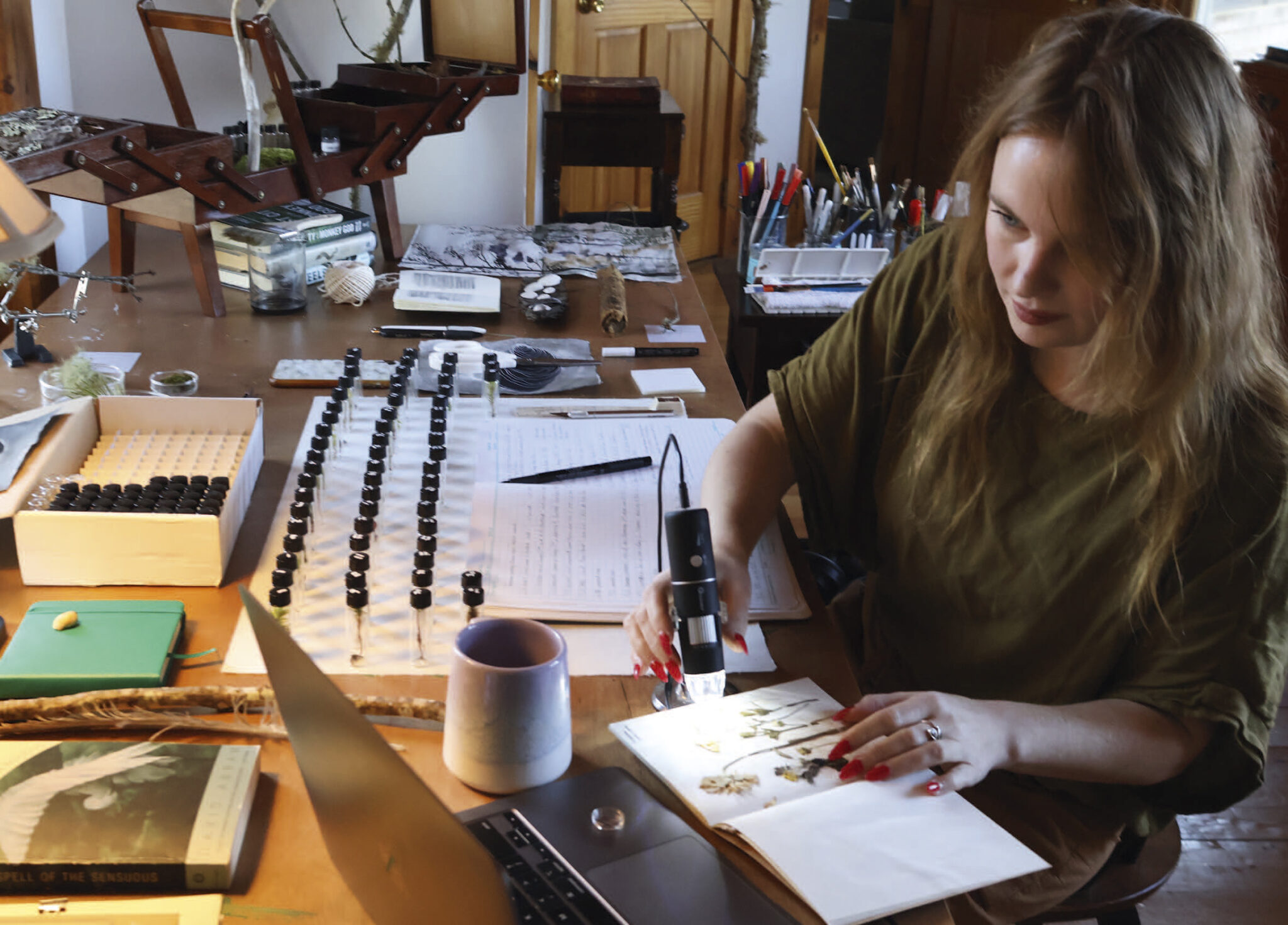
Eileen Ryan in her studio. Photo: Marsha Dunn.
Image: In some of your recent work, your inquiries have felt more explicitly personal. Is that a conscious turn for you, and did it bring any new worries or risks?
ER: Art is a way for me to work through challenging ideas, including thoughts I am struggling with related to myself. When I am creating something new and it isn’t clicking, sometimes I need to look inside and connect to whatever is blocking that flow of ideas, to get back to feeling something real. A lot of my recent smaller projects are deeply personal. For example, Nineteen Days was a study in identity. For nineteen days during a depressive episode triggered by isolation and loss, I recorded my physical and emotional state three times a day with a DNA extraction and corresponding mood log. After taking the DNA samples, I would draw what would float up in the vials. I saw that the DNA always remains the same, but our emotional state is changing moment to moment every day. Through this small effort, I was able to look in at myself as an outsider, even if just for the duration of making the drawing.
There is always risk in being vulnerable. I am always a little nervous the artwork will just be a confirmation that I am other, but it has done the opposite. It has informed my search for connection.
Image: Where do you see your work heading in the future?
ER: I have been really into copper lately. We will see where copper leads me.