


Karen Russell. The Antidote: A Novel. Knopf, 2025.
IT IS NOWHERE YOU CHOSE TO BE, yet here you are.”
The Antidote, Karen Russell’s recent Dust Bowl–era novel, begins with a visceral memory. A little boy named Harp is trapped in a pen full of wild jackrabbits that are being slaughtered to control their population. “Terror of cudgels, terror of ax handles and hammers, terror of being trampled.” Then, Harp is asked to do what he never wanted or asked to do. “‘Here,’ says Papa. ‘One is still living. You cannot be softhearted, Harp.’ Your father puts the club in your hands. And after that, you are always afraid.”
The thing about this memory is that Harp does not remember it. This is the spell of Russell’s novel, through which forgotten memories run as forcefully as a rising river. The plot hinges on a magical-real device: Members of this Nebraska community deposit their memories in a vault that is also a person, the Prairie Witch, whose body is their bank. Harp’s memory of the jackrabbit drive is one of many lifted from his mind for safekeeping on the boy’s behalf, then deposited in the mind of the witch as in a safety deposit box. The fact of these memory deposits is presented as a given, an ordinary service offered to ordinary folks, seemingly beneficial and acceptable to all. Russell has conjured an America in which forgetting is a service—possible, preferable, and good. It is a gift you might give your children on a special day: the power to forget where you have been and what you have done.
The Antidote explicitly names a whole host of our country’s bitter memories: the Great Depression and Dust Bowl, residential schools, homes for unwed 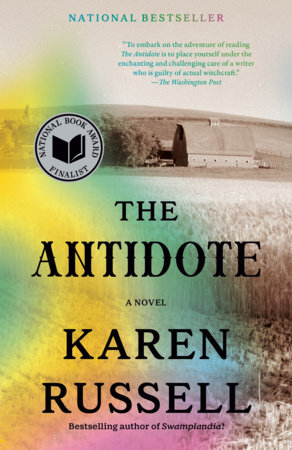 mothers,religious persecution, natural disasters, broken treaties, reservations, shabby treatment of immigrants, domestic violence, homicide, political corruption. The novel is epic in scope, dredging up a terrible volume of America’s scum and offering it to the light of day. Writing toward difficult things with rigor and whimsy has always been Russell’s particular magic.
She is also celebrated for her unusual voice, her willingness to engage the supernatural, and the sense of gravity she gives to outlandish settings. In 2012, her first novel, Swamplandia!, a magical-realism-laced coming-of-age story set in the Everglades, where Russell grew up, was a Pulitzer finalist. She did not publish another novel until last spring, just as a chorus of voices were suddenly talking about the Smoot-Hawley Tariff Act of 1930 as if it were a household name, drawing everyone’s minds back to the era she had zeroed in on.
Walking into The Antidote, I was thinking about The Grapes of Wrath as a migration story—a book about displacement, change, and instability. Steinbeck’s novel was my formative literary Dust Bowl reference, and this sentence still resonates in my mind: “In the souls of the people the grapes of wrath are filling and growing heavy, growing heavy for the vintage.” Opening Russell’s novel, I felt hesitant to return to this era, with its sense of rot, that painful ferment. But The Antidote takes a different tack, staying rooted in one place, zooming in on one strangely sanctified farm and farmer and replacing the heaviness of those grapes with a surprising buoyancy. Russell’s novel does not even consider the plight of the Dust Bowl’s migrants beyond acknowledging the need for many to leave; it’s as if she considers The Grapes of Wrath more than enough to hold that history. Instead of retreading Steinbeck’s path, Russell follows her nose to a place with less grit and more magic.
Still, revisiting such a well-trodden period, one grasps for references. At first glance, The Antidote appears to be more The Wizard of Oz than The Grapes of Wrath (with multiple witches, an earnest teen girl, and a sentient scarecrow), though in interviews Russell indicates that this wasn’t her intention, more of a happy accident. No, Russell is not trying to conjure Oz, but Uz, the biblical home of Job. She makes this explicit, a thesis rather than an easter egg; Uz is the name of the fictional Nebraska town where the story unfolds. But Russell’s Job proxy, Polish farmer Harp Oletsky, does not find himself in direct conversation with God in the wake of unfathomable loss. Instead, his is the only farm in town that hasn’t been ravaged by drought, a happenstance as confounding as the tragedies Job experiences. And yet God is silent. Russell’s novel seems to ask: Can a blessing disrupt a life as much as a curse? More so? And what must one do with that holy disruption? The path Russell sets for Harp through those questions surprised and delighted me.
The novel is light-footed and dynamic, changing perspective in each chapter, darting among human characters and even a cat and scarecrow. We meet Harp’s niece Asphodel, who, in spite of the horrors unfolding around her, is mostly preoccupied by young love and a fierce devotion to her school’s unraveling women’s basketball team. We also meet a Resettlement Administration photographer named Cleo, who finds herself in possession of a magical camera that photographs the past and future in addition to the present—passages that offer forceful meditations on art and memory.
The book is rich with—and sometimes bloated by—the details that make fiction successful. At four hundred pages, some of its twists and turns feel less propulsive and necessary than others. (Though critical to the plot, the sections on Uz’s corrupt sheriff and a local murder investigation lose emotional resonance.) But Russell’s prose regularly swerves toward poetry without ever feeling heavy or overwrought. (“God invented a thousand clocks, and winter wheat is one of the most beautiful.” Or, “But unlikely is not impossible. Unlikely is a door ajar.”) The book is often funny and just as often raw, and Russell’s runaway train of empathy makes it compulsively readable, even with the constant shifts in perspective and sheer volume.
If Harp is the novel’s conscience, then its last protagonist, a Prairie Witch named Antonina, is its beating heart. Anything told to the Prairie Witch through her special ear horn is instantly forgotten by the teller, kept safe until they bring back their deposit slip to recover their memories—if they ever do. She is known to the town as “the Antidote,” and she serves its people by containing unfathomable stories unknown even by her. She carries them around inside, “absorbing and storing my customer’s memories…. Sins and crimes, first and last times, nights of unspeakable horror and dewdrop blue mornings…. A prairie witch’s body is a room for rent. A vault to store the things people cannot stand to know, or bear to forget.” Her work seems like a trick, but the chasm inside her is real. For a time, she is able to deliver on her claims, holding people’s memories without knowing what they are. Unlike many magical realist writers, Russell offers an explanation for the magic: Antonina’s son was taken from her just after his birth at a home for unwed mothers, and she has been cavernous with grief ever since. Her raw emotion anchors the story’s magical elements.
The novel opens on Black Sunday, a historic 1935 dust storm, during which the Prairie Witch feels different. “Something vital inside of me had liquefied and drained away, and in its place was this new weightlessness…. Bankrupt was the word that rose in my mind.” A bankruptcy of memories, a different kind of devastation. The Prairie Witch’s vault is suddenly empty. Unable to return people’s memories, she finds herself in danger.
The idea of a vault for memories becomes even more intriguing once everything falls apart and the witch continues to take deposits after her trick stops working. The existence of this memory vault drives much of the plot, but it also serves as a tonal monument at the center of the book, an idea to be explored from many angles. There are whole worlds within the vault, and, like life, it’s a mixed bag: happy memories deposited for safekeeping; crimes, mistakes, sins, regrets, and whole years people want to forget. When a memory is placed in a vault, it does not stop being true, it just stops being remembered. That chasm between truth and memory is a fascinating space to explore, both in literature and in the world.
In an interview with Literary Hub, Russell says, “Antonina sells oblivion as a cure-all—for everything from gas-pains to nightmares to daydreaming to shame—and of course whatever temporary peace her customers gain from making deposits, they have to pay for with the poisoning of their lives. So that’s one dimension of what ‘The Antidote’ means, at least to me. One thing that really struck me, again and again, was how burying the past robs these characters of the chance to heal, to grow, to make repairs, to envision alternatives to ‘business as usual.’ It robs them of the tools to understand their own lives.”
Russell’s description of oblivion as a poison is clarifying. The book left me wondering what our modern oblivions are. Into what vaults do we deposit our lives, robbing ourselves of the tools to understand them? Talk therapy could function as one kind of vault, with its guarantee that whatever is said will go nowhere, but what leapt to my mind was the sacrament of confession. Less glitzy, simpler and more ancient than therapy, the rite of reconciliation does not allow us to forget the things we bring to a priest, though we are forgiven. Russell’s origins are in Catholicism, and in an interview with Guernica, she shares, “Growing up, our Catholic church really was such an incubator for my imagination, because all of those mysteries felt embedded in this insanely green, tropical landscape: the ocean nearby, the giant banyan trees. It all felt part of one seamless mystery to me.” A witch’s vault as a slantwise version of confession feels of a piece with the ghosts, spirits, and other magical elements in her work. The Prairie Witch and her vault are a strange new extension of that “seamless mystery” that began in Russell’s childhood in the church, surrounded by a diversity of mysteries.
Beyond confession, we create other, less sanctifying vaults to manage our memories—either to keep them safe or obliterate them as much as we are able. I had a beautiful childhood, but I remember little beyond broad strokes and a few truly vivid memories. My parents’ stack of photo albums helps, but only in snapshots. So much is lost. It is human to want to remember, and it is human to want to forget. Russell writes, “So much of what we have laid up in these Vaults turns out to be happiness. Scrolled maps to other worlds, the dreams we forgot, the unthought possible. The kind, laughing hearts that we had as children, we can recover. Our strong and soft and generous hearts. I saw this, and like Job before me, I saw more than I can tell.”
The centerpiece of the novel is one particular lost memory drawn up from a very old vault far away. While Harp was a child, his father deposited all the memories of his migration from occupied Poland to Nebraska, his experience of escaping oppression in Europe only to become an oppressor in America, robbing the Pawnee of their land and way of life. Finally experiencing the truth of his father’s life after so many years, Harp says,
I’d seen more than he had been able to see: the plow that broke these plains was the plow that broke my family back in German-occupied Poland: the plow of empire. The plow that displaces and murders people, tearing them from their homes. The plow that levels more than tallgrass. The plow pushed by people like me. Like my papa, I grew up believing that there was no other way for us to survive on this arid land. Could I imagine another way?
The plow of empire. Harp is handed his birthright in the witch’s shed, the truth of all his life has been built upon, and he is stunned and shaken. Though the truth is heavy, it is also clarifying. He reflects, “I understood now why our papa had made this deposit.… My father’s sorrow was no longer a mystery to me. It became my own.” Harp’s sorrow releases something in him. The truth turns him toward the other mysteries he is caught inside, softening his heart and shifting his perspective. “All this time, I’d had a role to play—a destiny, some big hat would call it. Some larger story was playing out here, and I was just a crumb of it.” Gearing up to try to rally his community away from a corrupt leader and call them to reform, Harp begins to see himself as an instrument, a moving part in something bigger than his own blessings and curses.
As I kept vigil each night, I’d started to realize that I’d been asking my questions from the wrong position—from the center of the field. Imagining, like Job before me, that I was at the heart of the mystery. What did the whirlwind do to Job? It spun him around to see the breadth of the earth. Forests and mountains, rivers and stars. Whales, crocodiles, hippos, eagles. The storehouse of the snows. The green womb of water. Suddenly Job could hear the voice of God everywhere—not only in the whirlwind, but in all creation. Job got pulled out of his suffering and his confusion, out of the middle of his mind, and replanted with a universe inside him.
In the end, after a disastrous town meeting, Harp’s disconcerting luck runs out, and he finds himself back on equal footing with his neighbors, together in fortune or misfortune, under the same skies. “The great consolation of difficult weather is that we live in it together.” Earlier in the novel, Harp had thought his family was specially cursed, but with age, he can see that sorrow has fallen much more widely than he had believed in his youthful short-sightedness. “My neighbors are not cursed by God,” he says. “They are like me: alive.”
To be alive is to be vulnerable. To carry and distill sorrow. To not forget, though we wish we could. This is the difficult weather we all plant and harvest in. Early in the novel, looking at his fertile fields surrounded by barrenness, Harp is confounded. It takes time, but he finds his way to a kind of curiosity, open-handedness, and humility. He stands beneath the vastness of collective memory, collective environment, atmosphere, and ecosystem. Releasing individual blessing, individual curse—that is what this novel offered to me in a moment when I really needed it. As I bear and raise healthy children, feeling unbelievably lucky, I watch bewildering history twist and turn around us in America. There are times when everything, both near and far, begins to feel quite personal, but we all stand together in the mystery. The Antidote is a novel I will carry with me for years. It is as wild a book as I expected from Russell, and somehow even stranger. Reading it felt like a rush of memory, all the lost things suddenly reassembled and offered back to me.
There are things in my life that I wish I could forget, and there is much I take part in without awareness. Russell writes, “It is very possible to live in a house built from stolen timber without thinking of oneself as a thief. For years, I did this.” I look at my two little boys and wonder what they will scorn us for—my generation, maybe me personally. Most often I feel that I and nearly everyone around me operates in a state of willing amnesia, deciding to forget the jackrabbit drives and stolen timber our lives are stacked upon. We have no witch to store our memories, but we hide the truth deep in our minds. We humans have always kept moving forward in spite of our violence and contradictions, letting old truths erode in the weather over the years. “Time [is] a watercourse,” Russell writes. A little further down the river, we are bewildered to find ourselves once again in the same trouble as before.
Historical fiction has a strange way of offering up life as it is now to us anew, and The Antidote almost overdelivers on that promise. Deeply earnest and deeply ambitious, it issues two gentle commands: listen and remember. I breathe a sigh of relief alongside Harp. Cycles of violence can be broken, in small and big ways. Russell closes the novel by alluding to the book of Job once more: “You can put it down now, my father sighs inside me. I don’t want to live this way any longer, swinging in a sightless panic to defend the box into which I was born, repeating the story that it’s necessary.… I wonder what might happen in the wake of such a restoration. We are full of days again.” Reading The Antidote gave me a new wish—to remember. I hope we can allow the fullness of time to enliven the future, all good and the bad we have lived, together.
Amy Bornman is a poet, doula, and artist living in Pittsburgh. She is the author of two books of poetry, Broken Waters (Fernwood) and There Is a Future (Paraclete). She publishes zines via her small press, Imaginary Lake, and designs sewing patterns. amybornman.com or @amybornman