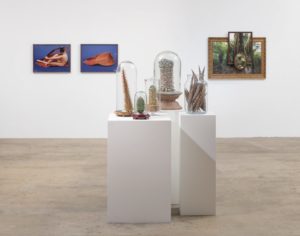


A WEIGHTY COWHIDE over a coatrack. A mighty African woman adorned with elephant dung. A disheveled Latvian man indifferently stuffing an apple into a child’s mouth. All of these are contemporary renderings of the Virgin Mary (by Dorothy Cross, Chris Ofilli, and Ance Eikena, respectively). Over the past decade, the Western visual art scene has seen a revived interest in Marian imagery in the context of contemporary motherhood. Exhibitions blending these themes have included Mama: From Merkel to Mary (2025) in Kunstpalast Düsseldorf; Acts of Creation: On Art and Motherhood (2024–26) traveling throughout the UK; Mother! (2021) in Copenhagen’s Louisiana Museum of Modern Art; and the Cleveland Museum of Art’s Picturing Motherhood Now (2021–22), among others. This trend is also echoed in my native Lithuania, a Baltic state with the self-given sobriquet “the Land of Mary.”
For decades, the soviet regime (like many Lithuanians, I resist capitalizing it) actively purged religious sentiment from public spaces. A 2017 WIN/Gallup survey found that less than half the population claimed to be religious—though the country consistently reports as predominantly Roman Catholic (74 percent in 2021). The global rise of new-age spirituality with an Eastern bent has had an impact here as much as anywhere. In addition, feminists and advocates of Baltic traditions have been inspired by the notion of the old-European goddess civilization, as put forth by prominent Lithuanian archaeologist Marija Gimbutas. There is no shortage of sacred maternal archetypes for those who are so inclined: Women’s circles and yoga studios around Vilnius express devotion to Gaia, Parvati, or Tara; Baltic ritual gatherings and song circles bow to Žemyna or Laima; and museum walls still harbor baroque Demeters. But in Lithuanian contemporary art, Mary alone is seeing a revival, while other mother goddesses are not. Since the early 2000s, several works a year have been exhibited in Lithuania with imagery of the Virgin Mary, from painted abstractions like Maria’s Bedroom by Patricija Jurkšaitytė (2006), to performance art like Pietà by Dainius Liškevičius (2013), to textiles like Mary Flies Back to Earth by Monika Žaltauskaitė-Grašienė (2020), to painterly reliefs like Aistė Gabrielė Černiūtė’s Piccolo Madonna, Protecting Against Untruth (2021). In the literary field, celebrated poet Giedrė Kazlauskaitė titled her latest volume Cantus Mariales (2025).
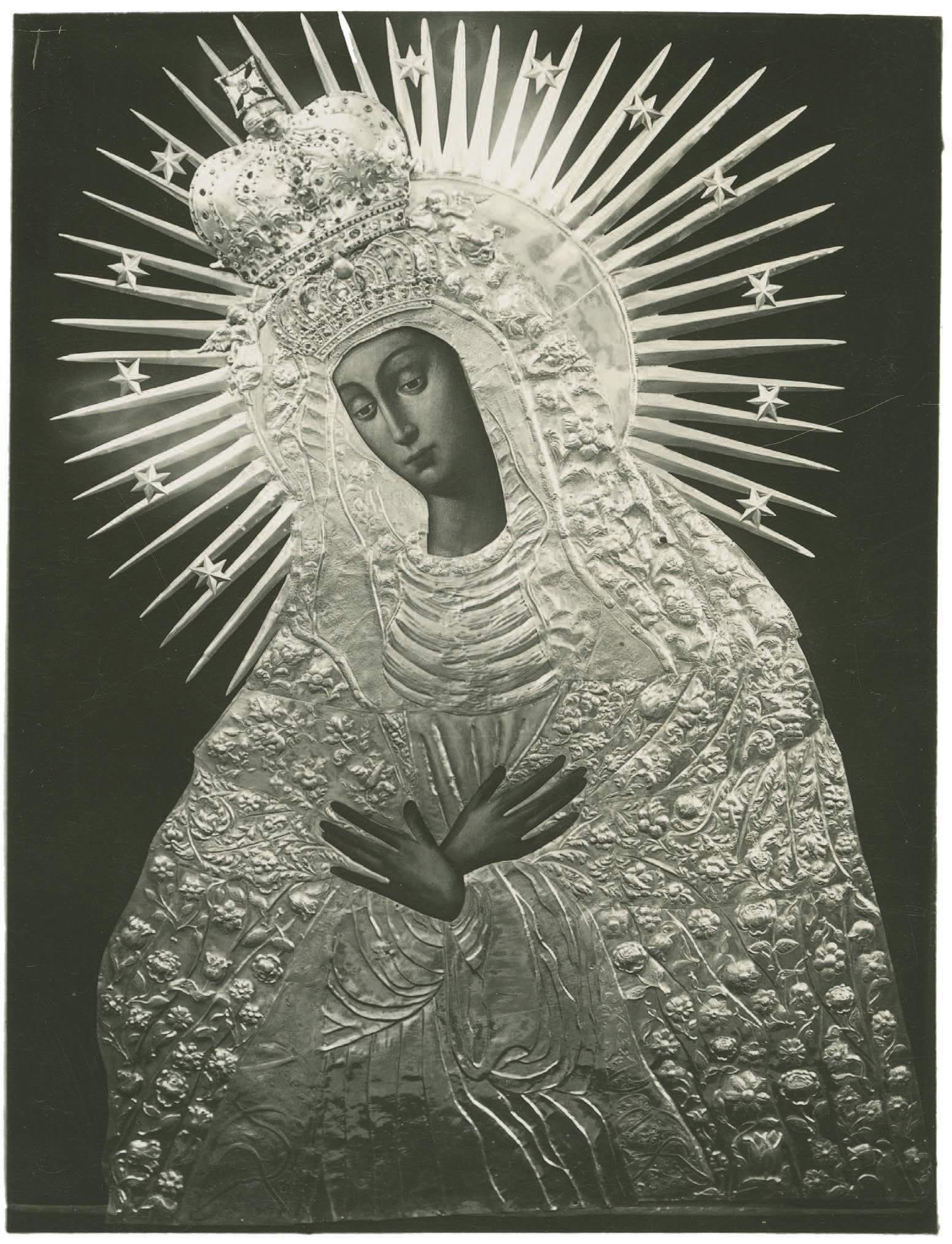
Artist unknown. Our Lady of the Gates of Dawn, c.1620–30. Oil on oak board. 79 X 64 inches. Photo: Jan Bulhak, 1932, courtesy of the Lithuanian National Museum.
I asked renowned artist Eglė Vertelkaitė why she thinks Mary is so pervasive. Her 2025 exhibition includes several family photographs, one titled Madonna (Benita with Baby Eglė) and another Vaidilutė (Pranutė)—named for a Baltic virgin guardian of the sacred fire, akin to a Roman vestal. Vertelkaitė says she was simply aiming for recognizable archetypes, nodding to Lithuania’s predominantly Christian character, and sees no contradiction between the two.
Historically, Marian iconography has been classified into broad types. There is Mary the guide (Hodegetria), a mother pointing to her son as the way; mother of tender mercy (Eleusa), who presses her cheek to her baby; protector of the suffering (Mater Misericordiae); the queen of heaven (Maesta); of virgin birth (Immaculata), among others. The litany of Mary’s attributes and continuously evolving local variations make the list inexhaustible.
Mary’s iconography as Our Lady of the Gates of Dawn in Vilnius seems to have attracted particular interest from contemporary local artists. The original painting, rendered by an unknown artist in the 1620s after an earlier engraving by Maerten de Vos, depicts Mary alone, without the Christ child, crossing her hands over her chest in a somewhat unusual gesture—arguably making it a unique iconographic type. In a monograph on this painting, Polish art historian Maria Kalamajska-Saeed classifies it as an Immaculata, though its official eighteenth-century title is Mater Misericordiae. Interviews with theologians and art historians suggest that from the very beginning, personal projections, or “seeing with the eyes of the Spirit,” have taken precedence over objective facts.
Over six feet high, painted in tempera on oak planks, the work has miraculously survived three fires and was pierced by a bullet in the eighteenth century (the hole in Mary’s sleeve is still there). Around forty years after it was painted, it was covered by an ornate gilded silver oklad, or riza, a decorative plate that conceals most of Mary’s body, leaving only her face and hands visible. Enshrined at the city gates, it became an urban pilgrimage site, ecumenically accessible and casually called upon for protection by those passing through. Given the icon’s history of resilience and its association with caretaking and protection, I propose that it aptly reflects the experiences of several generations of Lithuanian mothers—and illustrates a locally dominant mother complex I’ve termed the “mother-survivor.”
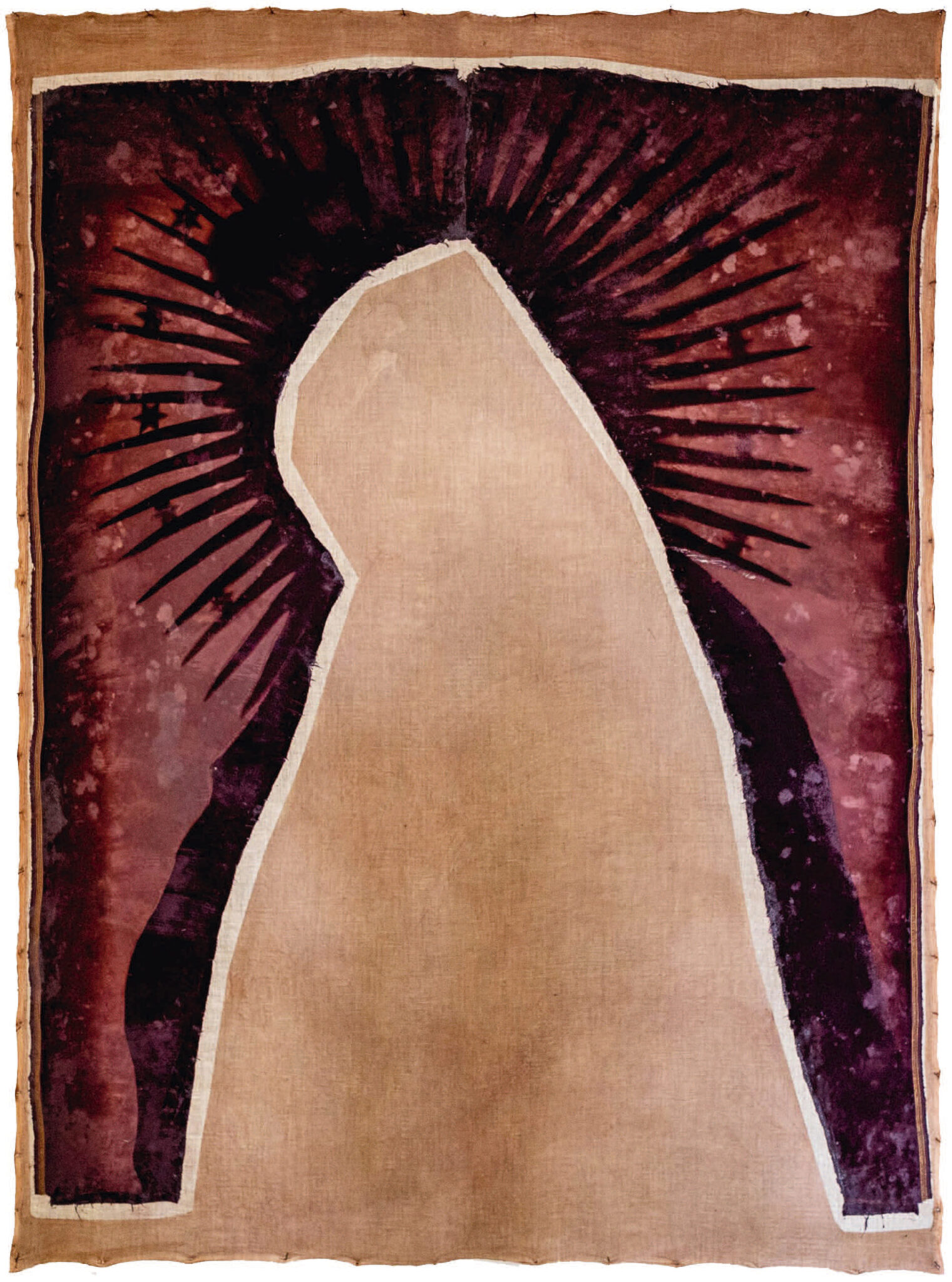
Sigita Maslauskaitė-Mažylienė. Our Lady of the Gates of Dawn, 2021. Velvet, canvas, sunlight, gelatin. 110 x 83 inches. Photo: Domas Rimeika, MO Museum.
This miraculous icon has carried significant political weight. Legend tells of it coming to the city’s rescue during a Swedish attack in 1702. During Russian occupation (from the eighteenth to twentieth centuries), a narrative attributing it to the Byzantine (i.e., Orthodox) aesthetic tradition was one of the public relations tools used to legitimize the Russian rule. Meanwhile, stories of the icon’s survival throughout the eighteenth-century Swedish incursion, as well as the long Russian one, stood as a monument to Lithuania’s centuries of glory as a grand duchy and were used to stoke a spirit of independence. According to historian Andrea Griffante, the coronation of this icon in Vilnius in 1927 was narrated by the Polish government as confirmation of the city’s rightful belonging to Poland, while the Lithuanian populace read it as an affirmation of the icon’s national significance. During the Cold War, Lithuanians in Siberian exile reportedly prayed to small votive images of Our Lady of the Gates of Dawn for a safe return. What could explain the lasting appeal of this unusual Mary to local contemporary artists, especially since nearly all other paintings of Mary in Lithuania are of the Theotokos type, in which Mary holds the infant Christ?
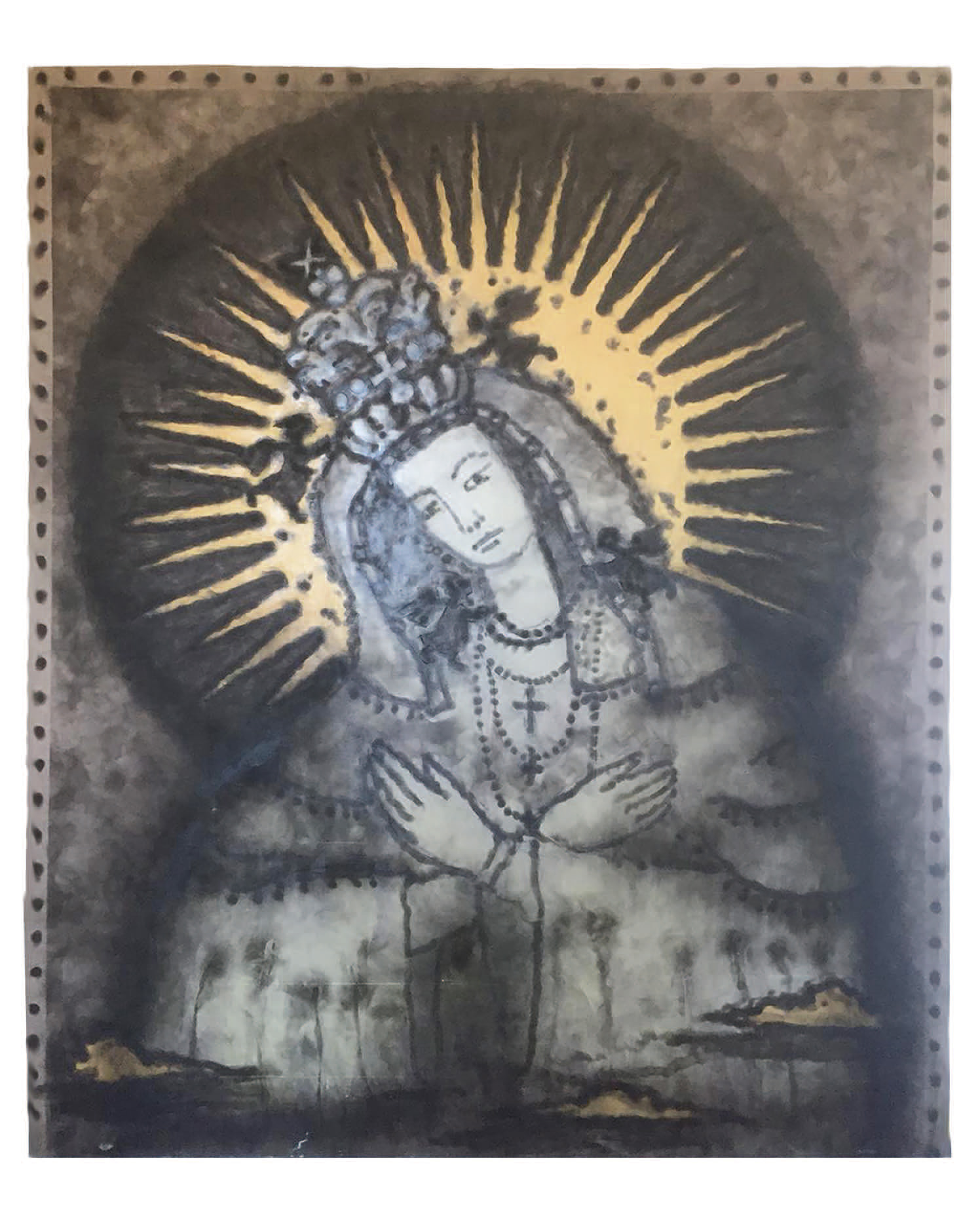
Jonas Gasiūnas. Holiest Virgin of the Gates of Dawn, 2006. Canvas, candle smoke, acrylic, aluminum and bronze powder. 87 X 73 inches. Photo: Mindaugas Vanagas.
Fresh Gaze at the Gates
One recent rendering is Agata Orlovska’s Oklad of Our Lady of the Gates of Dawn (2024) [see front cover]. Orlovska’s laser-cut industrial steel abstraction of the protective oklad’s shape, cold and heavy, keeps the scale and proportions of the original painting. Indeed, all the artists discussed here have emphasized the importance of size in their renderings of Our Lady of the Gates of Dawn—they see its monumentality as a central motherly attribute, allowing viewers to feel protected and cared for by a strong and capable presence.
Raised Catholic, Orlovska describes the church as her first experience of the power of art—while also pointing to the gradual return of spiritual themes to gallery art. Nevertheless, when a collector who acquired the piece proposed putting it in a chapel, the artist felt this would pervert the concept of her work and staunchly refused. To counter the contemporary daily surplus of visual stimuli, Orlovska strips her image clean of decorative detail, resulting in a paradoxically idealized rendering. The focus on the protective oklad rather than the painting itself emphasizes the stark shielding function of the icon, rather than the qualities of motherly care typically associated with Mary. Leaving the hands and face as empty spaces for the viewer’s imagination to fill also suggests an emptiness where a mothering face ought to be visible through the armor. It’s an apt metaphor for decades of collective experience by Lithuanian women: toughened up, geared for survival, with only their functional (hands) and representative (face) body parts accessible, their personalities and emotions more or less abstracted, their relationships with their children deemphasized.
This theme of emptiness is repeated in several other contemporary interpretations, including Hopeless (2020) by Kazimieras Brazdžiūnas and Aušros Vartų Marija (2021) by Sigita Maslauskaitė-Mažylienė. An established artist, Maslauskaitė-Mažylienė is also an art historian and theologian, presently serving as Lithuanian ambassador to the Holy See. Steeped in Christian iconology, she nevertheless chose an abstract rendering. In contrast to Orlovska’s steely architectural take, her canvas integrates the plush red velvet that once hung between the original icon and the oklad to protect the delicate paint from the metal. When the icon was briefly opened for restoration in 2020, the curtain was replaced, and Maslauskaitė-Mažylienė, then director of the Church Heritage Museum, was allowed to keep the old one. Over the years, sunlight had organically rayographed the oklad’s silhouette onto the fabric. The work is part of a series titled Acheiropitos (literally “not made by human hands”), stressing the minimalism of her own intervention. In her rendering, Mary is unaccompanied by the putti who typically bear her crown. Moreover, the photo-inversion—recasting the golden rays behind her head as supple yet precise black shadows—suggests a dethroning of the iconic figure, an effect amplified by entirely removing her bodily features. Has the Virgin Mother set the bar so high as to obscure actual mother figures, in all their complexity, from public view? But Maslauskaitė-Mažylienė’s piece could also be read in reverse: Perhaps any mother is a radiant Madonna, though her shining exterior likely masks ongoing battles with inner shadows.
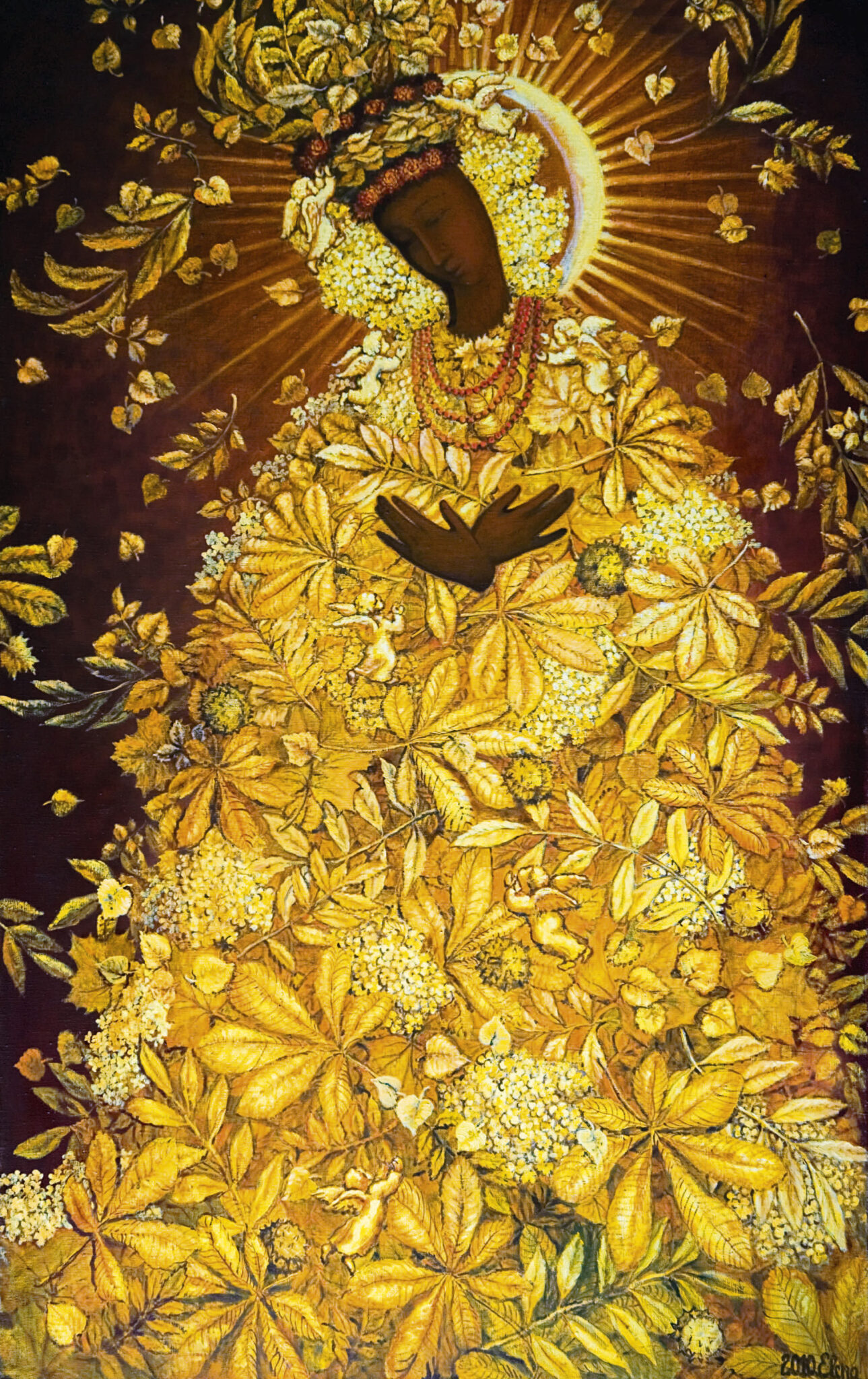
Elena Kniūkštaitė. Autumnal Mount for Saint Mary, 2010. Oil on canvas. 63 X 39 inches. Photo: Eglės Galerija.
Painting with smoke from a burning candle is a signature technique of renowned Lithuanian painter Jonas Gasiūnas. He was removed from his position at the Vilnius Academy of Arts in 2018 after years of student complaints about unwanted sexual advances, but his work retains national significance. His Holiest Virgin of the Gates of Dawn (2006) was widely described by heavyweight local critics as the highlight of a painting scene that was largely moribund in the early years of Lithuanian indepen-dence. Born in Siberian exile, Gasiūnas has repeatedly emphasized his traumatic past, using sociocultural icons—such as Gediminas’s Tower, the remnant of a medieval castle, and Grand Duke Vytautas, both symbols of national pride and independence—as narrative signposts. While he recognizes their declining legibility to younger audiences, Gasiūnas is well aware of foreign (especially commercial) fascination with the region’s soviet past.
The artist maintains an ironic stance toward religion—he claims to buy candles at nearby churches simply because they produce a richer smoke. But he has also linked his signature technique to the idea of burnt offerings as a means of communing with the divine, as well as the sense of danger that the smell of smoke instinctually provokes, reveling in the multilayered ambiguity. To paint Mary this way—with a technique inspired by graffiti burns on the ceilings of abandoned buildings—might be read as a kind of desecration; or it could be a way of highlighting her humility, accessibility, and melancholic fragility. “What is painted with smoke should be read as carefree fiction,” he suggests—yet the meticulous tracing of details makes his painting process akin to a ritual. Notably, two slightly different versions of this painting exist, from 2002 and 2006. In the former, the icon’s eyes are cast down, as in the original icon. In the latter, executed in brighter colors, she meets the viewer’s gaze.
Finally, there is Autumnal Mount for Saint Mary (2010) by seventy-five-year-old folk artist Elena Kniūkštaitė. Her Mary is portrayed full-length, in a lush robe of golden chestnuts—a rare allegorical choice indicating a virtuous core that emerges from painfully thorny experiences. A chestnut could also hint at a naturalist interpretation—of nourishment stashed away for winter hardships within a protective shell. Of all the images, Kniūkštaitė’s Virgin has the darkest skin and features most in line with the disproven story of the icon’s Byzantine origins. She is regal yet somehow also humble, adorned with necklaces instead of the original rosaries.
Curiously, none of the painters includes the sizeable silver crescent that sits just beneath the icon in its chapel at the Gate of Dawn, although the way Kniūkštaitė depicts Mary’s radiant halo evokes a sun joined to a crecent moon, an ancient symbol in many cultures. Gasiūnas also separates the original nimbus into two, with the traditional golden radiance encased by a larger circular shape—a shadow of the holy? Or a silvery lunar hint?
Mothering in Survival Mode: Wounded and Dark
Lithuania is still coming to terms with the painful experiences of the past century, collective traumas that might explain its enduring affection for this particular Mary. The postwar soviet occupation plunged the region into an oppressive silence under pervasive KGB surveillance (including a wide network of local collaborators) and persecutions. Generations of Lithuanians brought up during the twentieth century experienced some form of violence in the family—from wartime deaths and injuries (often after being drafted into the soviet armed services), to exile into Siberian labor camps and forced westward migration, to endemic domestic violence and alcoholism. Of the 132,000 people exiled to Siberia under soviet occupation, 70 percent were women and children; meanwhile, the widows and orphans of deceased and injured men struggled locally. In exile, mothers were so revered that the blessing of an elderly mother would often suffice to consecrate a marriage. There are stories of women escaping from exile and returning to Lithuania on foot or hitchhiking, sometimes with children in tow (prominent artist Marija Teresė Rožanskaitė was such a child).
Against this backdrop, the mother-survivor is a more realistic version of the idealized soviet woman—tough at work in a “manly” job while raising numerous offspring for the benefit of the nation—an image that masked the daily realities of tremendous physical and psychological pressure suffered in silence for fear of repressions. In the collective psyche, the hardened mother-survivor displaced the nourishing and vulnerable mother—until the qualities she displays (and lacks) began to seem like the norm.
Lithuanian psychologist Danutė Gailienė has written extensively on the lasting traumatic impact of soviet occupation. A culture of silence and reading between the lines permeated family life; the keeping of uncomfortable truths and feelings to oneself came to be seen as a form of care. Many Lithuanians tell of mothers and grandmothers who treated food as the principal (or only) way of showing affection. A survival mentality, confined to the base of Maslow’s pyramid of needs, became the norm. Meanwhile, the soviet regime actively sought to supplant the role of the family as a person’s primary allegiance—including by encouraging children to inform on their parents—further distorting the notion of mothering of several generations. Mother-and-child separation often started at birth, purportedly for health reasons (and was frequently marked by non-consensual obstetric procedures and verbal abuse by practitioners), and continued with the widespread institutionalization of children with special needs and those born into troubled homes.
Recent years have kindled a public interest in the psychology of the mother wound, as well as discussions of the dark side of motherhood, from birth trauma to postpartum depression to the psychological challenges of childrearing. Jung posited that children deprived of motherly affection develop a distorted relationship to the mother archetype. At one end of the spectrum, the result is a longing for the perfect mother, including spiritual devotion to Mary; at the other is the self-sabotaging negative mother complex; somewhere in between is the fear that showing vulnerability will lead to rejection. Perhaps the image of a protective, immaculate mother with no child in sight makes it easier for an upward-gazing adult to visualize being mothered and cared for—and also offers a mirroring respite to mothers-survivors themselves.
While these factors may help explain the continuing appeal of Mary in general and Our Lady of the Gates of Dawn in particular, is it possible to draw insights more specific to contemporary art? The beaming out of collective sentiment onto canvas offers one intuitive, if simplistic, answer. A trend in Western professional art that offers a partial explanation is the gradual relaxing of the taboo against religious themes, as noted by James Elkins in 2004. Indeed, Vaiva Daraškevičiūtė has described the return of religious imagery as a post-atheist pendulum swing.
In the opening chapter of On Freedom, Maggie Nelson articulates an “aesthetics of care” that might offer a relevant framework for what is currently unfolding in Lithuanian (and Western) art. She writes, “The twentieth-century model imagined the audience as numb, constricted, and in need of being awakened and freed (hence, an aesthetics of shock), whereas the twenty-first-century model presumes the audience to be damaged, in need of healing, aid, and protection (hence, an aesthetics of care).” Perhaps the return of religious themes aligns with an invitation to a sensitive plane of healing through acknowledging vulnerability. By analogy, fresh renderings of a familiar devotional icon, an image worn almost to cliché in the collective psyche, might open new space for a nation to reflect on a mother wound long shrouded in silence. Our Lady of the Gates of Dawn, this resilient, solitary figure—who turns back armies and survives fires and bullets unscathed, distantly perfect—might be the clearest reflection of how contemporary Lithuanians imagine a mother.
Eglė Elena Murauskaitė is a Lithuanian text artist, critic, and translator. Her research focuses on contemporary religious art and feminist bodily expression. She runs a monthly art criticism column, Kraštinė, at www.NARA.lt.