

Colin Page was raised in Baltimore and studied painting at the Rhode Island School of Design and the Cooper Union. His work has been featured in solo exhibitions and group shows including at the Kaiping Museum of Art in China, the Natural History Museum of Los Angeles County, and the Cape Cod Museum of Art. In 2019, he opened Page Gallery in Camden, Maine.
Image: Can you talk a bit about your artistic and spiritual influences growing up?
CP: I grew up in a Catholic family, with several years of Catholic school. While not devout, I respected aspects of others’ religious practice. Kindness, beauty, and generosity felt more important than dogma.
My household had Time Life art books, and I remember spending hours looking at reproductions of the Sistine Chapel and da Vinci’s drawings of inventions. I copied Todd McFarlane Spider-Man comics. I took lessons in drawing and painting. In tenth grade, an art history survey class opened up my interest in artists like de Kooning and in the impressionists, and I developed a love for colorful and expressive work.
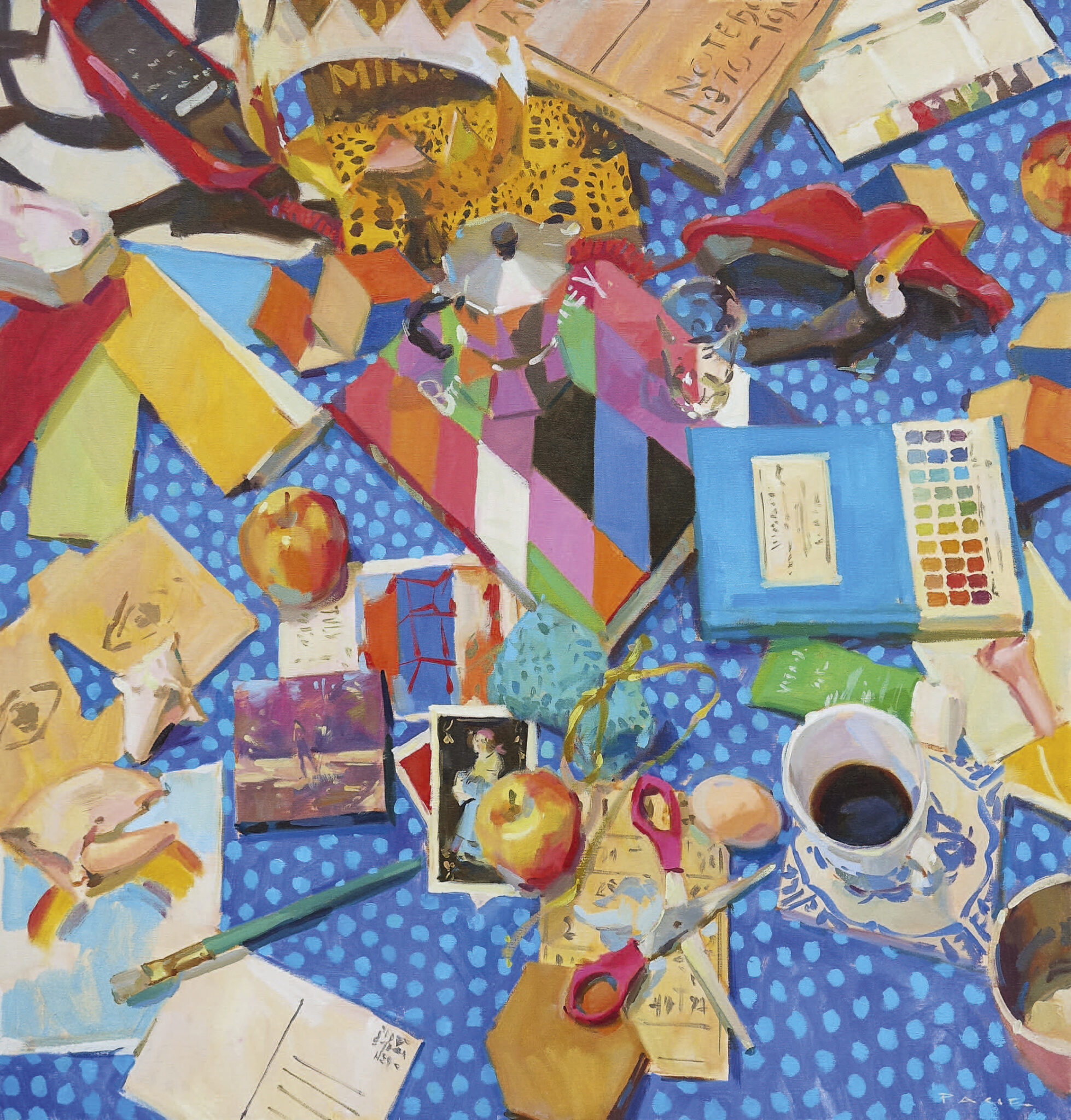
Colin Page. Geometrically Inclined, 2022. Oil on canvas. 36 x 36 inches.
I tended toward drawing and painting early on. The process of creating a successful illusion was mesmerizing for me—to translate the three-dimensional world onto a flat piece of paper. But I love working with my hands to make all kinds of things. I am a knitter. I like home improvement projects. In school I took classes in printmaking, photography, pottery, and sculpture. The creativity in all these fields feeds my desire to touch and manipulate, to make something out of nothing.
Image: Your paintings have a lush joyfulness to them, inviting the viewer into a sort of gentle revelry. Has this always been the case?
CP: I think this sense of joy became more apparent as I became an adult and felt more settled and comfortable with who I am. On a field trip with a college painting class, I saw a Pierre Bonnard retrospective at MOMA. As we walked through his brown, dark early paintings, I was wondering what the big deal was. Then we emerged into a room of dots and smears and washes of so many layers of color—vibrant orange next to lavender, blues, greens, and red. His trajectory tells such a rich and joyful story. It took many years for this to work its way into my paintings, and I think I’m still figuring it out every time I pick up a brush.
Image: Where does this joie de vivre come from for you personally? And if you’ll permit me, where do you stow the darkness of life?
CP: I am lucky to have found Maine, to be a parent, to be an artist. There is joy in nature and connection with loved ones. I have as many bad days as anyone, but I’d rather laugh than complain. In my art, I feel most rewarded when the colors sing, when I can point out the beauty in a moment the viewer has seen a thousand times before.
I believe opposing feelings create the most beauty. If an object in a still life has both happy and sad memories for me, it is even more powerful for the fullness of feeling.
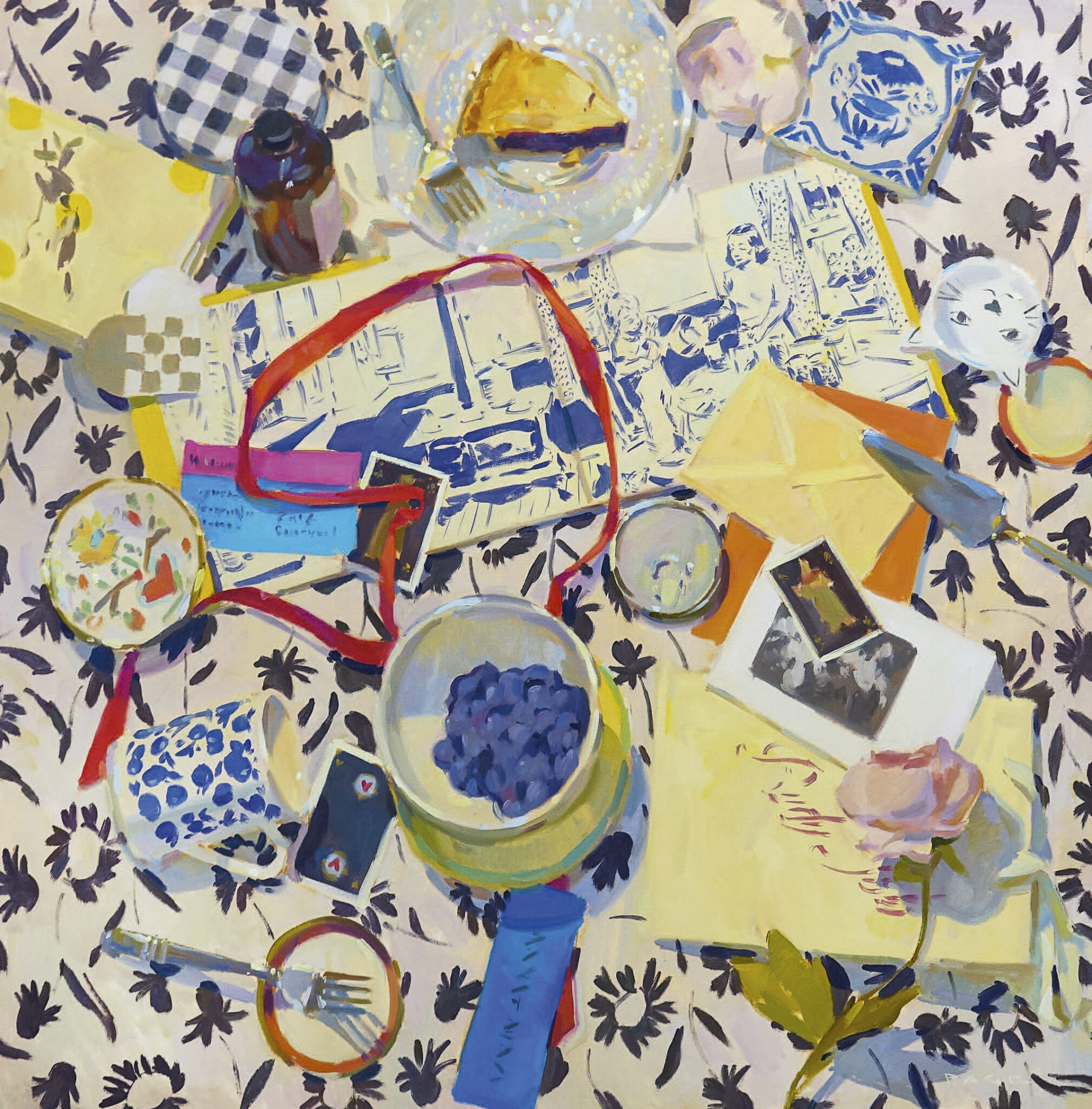
Colin Page. Afternoon Blueberries, 2025. Oil on canvas. 38 x 38 inches.
Love and beauty are complicated. I realize I’m putting them together here, and I think that’s right. Beauty and love are maybe one and the same for me. I think real beauty and deep love might line up together in significant ways.
For instance, I might see the idea of childhood play and creativity in a Crayola marker or Elmer’s glue bottle, but I also feel the sadness of knowing this was a fleeting time in my house. The kids enjoyed the time coloring while also fighting over who could use the blue marker. The good with the bad is what makes the beauty meaningful. Sweet food tastes best when paired with a salty snack. Maybe I don’t hide the darkness but see it as part of the joy.
Image: The attentiveness of your still lifes strikes me as spiritually infused. How do you conceive of the act of attention, and how do you develop this form of looking?
CP: Paul Valéry writes, “Even the most familiar object changes if you set about drawing it. You realize you did not know it. That you had never actually seen it.”
It’s fair to call drawing a spiritual act. To paint or draw anything, I have to let go of my idea of what it looks like. I have to stop naming it—to paint the thing and not the noun. If I say I am painting a nose, I bring baggage of what I think a nose should look like. If I look at a face and see a series of shapes and colors, the nose will find its way onto the canvas. This psychological shift is a way to see the world in a new way, and is the way to become a more painterly painter. I choose to paint objects and people who are meaningful to me, and then I have to let go of my idea of the subject in order to render it in paint. When I choose to paint a favorite book, I’m saying, “This book is special, and you should read it and love it with me.” When I pick up a brush to paint it, I need to say, “Look at that line of blue next to that warm orange tinted white.” This is a slight break in reality. Or more accurately, it’s a slight break into reality, when I see my subject as it truly is.
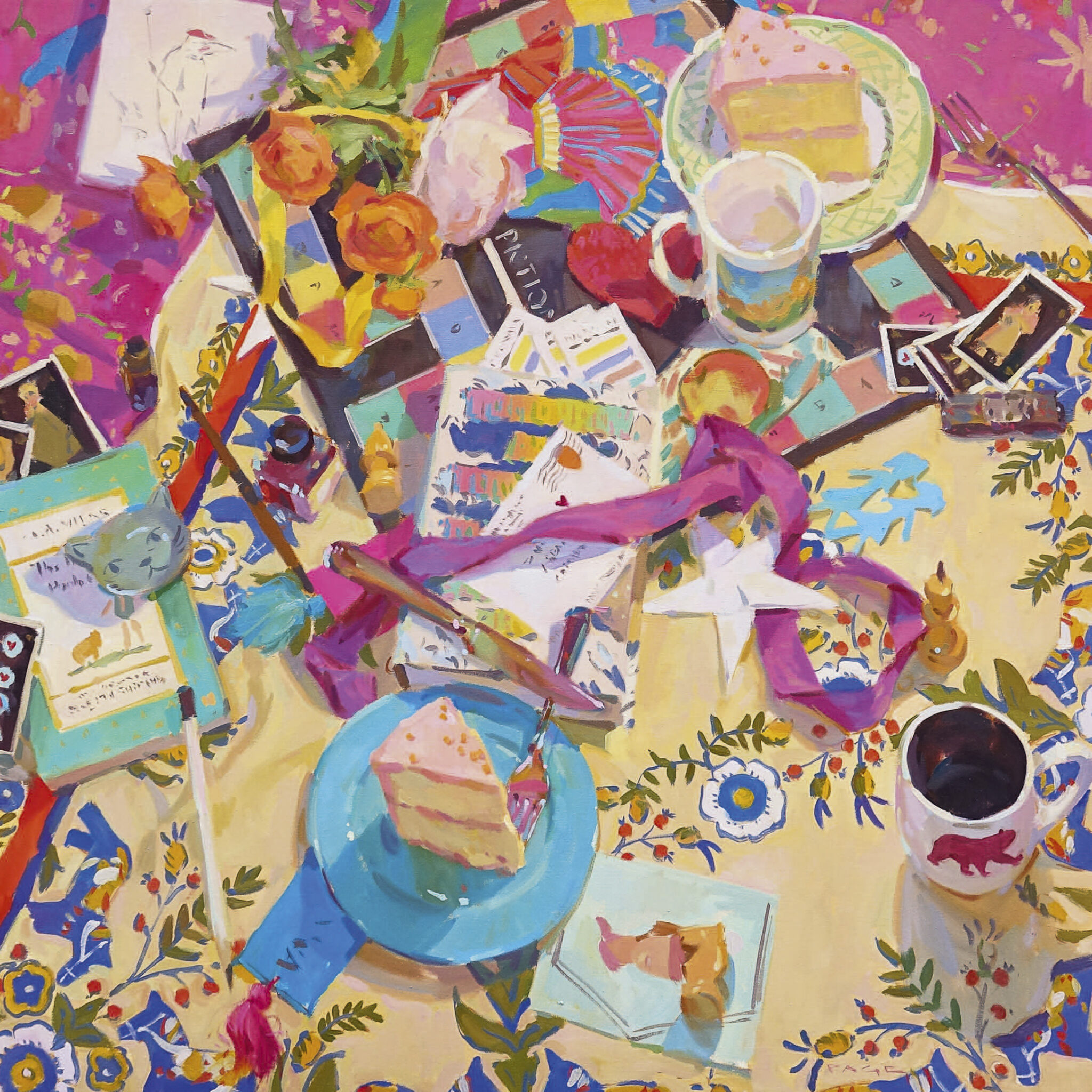
Colin Page. Again Tomorrow, 2023. Oil on canvas. 40 x 40 inches.
Image: The theologian David Ford describes the “spirituality of feasting”—the potential to luxuriate in the presence of the Other, or the divine within the Other. Your still life paintings seem replete with traces of the Other, as if loved ones have just left the table, or are mere inches out of view. Does eating together feel sacred to you?
CP: My still lifes are portraits of friends and family through shared love of things, colors, and memories. These are not my story, but our story. The still lifes became more personal during 2020, when my family was homeschooling and the dining table was the primary shared space. The story of my family was spread out there every day. It is the gathering of family that drives the paintings, and my life.
Image: Rilke wrote of Cézanne’s apples that “he makes ‘saints’ out of such things; and forces them—forces them—to be beautiful, to stand for the whole world and all joy and all glory.” To me this seems like the key to understanding still life painting. What’s your take?
CP: A landscape is found, and then composed into a painting, but a still life is built from the ground up—from the tabletop, to the angle of view, to the objects placed. An apple could have been chosen out of admiration for Cézanne’s apples, or as a reminder of a schoolteacher, or of farming and growing our own food, as a symbol of health, or because it was the only fruit in the house that day. Is it a green apple in reference to Magritte’s The Fifth Season? My point is that the artist made a decision to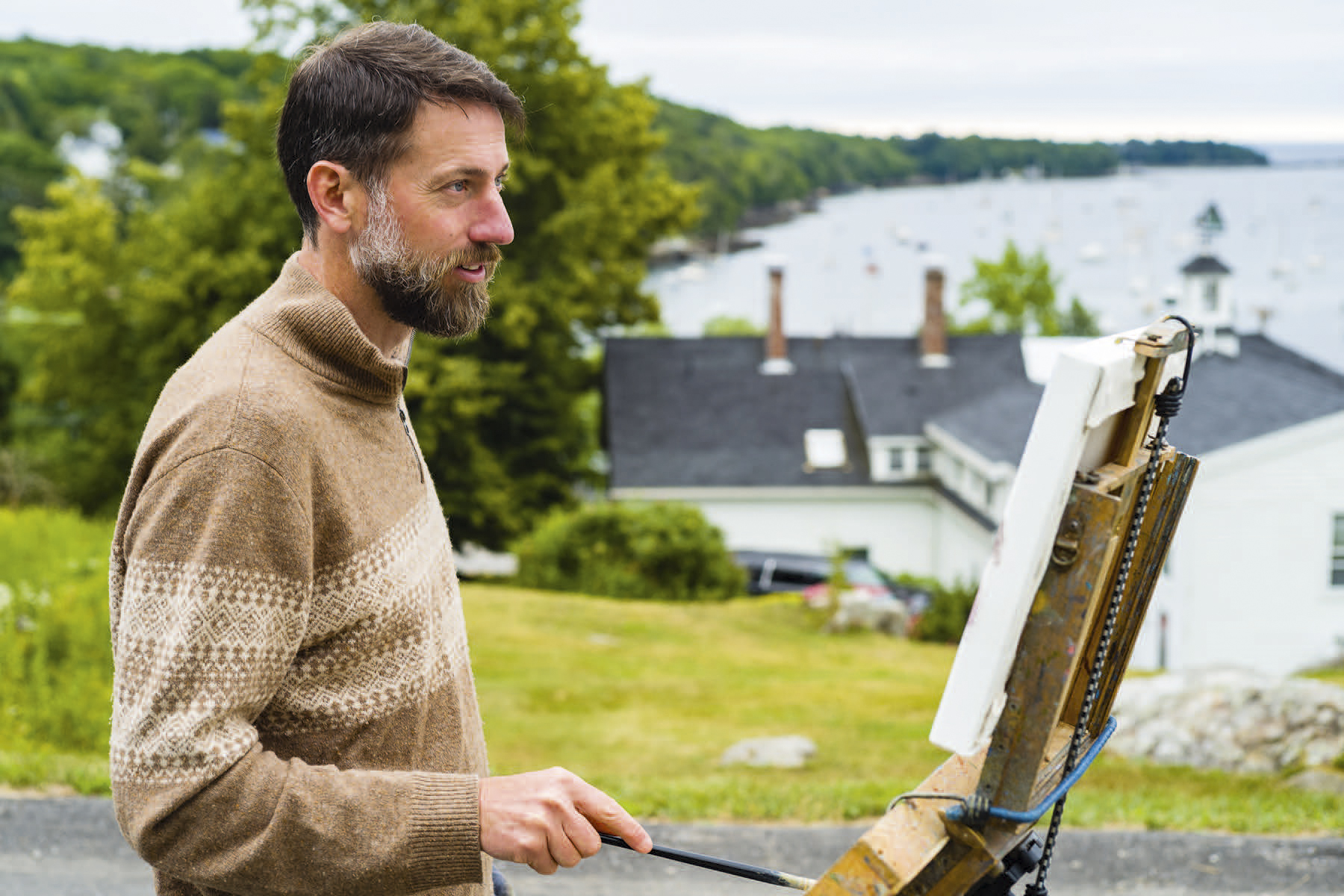 paint that apple. The act of painting any object gives it a status. It’s on the artist and the viewer to be open to the vastness of meaning implied in the act of choosing, arranging, composing, and painting it.
Image: Beyond references to professional artists, your still lifes often contain evidence of kids doing the making, from construction paper to scissors. Do these elements hint at how you perceive the creative act?
CP: My initial reaction is yes, they exemplify the childlike joy of creation. I like the idea that making art is tied to a sense of wonder, and I believe that’s an important value to hold on to, especially since painting is so darn hard sometimes. But making art is serious business for me, and I am fully committed to the life of a mature painting practice. I am constantly rethinking my approach, studying other artists, and looking at nature with an analytical eye. I want my paintings to read as effortless and joyful. I want them to sing and dance, to breathe. I want them to imply all that those kid-safe scissors suggest about me and my kids. At the same time, I want to have complexity buried in every painting, even if it’s just for me and the careful viewers.