


Burning Bright. Curated by Elizabeth Wyckoff and Timothy Young at the Yale Center for British Art, Fall 2025.
Elizabeth Wyckoff. Blake. Yale Center for British Art Collection Series, 2025.
WE HAVE HAD THE WORD ICON FOR A WHILE, since the 1570s at least in our language, but it has recently been subjected to fairly comprehensive alterations. First came the demotion from object of worship to double-clickable thumbnail; then a profligacy with its adjectival form, iconic, which now refers to anything that anyone has seen before. (A short list of things recently called iconic in the New York Times: the San Siro stadium in Milan, Loewe Amazona bags, skating at Rockefeller Center around Christmas, and the 1941 photograph known as The Last Jew in Vinnitsa.) And why shouldn’t it? Shifts in diction reflect shifts in thought; in a culture as voluptuously imagistic as ours, it seems natural for the icon to be a persistent subject.
But words and images both are subject to some of the laws of scarcity and abundance that set the price of rice. The more commodious a term becomes, the less immediate and particular its effect. And the same principle that tells us that changes in thought become changes in language advises us that the loss of a word’s earlier meaning may mean the loss of a concept. The icon’s concept was always its own incompleteness: that it focused a viewer’s attention on a metaphysical object without pretending to serve as its substitute.
These thoughts passed through my mind in November of 2025, as I visited the Yale Center for British Art’s exhibition William Blake: Burning Bright toward the end of its run. Curated by Elizabeth Wyckoff and Timothy Young, the show disclosed a special interest in the material elements of Blake’s art practice. (Wyckoff is also the author of a book, Blake, published to accompany the exhibition.) Wyckoff and Young’s curation, with its emphasis on Blake’s constant technical experimentation, presented Blake as a kind of Brian Eno or Man Ray: an artist-technologist whose work expresses an implicit philosophy of media.
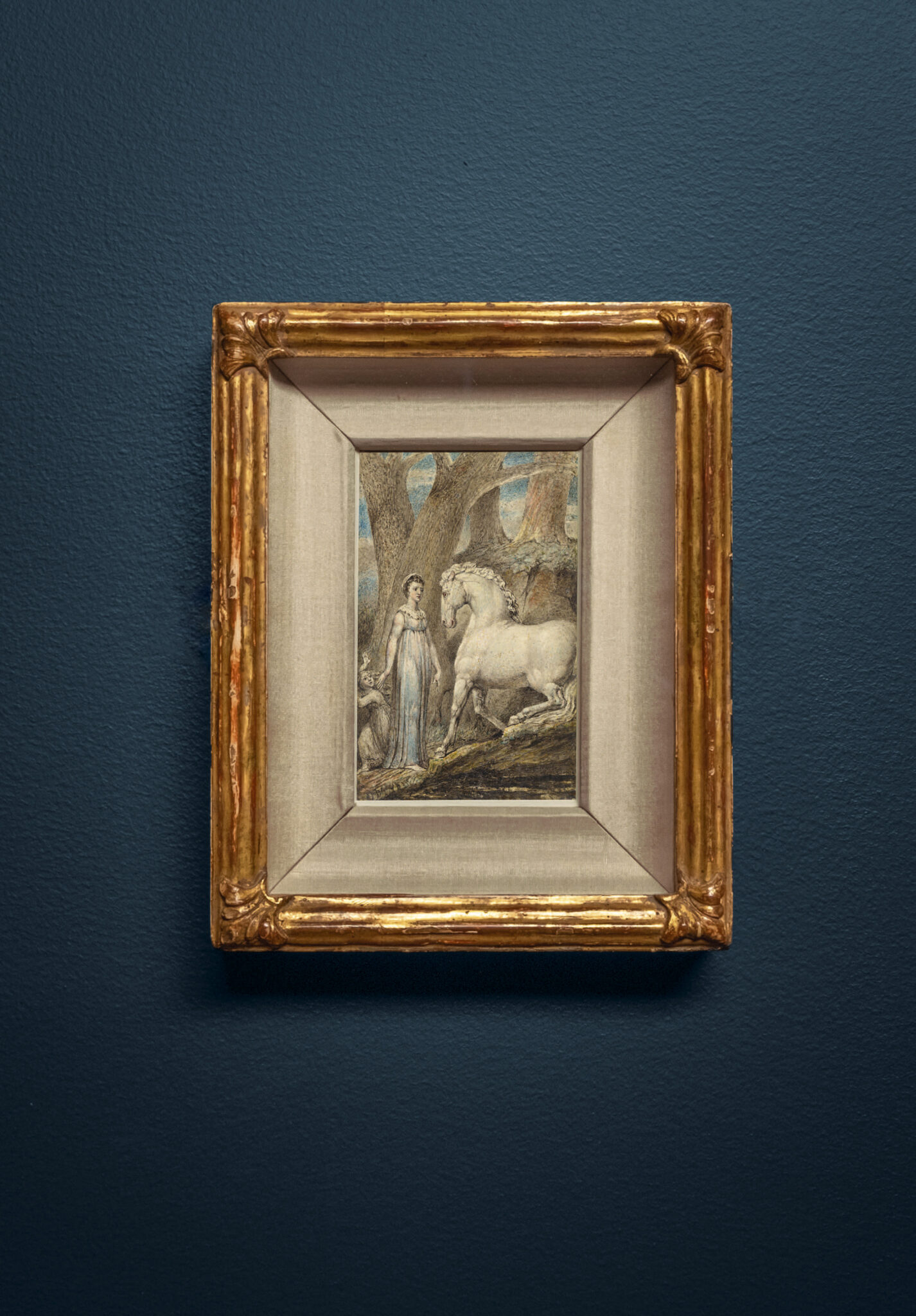
William Blake. The Horse, c. 1805. Tempera with pen and black ink on copper engraving plate.4¼ x 2½ inches. Yale Center for British Art, Paul Mellon Collection. Photo: Robert Hixon.
To be sure, proposing that Blake’s methods and way of thinking about art point toward the future we inhabit has at least the shape of sophistry. His paintings more often seem archaic than ultra-contemporary, as if they’d been conceived a few centuries too late. Or, as in his own appraisal, millennia: In an exhibition text for one of his own shows, he claimed to have copied his technique from visions of art in “the ancient republics, monarchies, and patriarchates of Asia” that predated Rome and Greece, “originals from which the Greeks and Hetrurians copied Hercules, Farnese, Venus of Medicis, Apollo Belvidere, and all the grand works of ancient art.” Blake believed that his sources were beyond and outside history. These originals could be viewed only in the imagination.
And taking a look at Virgin and Child, the old-fashioned icon that opened Burning Bright, you could be forgiven for getting a little historically confused yourself. The painting has the medieval love of gold and a geometric configuration of medieval simplicity; the effect is vaguely Byzantine. Its treatment of the figures’ bodies, however, manifests the classical-by-way-of-Renaissance preference for articulated muscle (the infant Christ is arguably too well developed in this respect). At the same time there are traces of a storybook, illustrated style closer to that of Blake’s own time, with a backdrop of fairy-tale, five-pointed stars and an expressionistic range of colors: greenish-black night, red-fringed halo, and rosy cheeks on both Madonna and child. Mary and her son have faces of a pious, premodern simplicity, manifesting no complicated personal emotion. Some nativities, like those of Raphael, derive their eloquence from the mystery of their subjects’ complete humanity, the strangeness of their having entered from mythic simplicity into finite human time. But Virgin and Child is not a painting of a particular moment any more than it seems to be a painting from a particular moment. It shows an imagined instant in an imagined time, accessible only to the inner eye; Blake’s pictures ask to be looked through, as if they were windows, not surfaces. Virgin and Child points in the direction of Mary and Jesus without nailing them, like captured butterflies, into the frame.
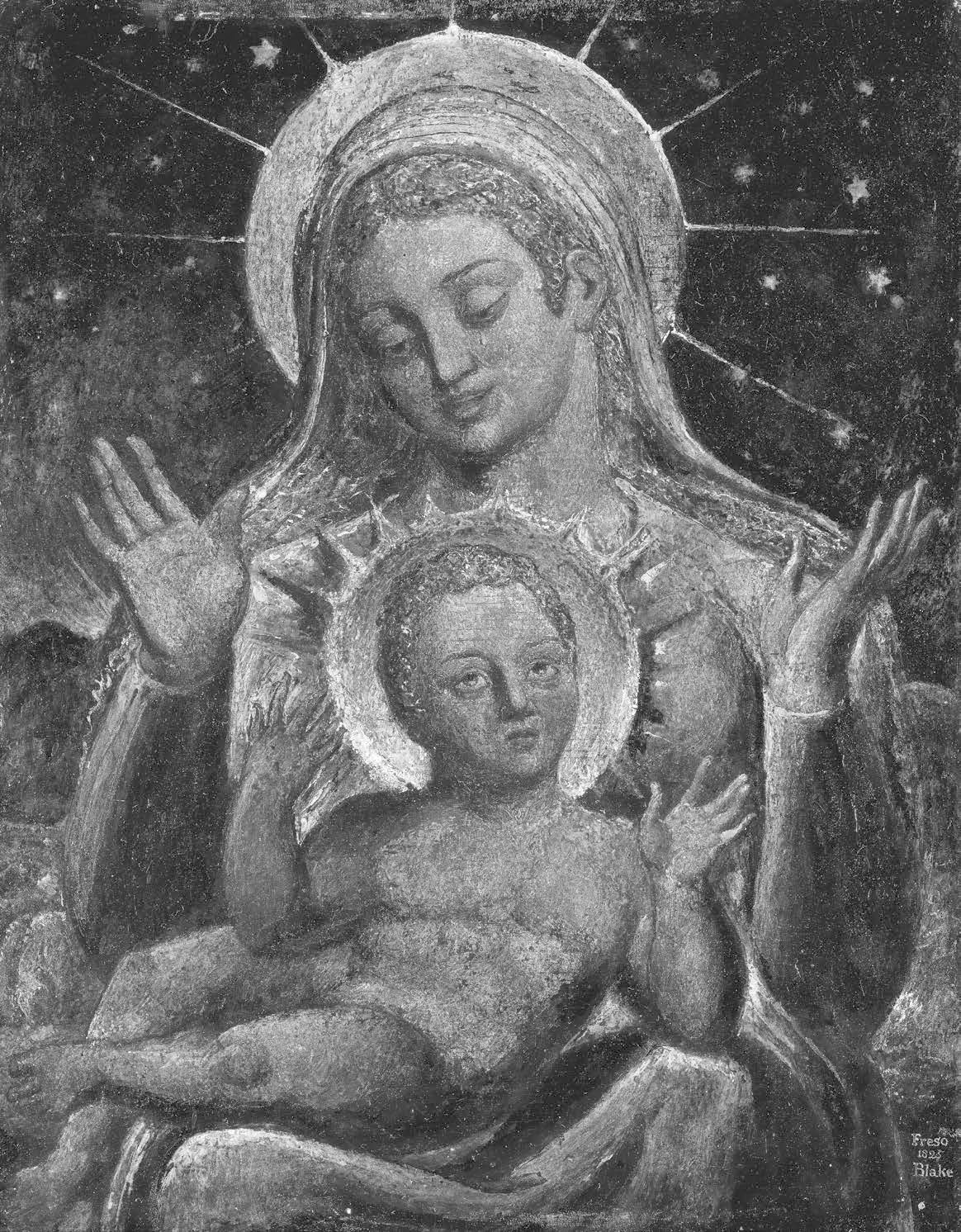
William Blake. Virgin and Child, c. 1818-26. Tempera on panel. 11¼ x 9¼ inches. Yale Center for British Art, Paul Mellon Collection
In his own time, Blake worried that his choice of subjects—the ideal object which was also absolutely concrete—would be misapprehended. Blake wasn’t working from his peers’ version of life or the scholars’ version of history or literature. He wanted to paint eternal things. “Painting,” he wrote, “as well as poetry and music, exists and exults in immortal thoughts.” And, for him, the eternal was no less solid than the near-to-hand. “A Spirit and a Vision are not, as the modern philosophy supposes, a cloudy vapour or a nothing: they are organized and minutely articulated beyond all that the mortal and perishing nature can produce.” Blake’s work took shape as he went along, never fixed or finished but seeming always to be caught mid-creation. He believed that the making of things was ongoing, everywhere, in thought and in world at once.
Today, Blake’s ancient, invented predecessors in forgotten civilizations unavoidably sound a bit like symptoms of internet-induced delusion. Revisionist history is back in style, and Blake’s history was certainly, in the strictest sense, revisionist. He believed a lot of idiosyncratic things, among them that the artistic patrimony of the Mediterranean Basin had early sources that were either forgotten or repressed. (If he meant Sumer, he was genuinely prophetic: Blake died before the translation of Gilgamesh or excavation of Nineveh.) He alone, or he alone in his milieu, had access to them.
To bristle at this is easy. Today, the people who sound most like Blake on history are the partisans of a paranoiac and bibliophobic turn in the culture. Popular commen-tators circulate fictions about history and prehistory that unknowingly satirize Blake, reattempting his speculations without his speculative powers. Graham Hancock, for example, a frequent guest on several of the country’s most popular podcasts, claims to have uncovered evidence of advanced ancient civilizations predating the Ice Age on both Earth and Mars. He says photographs from space probes show pyramids constructed by a civilization presently trying to warn us about a coming disaster.
Pictures of pyramids on Mars or the resurrected Jeffrey Epstein, leaked Navy video of jet exhaust mistaken for flying saucers, AI-generated images of the president as a king or a pope—a whole way of understanding what machines can show us is breaking down, though a little too slowly. We still feel, without really believing it, that a picture discloses a real and unmediated moment. But even as our images stun and bewilder us and stoke our moral passions, they lose all power to make us move and act. We are shown things that should spur us to extraordinary interventions, but instead we are dazzled into immobility. Blake seems to anticipate this; his simultaneous suspicion of the art object and veneration of the inner image offers us another way to look at things.
Continuing along the gallery into Burning Bright, I saw a series of variant pages from one of Blake’s most famous books, Songs of Innocence. Blake etched these pages himself, using the same “infernal” method for the poems as the images. In this technique, which he invented, the engraver painted words and images onto copper plates using acid-resistant ink; the plate was then washed with acid, leaving drawings and letters in relief. Blake wrote that for practitioners of the infernal method, as in hell, “corrosives” were “salutary and medicinal, melting apparent surfaces away, and displaying the infinite which was hid.” Words and images belonged equally to this hidden infinite, and each took on the other’s powers, so that his pictures that could act like language: pictures that could make ethical demands and issue imperatives. He printed small runs of these books and then, with his wife, Catherine, colored and painted each copy so that no two were identical.
Both Blake’s images and his poems had variants. Saree Makdisi, visionary critic, scholar of Palestinian history and politics, and author of William Blake and the Impossible History of the 1790s, argues that these variants reflect Blake’s skepticism not only of images transferred perfectly from world to surface but also of the final representation, in painted or illustrated form, of any inner image. Blake’s books and pictures were performances, complicating their subjects rather than promising any perfect transmission of the inner world. His technical experiments made it possible for him to extend and develop this implicit critique of the image’s finality.
Makdisi shows how the reproduction of images in Blake’s time was a common metaphor for industrial production in general, going on to argue that Blake’s process looked to undermine the homogenization of life by industry. This was also central, for Makdisi, to Blake’s critique of contemporary, mechanistic attitudes to time, the same attitudes manifested in our declining, photographic image culture, which pretends to give us accurate representations of the past. Of the illuminated books, Makdisi writes (emphasis added):
Reification here is an afterthought, not the driving logic of the whole process: the resulting object is the outcome of a variable process, not the confirmation of a determining prototype, a copy based on a prior original. In other words, what does not happen in this process of production is the generation of a stream of identical products, homogeneous copies of a single master image, which Babbage said was the key to industrial production. Instead…Blake has adopted the mechanisms of printmaking in order to produce drawings.
Blake, Makdisi argues, wasn’t a kneejerk technophobe: He was one of the earliest artists to see how “industrial” methods could be turned against themselves. While the imagination was transcendent and eternal, it was also material. The factory and the studio were overlapping magisteria. Again, Blake wrote: “A Spirit and a Vision are not, as the modern philosophy supposes, a cloudy vapour or a nothing: they are organized and minutely articulated beyond all that the mortal and perishing nature can produce.” Blake’s images were in some sense identical with their own making; the continuous production of variants was a way of undermining the presumptive authority of a single version, a denial of its right to refer to a real state of affairs either in the natural world or in the inner one.
Blake didn’t believe that an image could capture. Unless it was the kind perceived by the immortal eye, the image was incomplete, and it could not show in any final way how things were or how things are. In this sense, again, he manifested an attitude to time and the image that has been lost in the photographic age. Blake left room for a human dignity, and by extension a human sacredness, that could not be registered by preprogrammed apparatuses for making images.
The lines I quoted earlier about Blake’s visionary journeys to the past have been barbered a little aggressively. Blake didn’t claim to have gone to “the ancient republics”; he wrote that he had “been taken in vision” there. In other words, he was led to them.
The experiences of images that Blake transformed into art were involuntary, and he insisted on this quality, linking it with his prophetic self-conception. According to most histories, Blake began experiencing sudden, uninvited visions of angels and saints as a little boy. Impossible things came to him. Because they came to him, these visions had two special properties: They could contain things that went beyond his conscious desires, and they could carry ethical injunctions from outside himself. Blake’s images, which fuse picture and word, carry a universe of ethical assumptions whose authority comes from their strangeness and exteriority to his consciousness.
This attitude was once common among artists and writers, but our image culture has made it difficult to sustain. As philosopher and media critic Vilém Flusser argued in his Towards a Philosophy of Photography, the taking of photographs involves the inscription of physical theories onto images. For Flusser, to take a photograph was to exploit a possibility in the preexisting “program” of the camera. The photographer was like a hunter, looking for things to capture that could help to complete the camera’s programmatic universe. This act produced new information, significant or insignificant. In part by replacing narratives in language with self-sufficient “information,” photography was, in Flusser’s analysis, leading us out of history into something more like the prehistoric universe of magic and myth.
Forty years after Flusser was writing, we continue to hunt in the world for images, but we also hunt in the great virtual libraries. If we want a picture, we request it. An image of anything can be made available immediately, and if the picture we want doesn’t yet exist, one can easily be confected by a request in “natural language” to an AI system. (Flusser predicted this situation in another of his books, Into the Universe of Technical Images.) Because we specify what we want from them, because they don’t come to us unbidden, these pictures have lost the power to seem actually external to us. At the same time as they have displaced and impoverished our own internal powers of seeing, they have cost us the ability to be struck by things we see, moved to real ethical action, because they can only reveal things we already know.
William Blake: Burning Bright ended with a display of Chaucer’s Canterbury Pilgrims, the etching displayed alongside the copper plate upon which Blake worked directly. Given the attention elsewhere in the show to Blake’s interest in variants and the pragmatics of his own technique, this seemed to point again to his wariness of the image’s finality in artmaking. By presenting simultaneously the reproduced object and the tool of reproduction, Wyckoff and Young were stimulating visitors to consider the contradictory, open-ended character of Blake’s practice. Neither of these objects, the plate nor the print, is the image of Chaucer’s pilgrims—or maybe they both are, because there can be no final picture. Especially of Blake’s chosen subjects: spiritual and literary beings, which, for him, partook of one and the same kind of existence.
What is significant in the comparison Burning Bright invited between Blake’s methods and ours—the technical image which comes to us from cameras or AI systems as against the visionary, proliferating images of the true and imaginary world (for Blake, the world)—is not the direct effect, aesthetic or moral, that each has on a viewer or spectator. Instead we should be interested in the attitude toward reality, and to the dignity of the human being, that each form expresses in its normative presentation. Photographs, videos, and now Dall-E outputs, when we look at them the way they ask to be looked at, show us a world that can be (that has been) specified, described, and organized by apparatuses we built. This is an impoverished reality, and the human being who remains fully within it is also impoverished. We are deprived of a moral standing possible only where the program is incomplete, where there are things that don’t appear to us when we call them.
There is no reason we have to experience images this way, whether photographs, iPhone videos, or the pictures we’re shown by AI. Mediums can make things possible or impossible; to accept, however, that medium is message would be premature resignation. Like any technology put to artistic ends, these methods can be misused to reveal things which otherwise would have remained hidden.
Blake showed one way to see what couldn’t be encoded. To see, as in “Auguries of Innocence”:
…a world in a grain of sand
And a heaven in a wild flower.
This is something we can all learn to do again, though the techniques have to change with the times: to see the making of form as perpetual, to look through putatively final images at the heterogeneous world their revelations conceal, and to recall that there are inexhaustible infinities everywhere. The next Blake will need to use the technologies of our moment to achieve this. But not as they are handed to us; as in Blake’s case, the imaginative idea, which is the same as the religious idea, will need its own mechanistic complement, a new infernal method for our infernal condition.
Yoni Gelernter’s work has appeared or is forthcoming in The Drift, Kenyon Review, The Baffler, Santa Monica Review, and elsewhere. He lives in Brooklyn.
Related Culture


After Disenchantment: C.S. Lewis, Sally Rooney, and the Perennial Hunger
ByCornelia Powers