

WHEN I WAS THIRTY, a fire destroyed my childhood home, where I still lived, and nearly everything I owned. Books and sketchbooks, clothes, furniture, and years’ worth of paintings and textile art in cotton, linen, and silk-all of it burned.
Afterward, I turned toward making work in ceramics and steel. These media gave me permanence and tactility, something fireproof. I experimented with porcelain vessels, salt-fired to evoke tears, and later with rich earthy clays and atmospheric wood firings. A vessel is both universal and personal. It holds, transports, and symbolizes transition, hope, and adventure. For me, vessels became a way to explore both grief and continuity.
I believe that every creative act releases a positive charge of energy-first for the artist and later for the person who receives it. When my world gets off course or turned upside down-like after the fire-working with my hands makes me grounded and calm, able to process the ups and downs. In that creative zone, a portal opens between my unconscious mind and the spiritual realm, and I become a conduit.
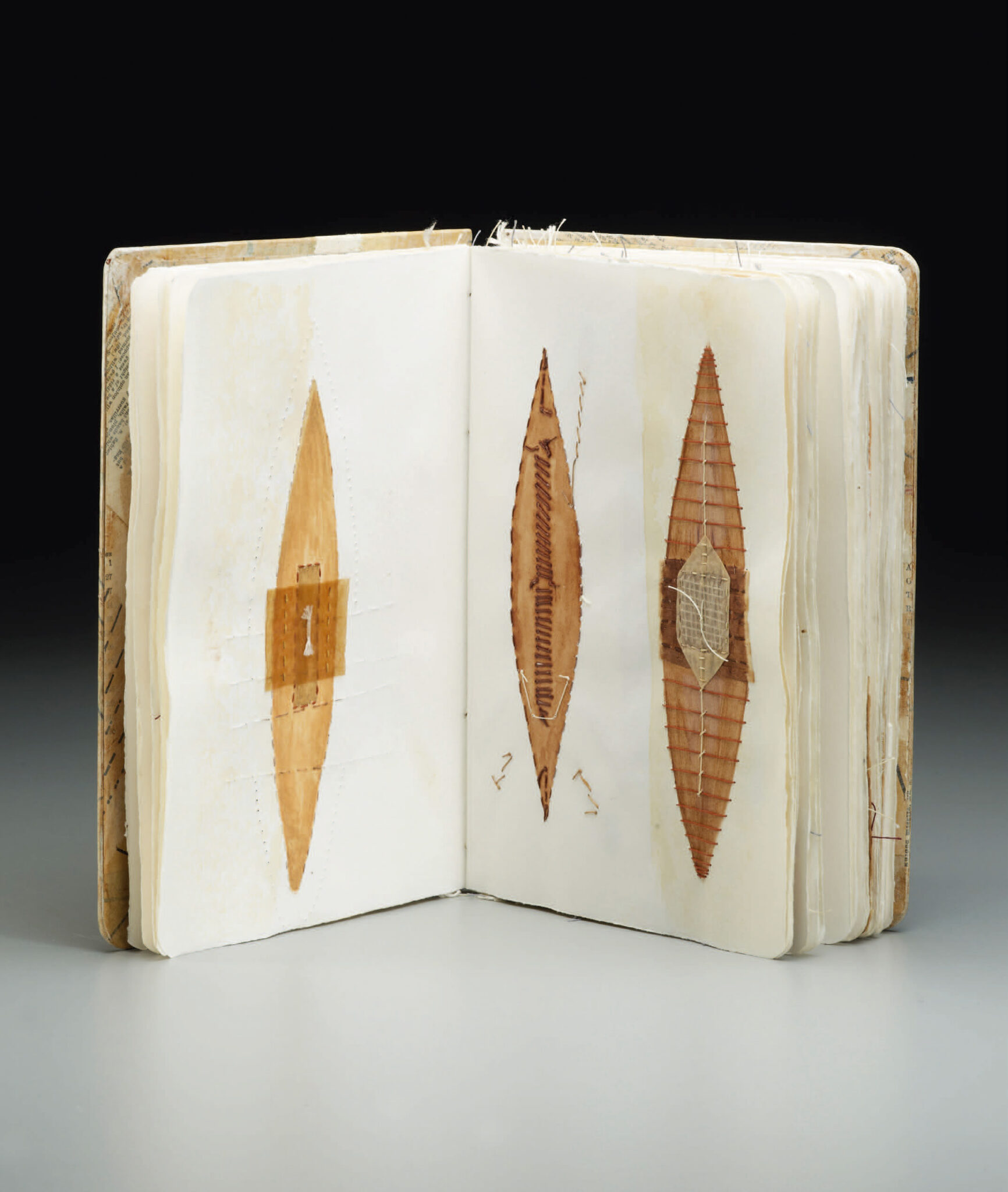
I use visual journals to filter my life. While in graduate school in New Bedford, Massachusetts, I became fascinated by quirky staircases and doorways and often sketched them in my journal. To me they are metaphors: ascent and descent, twists and turns, pauses on landings, doors opening or closing.
Growing up in rural New Hampshire in a wonderful old farmhouse shaped me as an artist. The brilliant fall foliage and garden flowers infused my early work with a vivid palette, and my architectural textiles expressed my love of color and texture. Collectors often tell me my textiles bring energy into their homes, affirming my belief in the positive ripple of creativity.
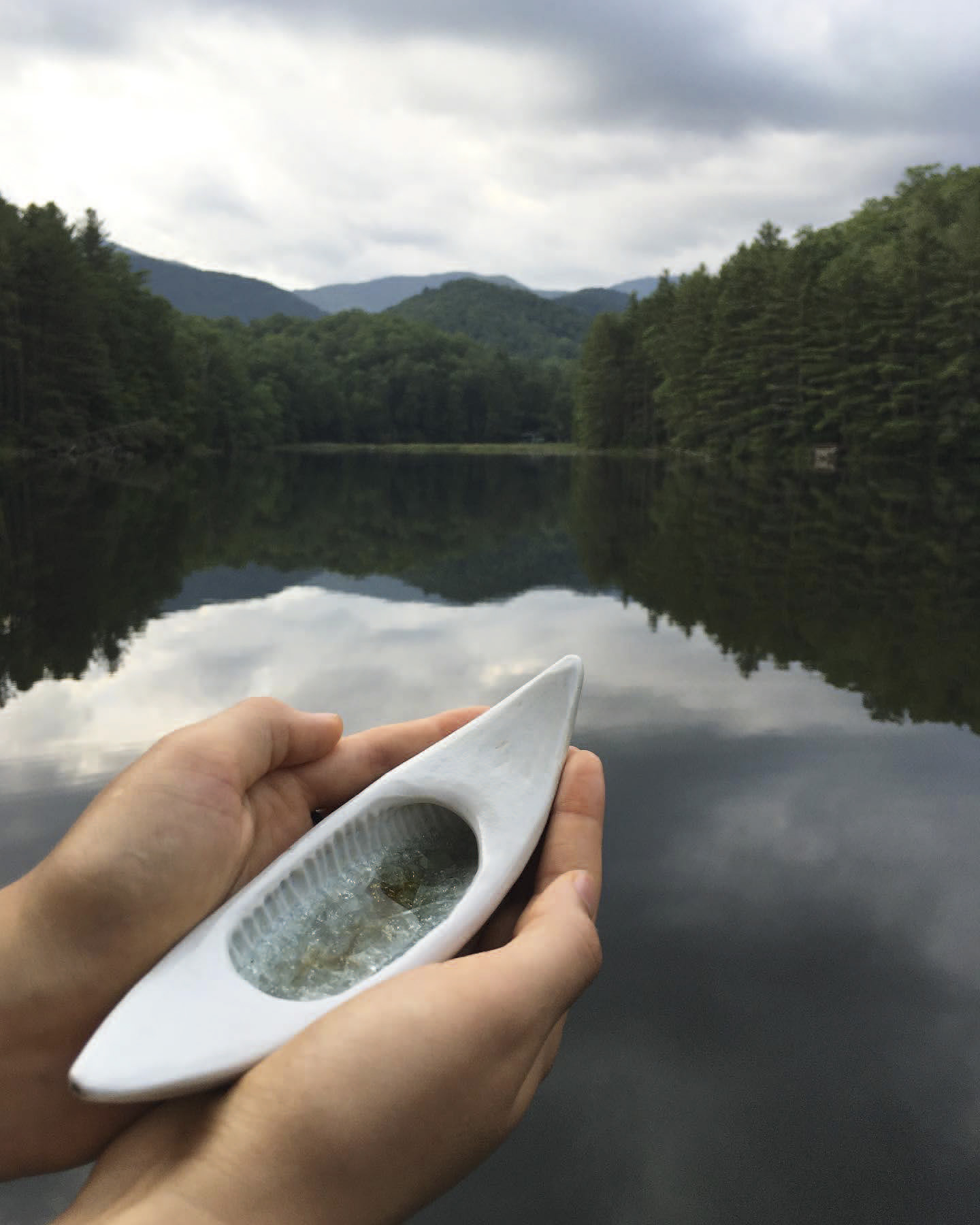
Heather Hietala. Meditation Vessel, 2018. Salt-fired porcelain, recycled glass. 2 X 8 X 2 inches. Photo: Steve Mann.
Those early years were about looking outward for inspiration while listening inwardly for artistic guidance. I trusted my impulses, even through failures and detours.
Eventually, my staircases led me to the water’s edge-in Japan along a canal, and then in Paris along the Seine, where I boarded a boat. On water, the pull of gravity lessens. Being on a boat reconnected me to experiences in canoes and sailboats in childhood and in kayaks as an adult. That sense of weightlessness shifted my art. Boats began appearing in my journals. At the same time, several significant people in my life passed away. My art transitioned from staircases to vessels. The palette also quieted, but the metaphor of journey remained constant.
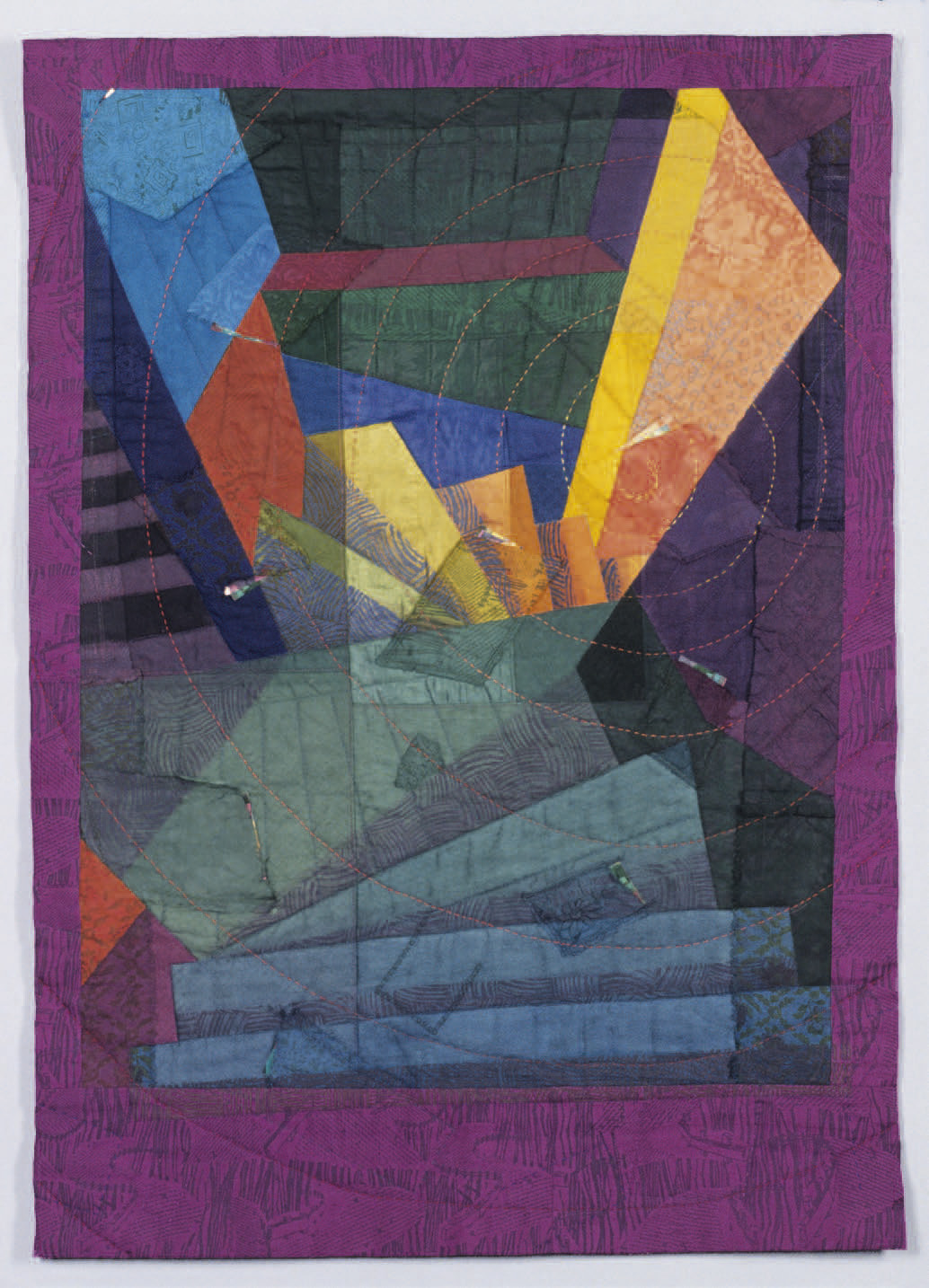
Heather Hietala. Park, 1995. Cotton, linen, silk, antique lace, photographs. 40 X 29 inches. Photo: Tim Barnwell. Opposite: artist’s journal.
Words became essential to me after the fire. I began inscribing phrases and stories into porcelain, then stoneware, where they would undergo transformation by intense heat and survive. In clay, I can write words that endure, unlike the letters and journals consumed in the house fire-an act that continues to be profoundly healing.
I also imprint clay slabs with textile textures, piecing them together like fabric, mending cracks with steel sutures. Rather than hiding flaws, I celebrate them. These visible mends echo the way aging marks our bodies-wrinkles of laughter, scars of grief, the beauty of a well-lived life.
Heather Hietala. Flow (detail), 2024. Wood-fired stoneware, underglaze, recycled glass. 45 X 55 X 2 inches. Photo: Steve Mann.
Traditional wood firing has deepened my understanding of unpredictability. I take part in a communal wood firing three times a year as part of a group of six ceramicists. It’s a collaborative process, with crews working in shifts of three to four hours. Each crew develops its own rhythm and approach to stoking the fire, subtly altering the movement of flame and heat through the kiln. Everything from the weather conditions to the species and terroir of the wood being burned to how the kiln is stacked can affect temperature, airflow, and outcome.
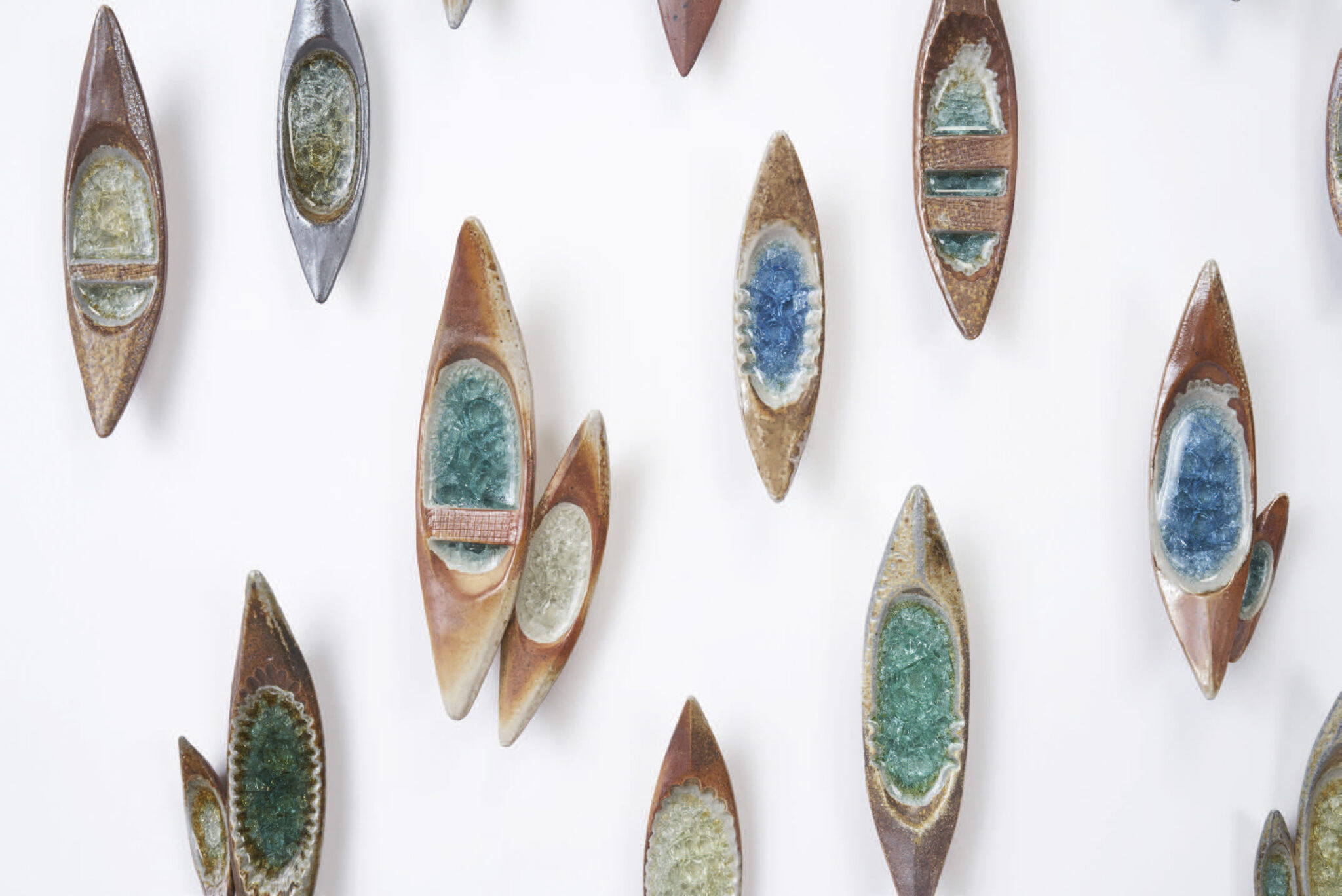
Heather Hietala. Flow (detail), 2024. Wood-fired stoneware, underglaze, recycled glass. 45 X 55 X 2 inches. Photo: Steve Mann.
As the wood burns, ash, volatile minerals, and gases circulate through the kiln, interacting with each piece in a unique way. Ash settles and melts onto the pots, creating subtle variations in color and surface. Once the desired temperature is reached, we heavily stoke the firebox and close the kiln, depriving the fire of oxygen. This creates a reduction atmosphere, forcing the remaining fire to pull oxygen from the clay and glazes. The result is a range of rich, earthy colors and surface effects that are often dramatic and impossible to predict with precision. Unloading the kiln feels like reuniting with old friends who have returned changed from a great adventure.
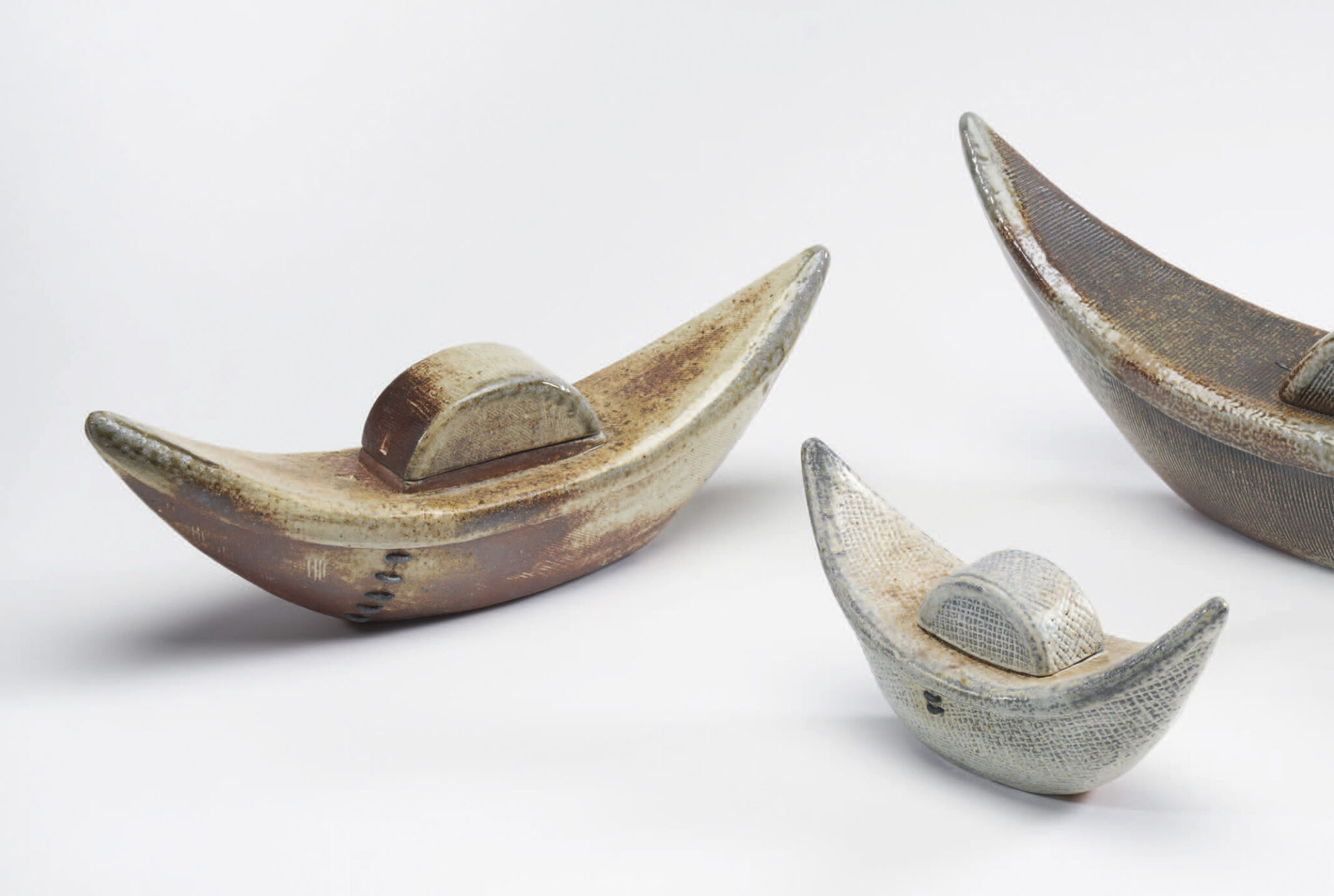
Heather Hietala. Funerary Urns, 2024. Wood-fired stoneware, steel, underglaze. 12½ to 20 inches long. Photo: Steve Mann.
When my father developed Alzheimer’s, I searched for a way to capture his spirit-the essence still visible in his eyes even when he couldn’t recognize me. I began breaking glass and placing the shards in vessels, which then melted during the wood firing to form luminous pools. The transformed glass-shattered, re-formed, full of light-was like a person’s gaze.
One summer evening at dusk, a chimney swift ran into a telephone line and fell stunned onto the road in front of my house. I held it for hours as it recovered, finally wrapping it in a towel for the night, to be released in the morning. It inspired a series of “meditation vessels,” small handheld forms shaped by cupping my palms. These vessels, each with melted glass inside, catch light and evoke spirit. Born in atmospheric wood fires, they are intimate, comforting, and each unique. I have sent many to friends who were grieving. During Covid, I explored mounting versions of these vessels on walls, reflecting themes of togetherness and separation. Flow is the first in this series.
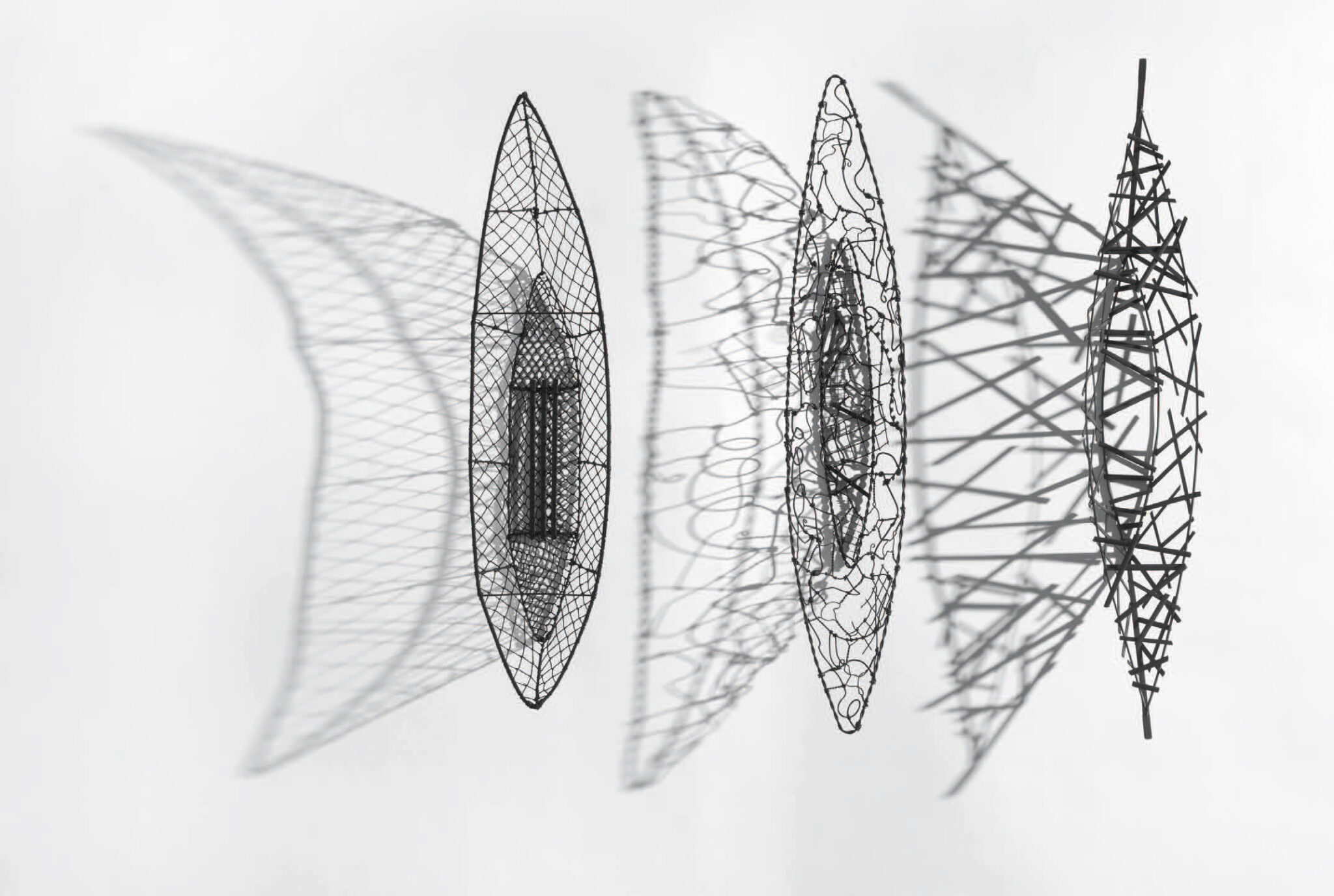
Heather Hietala. The Space Between, 2025. Bamboo, wood, steel, plastic netting, paint. 26½ X 50 X 5 inches. Photo: Steve Mann.
When my mother was dying, I stayed in New Hampshire to care for her. She was an anchor for me, and being present for her final season was one of the most profound experiences of my life. To steady myself, I worked slowly on small projects-gluing bits of bamboo, sometimes just one or two a day. This simple, repetitive act offered me a brief, positive charge of creativity, keeping me connected to my reservoir. The resulting skeletal vessels, part of my series The Space Between, explore the shadows they cast-shadows that extend beyond the vessel yet remain intangible. The shadows can touch us, but we cannot touch them.
If the colorful textiles of my earlier years reflected the spring and summer of my life, and now, in my sixties, my wood-fired ceramics carry the autumnal tones of middle age, the skeletal vessels hint at the quiet palette of winter to come.
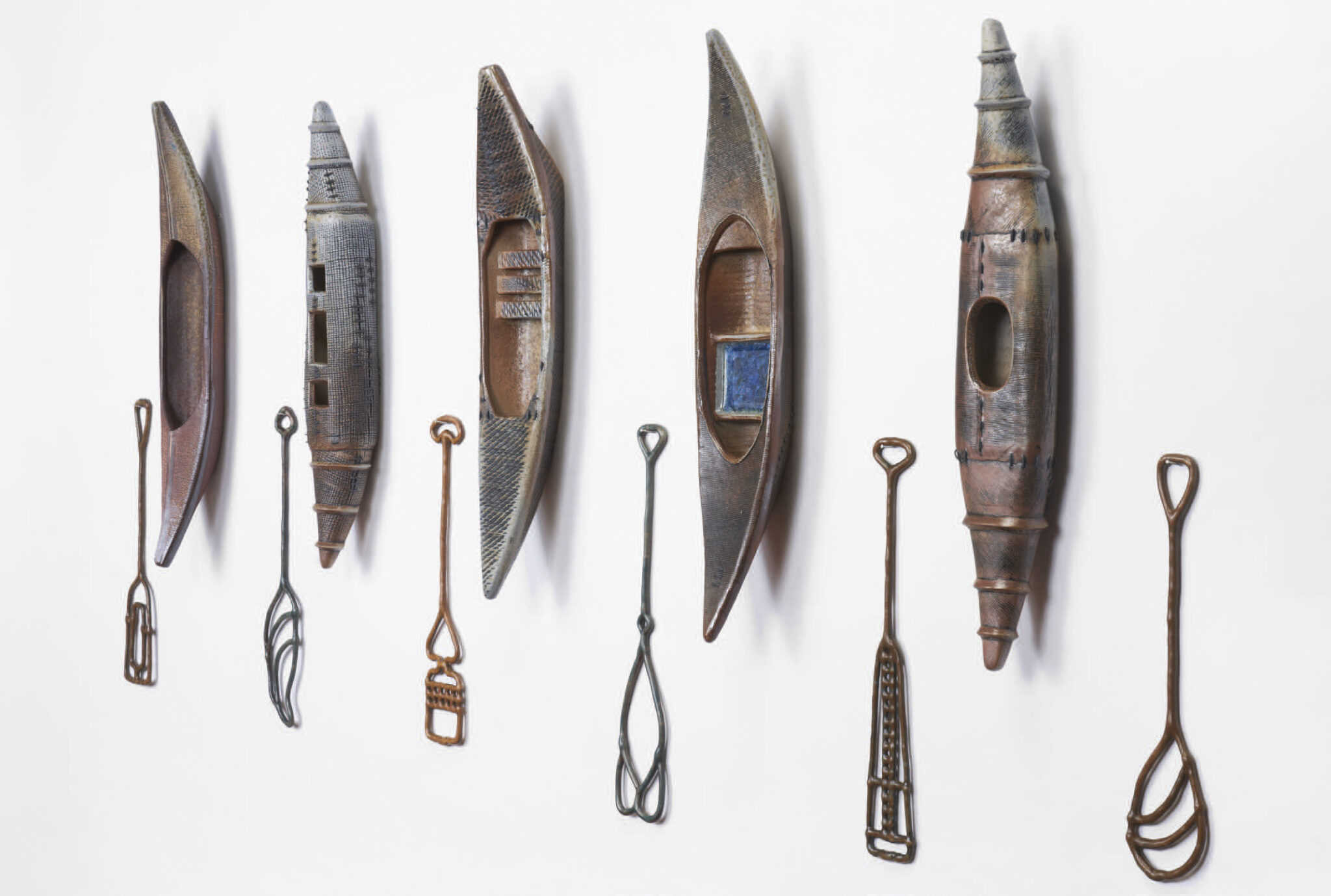
Heather Hietala. Seeking, 2024. Wood-fired stoneware, steel, recycled glass, paperclay underglaze, encaustic. 34 X 71 X 3 inches. Photo: Steve Mann.
Across cultures, vessels have long been tied to funerary rituals, representing the journey beyond. In recent years, searching for forms that express both release and grounding, I have begun exploring urns. The shape I’ve developed sweeps upward, like arms raised toward the spirit world, with lids that curve downward to anchor those left behind. Subjected to fire, they undergo their own transformation, emerging to hold and comfort.
Groupings of vessels on a wall, as in Seeking, suggest choice and possibility: The boat you select, the paddle you take, determine your path. The materials I use-clay, glass, wire, bamboo-are familiar and grounding, but in their transformation, they point to something beyond the ordinary.
Heather Hietala exhibits and teaches internationally, and her work is held in the collections of the Asheville Art Museum, Racine Art Museum, North Carolina Arts Commission, and Gregg Museum of Art & Design. She is the author of Weaving Contemporary Rag Rugs (Lark), and her work is represented by Momentum Gallery, Asheville, and Oeno Gallery, Ontario. www.heatherhietala.com