


TWO YEARS AFTER I received a monstrous beating, I became interested in pietàs. What happened, according to the police report filed in Morris Park, was this: The G train approached the Flushing Avenue stop at nine on a Tuesday evening. The car was half full. I was journaling and reading Flaubert. A man in matching red sweatpants and tank top sat next to me. We rode in silence. I did not notice his forearms or the prominent veins pulsing into large hands. I did not think he would punch me six times beneath my eye. The back of my head smacked the window. He called me “a bad actor.” This was not my first concussion; I was already down three to five, the results of elbows-to-temples in basketball, pickup football, and one big old hoss motoring up the first base line with me as a temporary roadblock. I remember joking with the PA at urgent care about the swelling, but not much about the ER visit that followed.
Concussions are strange, even when the symptoms are expected. Knowing you will be moody and irritable does not prepare you for the feeling itself. I was suddenly enraged by my upstairs neighbors’ children, who had committed the atrocity of walking too loudly. It was not anger so much as an estrangement from myself, as if the emotion were happening one step away from where it should have been. I put on my favorite music—usually Coltrane or Merle Haggard—and found I could no longer follow the lines, could not stay with a melody long enough for it to become a phrase.
What passed for my collegiate fighting days did not prepare me. Nothing could. Not drunkenly strapping on boxing gloves and throwing increasingly winded jabs in a Boone, North Carolina, backyard. In between rounds, I’d shotgun Rolling Rock opposite my opponents, my friends—future accountants, small-business owners, gym teachers who’d later argue over mortgages and 401(k)s. Lacking headgear and fearing litigation (many of their parents were lawyers), we created a strict set of rules. No head punches. The fight’s called if somebody throws up. Our Marquess of Queensberry, Graham, who promoted and officiated these bouts, later told me he was terrified for me each time I entered that lawn knotted with half-cut stumps. After I left the hospital, he apologized for ever letting me tape my hands.
Backyard fighting has the same relation to sucker punches that reading Greek surgical manuscripts has to working in an operating theater. Hippocrates’s treatise On the Wounds of the Head first identified head trauma and pathways to treatment. The text obsesses over the effects of skull size on bandages, the prohibition of wine as debrider, bone thinness and the dangers of depressions, and (of particular note) trepanning. Moderation is urged. After initially sawing through denuded bone, when the brain is exposed, the surgeon must “desist…and leave the bone to fall out of itself.” Strikingly, the word brain does not appear in any trepanning instructions. In the entire treatise, Hippocrates uses it only six times. Beyond a brief, almost-accidental observation that “convulsions seize on a person” on the opposite side of the body from a brain incision, there is almost no concern for the function or health of the organ. Of less interest still—barely imaginable—is the mind, consciousness, or the self.
“Bad actor.” My attacker accused me of something spiritual and epistemological. I doubt it was Madame Bovary, my long camel peacoat, or any other cultural signifier of the overly educated and gently declining. The man did not seem to have an ideological bent—no manifesto or sloganeering. Nor did he indicate any mental distress. While I read, he was calm. He watched me for a few stops and focused on the one thing that would unsettle anybody: that I, apparently, was mediating my existence, that there was a subjugation of raw bodily experience by interior discourse. That I was living one step removed from myself. It is easy to ignore. But then I’ll be on a 5 uptown train, and some middle-aged lady’s phone will ring, and it will irritate me since mine is always on silent. Yet that Samsung’s odd cadence fascinates, and my index finger rises with the first synthetic phrase. I’ll anticipate the next loop, never quite able to keep time, as if the world arrived a half-second late, my consciousness ahead of sensation. I imagine he saw me as I sometimes see myself: an isolated mind rationalizing distance and time. Or rather, how some people close to me have seen me: As someone always watching, looking for something, perhaps even without noticing I’m doing it. And that once I notice, I follow the old maxim that a writer will always sell someone out.
Two years later, around the time I visited the Santa Cruz Monastery in Coimbra, Portugal, I learned the Greek word for actor, hypokrites—the etymological root of hypocrite. After Dom Afonso I consolidated power to become Portugal’s first king, Santa Cruz was the center of the monarchic-church complex. Outside of the azulejo tilework, the monastery’s stunning design is often derivative: Much of its interior isn’t ethnically or aesthetically Portuguese. Originally Romanesque, it was completely rebuilt under Manuel I, drawing heavily from Italian, Spanish, and Flemish vernaculars. From woodwork to statuary to paintings, Santa Cruz was furnished by foreign craftsmen who subjugated local taste to dominant Renaissance styles. Even to the modern viewer, who might encounter its contents as museum artifacts stripped of temporality and sincere religious belief, there is heavy irony. Santa Cruz, the projection of burgeoning unified colonial power, is a bad actor—imported style reciting devotion in a counterfeit Portuguese accent.
The wooden pietà at Santa Cruz is Flemish, sculpted by an unknown artist. Here the mind insists on a birth story; I shall submit. When this sculptor set out to carve this masterpiece, he prayed and thought about the stab victims whose stolen corpses he sketched under a weak candle and full moonlight. (I am not inventing this ex nihilo. Vasari writes that his Florentine predecessor Antonio Pollaiuolo “understood the nude [in a] more modern way than any of the masters before him and moved the skin of many corpses to see the anatomy underneath.” In Pollaiuolo’s engraving The Battle of the Nude Men, skin is transparent like the skin of baby skates—the dead or dying man in the bottom right corner pulses with the potential for violent electrical movement.) To understand anatomy, this pietà claims, is to understand the mind.
How heavy the body. Jesus is emaciated and dehydrated. He must weigh over two hundred pounds. His muscles do not bulge or twist. His skin is a lacerated coffee sack—the wound flaps. Mary struggles to hold him up. There is no divinity, only weight.
Too often religious art, and in particular pietàs, suffer from bad acting. Mary is too serene in her grief, her blue robes too ornate or baroque in their flow. The artist is clearly asserting secular dominance, saying, “Look, I am a master.” El Greco’s pietà contains none of that pretense. Jesus’s skin is alien, gray, the kind that comes after the slackening that follows rigor mortis. Can a body be too dead? El Greco asks. Rarely does Jesus look so predisposed to the natural forces of decay. Usually, a pietà confronts us with the shock of the very recently dead. This is a theological quandary. The Catholic Church has no problem with death—any reliquary will have skulls, finger fragments, and saints’ teeth in plain view. But these are regular deaths, and even the skulls rest inside statues that show the saints as if they were alive—holy, young (and, if women, virginal). Here lies the double bind. Jesus has to be fully dead, because there has to be a division between the temporary body and the eternal Son of God. But if Jesus is fully dead, then there is no access to his divinity, and what is left is the pure horror of the body. El Greco’s last question: Is faith enough to subsume fear?
Three centuries later, El Greco’s interrogation finds its echo in Alexander Gardner’s photographs. Like a necrophage, Gardner followed the Armies of the Potomac and Northern Virginia to pose dead Yankees and Confederates. Morbidly, in Home of a Rebel Sharpshooter, Gettysburg, Gardner and his assistant, Timothy O’Sullivan, construct a still life in its most literal sense—in Italian it is natura morta, dead nature. A still life serves two purposes. It demonstrates mastery over composition, light, and form. Second, it documents the material possessions of the artist or commissioning patron. The sharpshooter is not the camera’s main object. Gardner focuses on the rifle and the sniper den’s rough geometric patterns. The sharpshooter is subordinate to the composition. His hand curls over his chest, face barely in focus. The limpness of his body and the softness of his collapse say it was an easy death.
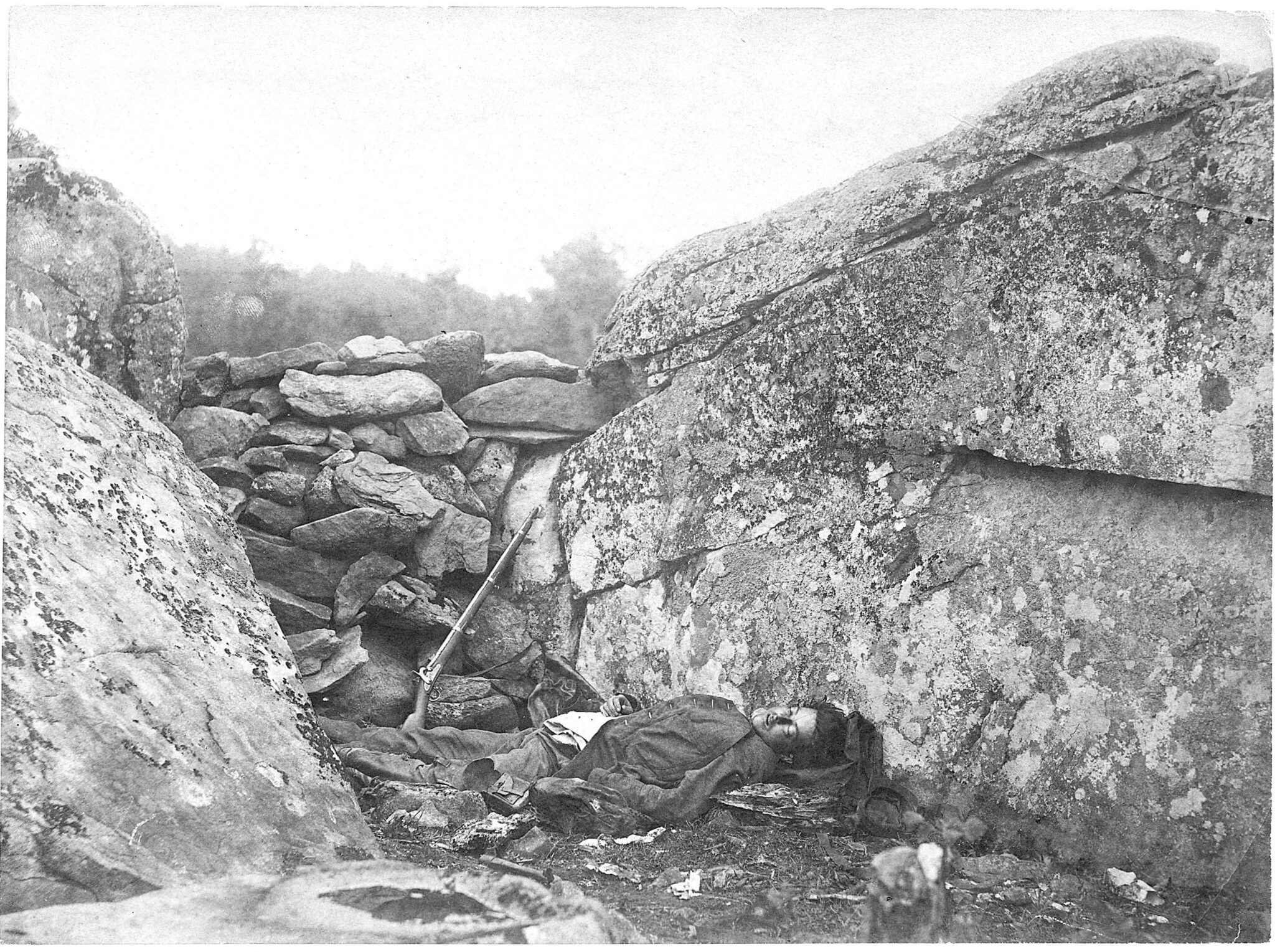
Timothy O’Sullivan and Alexander Gardner. Home of a Rebel Sharpshooter, 1863. Staged wet-plate photograph. Gettysburg, Pennsylvania.
But Gardner’s acting betrays itself. The more he attempts to impose order on his subjects, the more apparent is death’s limitlessness. This negotiation is enacted with the folding of the uniform, the moving of heads. Artistic control is inseparable from commercial ambitions. Gardner was not a sober documentarian. His income was dependent on the widespread circulation of photographs, and his authority derived from turning unordered death into aesthetic form. His Civil War work constantly negotiates between compositional mastery and the object’s loss. The sniper is acted, owned, framed, shot—yet still inscrutable.
If the battlefield required improvisation, the Lincoln assassination conspirators allowed Gardner the rarest of opportunities—the forced collaboration of doomed men. The youngest, twenty-one-year-old Lewis Powell, seems granted a degree of autonomy, though constrained by handcuffs and Gardner’s framing. Powell looks frighteningly modern, with a full head of pomaded hair and straight-razored part. Defiant eyes and a performative blank mouth. The frame does not reach his chained wrists. With shoulders slightly slouched, Powell carries the aura of a soon-to-be hanged man. And then the execution. Gardner sets up his camera from afar. At each stage they are photographed. First near the gallows, then with the hoods, then standing on the trapdoor. Finally, dangled bodies with snapped necks. Gardner’s framing cannot animate them. There is no acting.
Our desire to aestheticize and control the dead is not new. In the earliest iterations of the Gospel of Mark, Mary, Mary Magdalene, and Salome gather spices to anoint the body but find the cave empty. “Trembling and bewildered, the women went out and fled from the tomb. They said nothing to anyone, because they were afraid.” No faith, just the vacancy of a body and the failure of language. It is precisely against this openness that later editors recoiled, adding a coda in which Jesus rationalizes, rebukes, commands, and interprets himself. Terror and awe, the most human and religiously pure reaction, becomes flattened, acted, and mediated by narrative. Jesus resumes his place at the right hand of God and “then the disciples went out and preached everywhere, and the Lord worked with them and confirmed his word by the signs that accompanied it.”
I like the original version because of its refusal of consolation, its desire for the sublime. The interval between event and explanation is interpretation. The synoptic editors needed coherent structure: Aristotelian, causal and effectual. They needed proof, testimony, teleology. Maybe I am wrong about what the man on the train accused me of. Maybe a “bad actor” is the opposite of what I thought he meant. Maybe bad actors do not over-mediate existence but live too long in overwhelming sensation. Their performances feel false because they resist the world’s demand for distance. Perhaps the man was unnerved that I sat there next to him fully engaged in my own world, never acknowledging his own threat, which would have made his encounter into something legible.
Similarly, the modernist French filmmaker Robert Bresson detested theater acting, calling it a “bastard art” compared to cinema’s purity. This is not a critique in favor of subtle facial expressions. Bresson rejects acting as form. Why simulate grief, he argues, when the camera can witness and transcribe the body and its damage? French New Wave and New Hollywood’s rhythms drew attention to film as a constructed art form via the destruction of continuity and reflexive shots—think jump cuts, reading of texts, insertion of pop art, nonlinear narrative. Bresson insists on an opposite discipline: the clarity of an unadorned image, as flat as an icon or medieval painting.
His films, especially Au Hasard Balthazar, are brutally linear. Balthazar the donkey becomes victim to his own passion play. First owned by Marie (Bresson is not the most subtle director), he changes masters seven times, suffering in stages that mirror the Stations of the Cross. There are many ontologically pure images of Balthazar-as-Christ. Balthazar the suffering servant who makes no noise as he is beaten by Gerard; Balthazar with a crown of flowers; Balthazar with his side pierced by a bullet; Balthazar dying among a flock of sheep. Yet no sooner does Bresson craft soteriologically than he snatches it back, insisting on Balthazar’s own natural, irreducible animality. As part of a circus act, he confronts other caged beasts and does arithmetic on stage. When Balthazar’s tail is lit on fire, he screams in anguish, running scared. The sheep among which he dies are shown to be a passing herd. Redemption is unattainable for us—the viewer cannot be saved through a brute, un-theological being. Why do we attach ourselves to thin narratives of salvation? All that’s left is inscrutable, random, linear, natural suffering.
Redemption escapes us. I encountered a parallel, Eva Baltasar’s novella Mammoth, in a Lisbon English-language bookshop, surrounded by overpriced lattes and yappers on laptops. Baltasar’s unnamed narrator is young and alienated from the material world. Despite being a political lesbian, she sleeps with men, but only out of a deep desire to gestate. The word gestate serves as the novella’s fugue. She is obsessed with the overwhelming fecundity of the world and her own body. Beauty, love, the connection between mother and daughter—all are absent. On the surface, so is religion—this is a solidly rational and atheistic context. However, after unsuccessfully trying to conceive and becoming immediately aware of the failure, her “whole body reeked of warm algae, of sweat and pond scum, of stagnant water in which tiny militias of egg were seething.” The membrane between woman and world bursts. She imagines herself “as a rodent dwelling on the forest floor, a tireless mammal designed to feed larger animals of all species.” Here, as for Balthazar the donkey, the act of witnessing is connected to a wider, indifferent proliferation of life.
Mammoth constructs a post-faith faith, or perhaps an unwitting pantheism. The narrator abandons her sociology studies and retreats to a small village in the Pyrenees, where she tends to sheep, encounters lonely shepherds, and lives roughly in a simple cottage in a town blighted by tourism. Here the urge to be reminded of Walden must be resisted. Unlike Thoreau, she finds no transcendence in nature or any consolation from the divine. No knowledge is transferred while shearing or lighting a wood stove. Desire and reproduction exist only as material, instinctual drives. When she sleeps with the shepherd who befriends her, she gains no pleasure and is repulsed by his body. Baltasar suggests we can only acknowledge and, at best, witness the grotesque fecundity of the world. There is no dialectical confrontation. This impenetrability, this refusal of narrative closure, makes the novel crackle.
What is the exact moment of time’s analgesic? How many years must pass before the subject’s suffering softens, recedes, in the viewer’s eye? Did somebody think to themselves, as my head slammed against metal, that my movement looked beautiful? Dispassion, like tree sap, hardens slowly, sealing memory into a brittle glaze. I am sure that for the strange woman a few seats down, who looked at me with pity and then looked away, the violence has already begun to crystallize, to be transformed into something distant, almost abstract. I don’t blame her—I wouldn’t have intervened. Sometimes my head hurts. Time offers no absolution, only a peculiar flattening: near and remote. A tension in which recognition flickers and fades, unclaimed and unshareable.
Eric Janken received his MFA from Hunter College. His work has appeared in Prism International, Metropolitan Review, Birmingham Poetry Review, Shenandoah, and elsewhere.
Related Culture



After Disenchantment: C.S. Lewis, Sally Rooney, and the Perennial Hunger
ByCornelia Powers