


Posts by Staff
The Eighth Day: Reclaiming a Neglected Novel
July 17, 2015
It must be a common occurrence—having certain inanimate things make periodic appearances throughout a life, much like acquaintances who keep popping up in odd places—on the bus, in a crowd, across a room. They’re noticed, but barely so; the conscious mind remarks upon them—“There’s that thing again”—then moves on until they reappear, stepping out from the flood of experience with a gentle tug at the sleeve.
When I was a boy, a paperback copy of Thornton Wilder’s The Eighth Day would appear like this. I remember it on a table; I remember it in a box; the last time I recall seeing it, the book lay on the floor of a garage closet. It was a thick little text, with a cover that bore a sunrise in a yellowish cast and a title in Ten Commandment-size font. Still, I don’t remember ever thumbing through it. At some point, it must have been thrown away; it disappeared and has never resurfaced.
Read MoreA Conversation with Artist Natalie Settles, Part 2
July 16, 2015
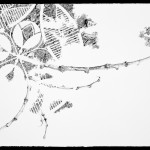
Image: Natalie, a lot of your recent artwork is temporary—that is, it’s drawn directly onto gallery walls and when the show is over, only photos are left. Can you speak to this?
Natalie Settles: Yes, these are works with lifespans. In fact, the installations are typically up for the same amount of time over which the lifecycle of a small annual plant would play out.
A Conversation with Artist Natalie Settles, Part 1
July 15, 2015
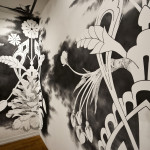
I’d noticed a lab whose work seemed to be driven by some of the broader questions that motivated my own studio practice—life in the margins, forms shaped by place, the ideal and the compromised, things that are compelling and powerful and also fleeting. This was Steve’s lab.
One evening while we were walking the hilly streets of Pittsburgh, a friend urged me to get in touch with Steve to see what would happen. The next day I emailed him and told him I was an artist and was interested in his work. A couple days later, we met for a two-hour chat over coffee; now, four years later, the rest is history.
Read MoreBeauty, Christian Love, and Gay Marriage
July 14, 2015
Justice Anthony Kennedy, in the recent Supreme Court ruling legalizing same-sex marriage, wrote the following concluding paragraph:
No union is more profound than marriage, for it embodies the highest ideals of love, fidelity, devotion, sacrifice, and family. In forming a marital union, two people become something greater than once they were. As some of the petitioners in these cases demonstrate, marriage embodies a love that may endure even past death. It would misunderstand these men and women to say they disrespect the idea of marriage. Their plea is that they do respect it, respect it so deeply that they seek to find its fulfillment for themselves. Their hope is not to be condemned to live in loneliness, excluded from one of civilization’s oldest institutions. They ask for equal dignity in the eyes of the law. The Constitution grants them that right.
Quite a few commentators have noted the beauty and elegance of this statement’s prose (not a given for Justice Kennedy, who’s been known to drift toward the purple with his pen). Jordan Weissmann, for instance, titled a post for Slate “The Beautiful Closing Paragraph of Justice Kennedy’s Gay Marriage Ruling.”
Read MoreAirbnb and the Art of Hospitality
July 13, 2015
Though Airbnb is born of modern times and technology, it almost seems a throwback to the art of innkeeping in much earlier eras when for a reasonable fee people opened up extra space in their homes, however humble, to strangers. And to me it’s somewhat remarkable in our suspicious age that people would do this. Hosts are making themselves and their things vulnerable by leaving their homes and appliances and personal belongings in the hands of unsupervised strangers. Guests are trusting that the space will be as advertised, and relying on the hosts for good information and functional plumbing.
Read MoreMy Evolving Identity
July 10, 2015
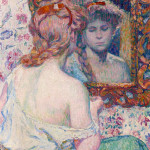
I’ve just read a thirty-page article called “Whitman Music: The Problem of Adaptation.” A critical analysis of musical settings of Whitman’s poetry, the article was published in the 1965 issue of Books at Brown, a journal devoted to materials in the Special Collections of Brown University’s library. The author is Peggy Z. Rosenthal.
Read MoreArt on Fire: The Life and Work of Melissa Weinman, Part 2
July 9, 2015
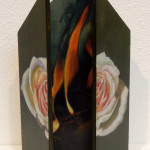
When Weinman completed her fellowship in Europe, she came back to the U.S., where she began a new life that included marriage, the birth of two daughters, and a new chapter in her pilgrim faith.
“I think I’m a Christian, but I don’t know how to do it.” This was how she approached an Episcopal priest in her neighborhood, looking for spiritual direction. Although he was on the point of retirement, he agreed to meet with her once a week, and for the next year, they discussed Christian teachings and the Bible.
Read MoreArt on Fire: The Life and Work of Melissa Weinman, Part 1
July 8, 2015
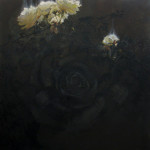
In a recent painting by Melissa Weinman, a small, white rose floats over darkness. The rose is in full blossom, almost blown, and crowned by a pale fire rising from its petals like mist.
Read MoreMorning Prayer and The New York Times
July 7, 2015
Summer morning routine: a cup of Awake tea, the Opinion page of The New York Times.
What am I looking for to get my day going? Information to spark the brain? A needle to inject righteous indignation into my sleepy heart?
The flag is coming down. You know which one.
Read MoreThe Bearable Weightiness of Being
July 6, 2015
I was restless this spring, edging manic. I think my kids noticed. One Thursday I checked them out of school for an impromptu road trip.
“Isn’t this fun?” I asked. If this were a novel I’d say my eyes were glittering, but this is not fiction: I have no idea how wild-eyed I was.
Read More